Chapter 12
Build a Community That Can Follow Through
At a Glance
The central idea: A community resource becomes care only when someone can actually receive it.
What you’ll explore: How hospitals, clinical practices, social workers, Day Centers, transportation services, and other partners turn separate capabilities into dependable support. Follow Pat and Ellen when a confirmed ride does not arrive. Learn to distinguish responding to today’s problem from changing the arrangements that allowed it to happen.
Design and AI: Give partners shared meanings, clear responsibilities, and usable response routes without requiring them to become one organization or use one system. Explore how an approved AI assistant could prepare handoffs, identify missing confirmations, retrieve relevant options, and help people learn from an interrupted service.
Put it to work: Create a Partner Handoff Agreement that identifies who acts, what information may travel, how acceptance and delivery are confirmed, and what happens when the usual arrangement fails.
Evidence and evaluation: Examine referral guidance, navigation research, transportation evidence, and social-learning models. Measure received services, unresolved needs, family effort, access, and partner workload—not referral volume alone.
“By a system I mean that the diverse people actually work together to direct their specialized capabilities toward common goals for patients.”
— Atul Gawande, MD, surgeon and writer, Harvard Medical School commencement address, May 26, 2011.87
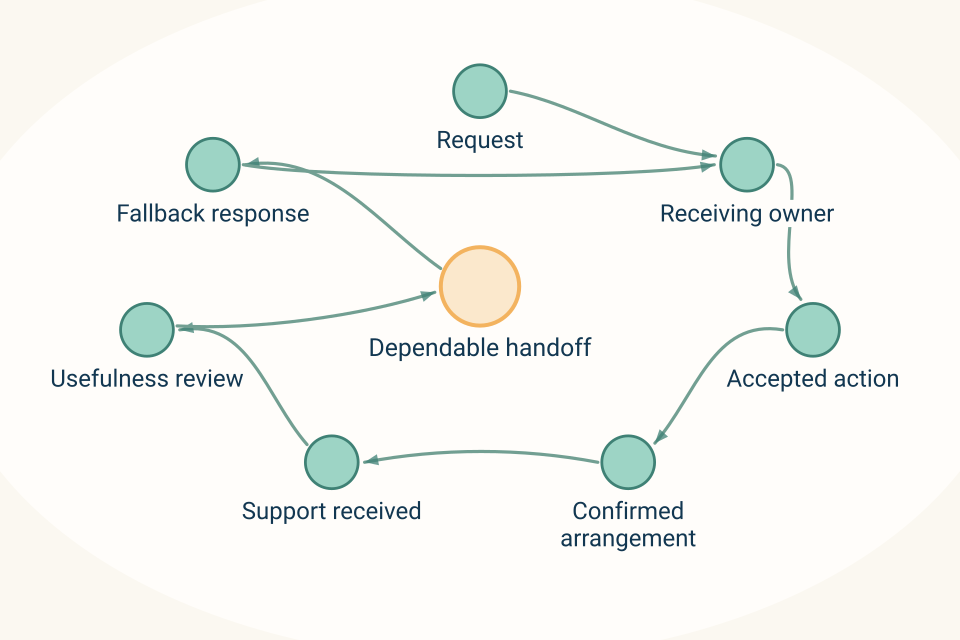
A request must reach an identifiable receiving owner. The receiving owner accepts a defined action; receipt alone is not acceptance. The accepted action is arranged and confirmed. Check whether the confirmed arrangement actually delivered support. Review the usefulness of the support received. The review informs how to make the handoff more dependable. A dependable handoff includes a planned response when the usual route fails. The fallback routes the problem to a responsible person rather than leaving the family with another number. The arrows describe responsibilities to confirm, not automatic movement from referral to care received.
Stage | What must be confirmed |
Sent → received | The intended service received the request and relevant authorized information. |
Accepted → arranged | A named role accepts a defined action, with timing and an alternative when needed. |
Delivered → reviewed | Support actually occurred; the person can say whether it was useful. Keep unmet needs open. |
In context
In Context — The ride that did not come
The continuing family and partner scenes are fictional illustrations. They demonstrate proposed arrangements, not documented cases or claims about a particular transportation service.
It was one of Pat’s confirmed Thursday Day Center days. The transportation service had separately confirmed the trip.
The pickup window had passed.
Pat sat at the kitchen table with his coat over the chair. Ellen checked the information beside the telephone.
“Should I put this back on?” he asked.
“Not yet.”
“I may finish the book before we get there.”
Ellen called the Day Center.
Lena checked the attendance plan. Pat was expected. That told her nothing about where the vehicle was.
“Where are you both now?” she asked.
“At home.”
“Is there anything you need help with while we check?”
“We’re all right. We’re waiting.”
Lena confirmed the transport details Ellen had received.
“I’ll speak with the dispatcher. I’ll call you by ten, even if I don’t have a replacement arrangement.”
Ellen began looking for another number.
“You don’t need to call the other services while I check,” Lena added. “I’ll tell you what I find, and we can discuss what works for you and Pat.”
Pat looked toward the telephone.
“Tell them I was looking forward to the photographs.”
Ellen repeated his message.
The missed ride was not merely a transportation problem.
Pat was missing people and an activity he had chosen. Ellen’s time was becoming uncertain again. The Day Center had prepared for someone who could not reach it.
Several organizations were connected to the family.
At that moment, connection was not enough.
The space between organizations is part of care
In Chapter 5, we examined how community makes belonging and support possible. In Chapter 7, we connected encounters into a pathway. Chapter 11 asked whether the people carrying responsibilities had enough support themselves.
Now we examine what happens where those responsibilities meet.
The original CarePhysics Community principle includes family members, caregivers, and community partners working around the person. That collaboration becomes practical only when the organizations understand what they are agreeing to provide.
A community resource becomes care only when someone can actually receive it.
A hospital may recognize a need. A navigator may find an appropriate service. The service may accept a referral. Yet the person can still be left without help because an appointment, ride, document, payment arrangement, or response has not been secured.
This chapter is not about adding more organizations to a directory.
It is about helping the partners already involved make commitments they can understand, deliver, and repair.
Their shared purpose should be stated in terms the person would recognize. For Pat and Ellen, that includes a worthwhile day, appropriate support, and time Ellen can use without continuing to coordinate every detail.
The purpose belongs to them. The partners contribute different parts of making it possible.
Respond to the person before reviewing the process
When an arrangement fails, begin with the present situation.
Where is the person? What support are they relying on? Is there a concern requiring immediate professional attention? What has actually happened, and what remains unknown?
A missed community service should not be interpreted as a clinical emergency solely because a record is incomplete. Equally, a clinical concern should not wait in a routine referral queue. The responsible people must use the appropriate response route.
Then establish who will coordinate the immediate response and when the person will hear again.
In context
In Context — An answer, even when it is not the hoped-for answer
Lena called before ten.
“The assigned vehicle cannot make the trip. The transport service is checking alternatives, but they have not confirmed one that meets today’s arrangements.”
“So we should keep waiting?” Ellen asked.
“Only if you and Pat want us to continue checking. I cannot promise when a suitable ride would arrive.”
Pat wanted to know how much of the day remained.
They discussed it together. No suitable alternative could be confirmed in time for the visit to remain useful to them.
Ellen stayed home with Pat and changed her own plans.
Lena explained what she would do next. She would record that the service had not been received because the confirmed transportation failed. The center would review any related charge through its normal process and tell the family the result. With their permission, she would also involve Sam in the follow-up.
“This should not be recorded as though you decided not to come,” she said.
“I didn’t,” Pat replied. “I was dressed for it.”
The response had not restored the morning.
It had stopped asking the family to wait without an answer and made the failure something the organizations had to address.
That matters. Honest recovery does not always produce an immediate replacement. It should produce clarity, appropriate assistance, and responsibility for what remains unresolved.
A video, an encouraging message, or an optional activity at home cannot be reported as equivalent to the service that was lost.
A handoff includes responsibility—not only information
AHRQ’s TeamSTEPPS guidance describes a clinical handoff as transferring relevant information together with clearly understood responsibility and authority. It includes acknowledgment, questions, uncertainty, and contingency plans. Its clinical context should remain visible when adapting the idea to community services.88
A transport provider does not inherit clinical responsibility for Pat because it accepts a ride. A Day Center does not become responsible for every need at home because Pat attends.
The agreement concerns a defined part of the support.
What assistance has been accepted? Where does it begin and end? Who receives the person or information next? What must be confirmed before responsibility changes?
For a transport arrangement, “door-to-door” may still leave important questions unanswered. Does it include assistance from the agreed entrance? Who meets the person at the destination? What happens if that person is unavailable? How is the return journey handled?
Ask about the individual’s needs rather than inferring them from a diagnosis.
AHRQ’s referral guidance also recommends agreements between services, direct information exchange, and a process for confirming completion rather than relying on patients to carry information between professionals.89
The proposed CarePhysics application extends that discipline across the relevant community partners: an accepted responsibility should have a defined scope, a responder, and a way to establish what occurred.
Close the communication loop—and check the service
There are two different things to confirm.
First, did the receiving person understand and accept the message?
AHRQ’s closed-loop communication guidance describes an exchange in which the recipient provides feedback and the sender verifies understanding.37
Second, did the intended service happen?
A dispatcher can correctly understand a request and still be unable to provide the trip. A clinic can receive a referral while no appointment is available. A navigator can explain the next step while the underlying need remains unmet.
Keep the stages distinct:
Requested → received → accepted for a defined action → scheduled or confirmed → delivered → reviewed for usefulness.
A waitlist, a declined request, an inability to contact someone, and an unavailable service need their own descriptions. They are not interchangeable failures of participation.
“Completed” should identify what was completed.
The introduction may be complete while assessment remains pending. The assessment may be complete while the service remains unavailable. The administrative record may be closed while the person still needs help.
The communication approach used here puts the distinction plainly: need, role, permitted information, current stage, and ownership of the next action must remain visible.
For Pat’s missed morning, the trip had been confirmed but not delivered. Recording the cancellation did not resolve the lost Day Center time or Ellen’s interrupted plans.
Agree on the ordinary day and the difficult one
The Partner Handoff Agreement is this chapter’s practical output.
It is an operational planning aid, not a substitute for the partners’ contracts, clinical instructions, or appropriate legal and privacy review. Begin with one recurring handoff rather than attempting to settle every relationship in the community.
The agreement makes the following elements explicit: purpose, permission, minimum necessary information, fit, status language, responsible people, expected response, failed-handoff route, and closeout.
Agreement element | What the partners must establish |
|---|---|
Shared purpose and service scope | What the person wants to accomplish, what each partner provides, and what falls outside that service |
Fit and availability | Eligibility, assistance requirements, hours, capacity, costs, and what must be verified for this particular request |
Named responsibilities | A person responsible on each side, appropriate coverage, and a clear point at which the next responsibility is accepted |
Information and permission | What needs to travel, why, who may receive it, the approved route, and how errors or changes are corrected |
Confirmation | What counts as acceptance, booking, arrival, delivery, and completion; which facts require direct confirmation |
Response expectations | When an acknowledgment or decision is due and how the family will hear, using the route they chose |
Failure and urgent needs | What happens after silence, cancellation, staff absence, an unavailable service, or a safety concern; who investigates alternatives |
Return communication | How the person, relevant family members, and referring partner learn what happened without receiving unrelated private information |
Review and resources | Who examines recurring problems, funds and staffs the work, approves changes, and tests whether they helped |
Replace role labels with actual names and coverage arrangements in the working agreement. “The team” is not a sufficient answer when everyone could reasonably believe someone else is acting.
Do not transfer unlimited coordination to Sam. His role in bringing people together does not make him the transport dispatcher, clinical decision-maker, or owner of every unresolved task.
A dependable partnership distributes responsibility explicitly.
Learn why the failure happened
In context
In Context — The partners compare their accounts
At the agreed review, the transport coordinator explained what the provider’s record showed.
The trip had been accepted. When the assigned vehicle became unavailable, dispatch began searching for another. The change had not triggered a prompt call to the family or the Day Center.
The center’s attendance plan still showed that Pat was expected.
Sam asked the partners to separate the two problems.
“One was the unavailable vehicle. The other was the missing update. They may need different solutions.”
Ellen described what the delay had meant at home.
“I didn’t know whether to make another plan. I thought leaving the phone might make us miss the ride.”
Pat added his own request.
“Tell me when I can stop waiting. I can choose something else to do.”
The transport coordinator agreed that a service interruption should trigger a human update while the search for an alternative continued—not only after a replacement had been found.
Lena’s team would identify the person covering transport-related calls during arrival time. They would also agree how to check an expected arrival without assuming that every absence was caused by transport.
The partners would test the revised process before treating it as dependable.
Nobody had to decide that a driver or staff member did not care enough.
They needed to identify the missing action, give someone the authority and capacity to perform it, and check the result.
That approach does not remove accountability. It makes the responsibility specific enough to examine and change.
The transport example also shows why the goal of an improvement must be named. A replacement vehicle could restore the trip; an earlier update could reduce uncertain waiting even when no vehicle is available. Both matter. A constraint analysis should distinguish these purposes rather than dismiss communication because it cannot supply transport. See Chapter 7’s constraint-focused design example.
Match the support to the barrier
A better reminder would not have repaired this morning. Pat and Ellen were ready.
COM-B helps explain why the distinction matters. The barrier may concern understanding, ability, opportunity, motivation, or several things together. The research review informing this book warns against treating a service-access problem as a shortage of motivation.
Ask what needs to change before selecting the response.
If the person does not understand the referral, explain it.
If they are uncertain whether the service fits, offer a conversation or appropriate introduction.
If the route is unaffordable, inaccessible, or unavailable, investigate the resource problem.
If the person no longer wants the service, respect that decision while discussing any relevant alternatives.
AHRQ’s social-needs guidance recommends asking whether people want assistance, maintaining current community information, establishing referral agreements, and following up with the service provider. It also allows people to choose self-referral rather than a direct introduction.10
Support should be proportionate. Some people want to make their own arrangements. Others welcome help with one step or with the whole introduction.
The purpose is not to make navigation compulsory. It is to ensure that choosing assistance actually supplies assistance.
Design the handoff people will experience
A partner agreement is the working document behind the service. Families need a clear account of the part relevant to them.
For an agreed Day Center trip, an illustrative confirmation could use familiar headings:
Your Day Center visit and travel arrangements
What is confirmed Your service day and transport arrangement are listed separately, with the agreed date, pickup window, destination, assistance, and return plan.
Who can help The transport contact manages the trip. The Day Center contact manages your arrival and the day’s program. Their actual numbers and availability appear here.
If something changes The responsible service will contact you through the route you chose. You can also call the agreed first contact. The organizations will clarify who is following up rather than asking you to make every call.
What happens next The appropriate people confirm arrival and the return arrangements. Tell us if the plan no longer fits or if you need a different explanation or format.
This wording must be completed from verified local arrangements. Do not promise a response process that nobody has accepted.
The content around it can perform different jobs.
A tile can hold a short video, article, practical questions, and the contact information. A video can demonstrate an arrival handoff and one exception, such as the expected staff member being unavailable. An article can explain assistance, service limits, and costs in more detail. A telephone call or virtual meeting can address individual requirements. A brief feedback question can ask whether the arrangement worked and identify who will respond.
Keep the purpose, main idea, demonstration, chosen next step, question route, and follow-through recognizable across those formats. Urgent information comes first; nobody should have to watch an introduction before learning that a ride has been canceled.
The family’s contact route is a way to obtain help—not a requirement that they detect every service failure.
Share enough information—not the whole life
Different partners need different information.
A transport provider may need verified locations, relevant assistance requirements, contact arrangements, and who will meet the person. That does not automatically justify access to private family conversations or an entire clinical record.
The Day Center may need updated professional guidance relevant to its service. A volunteer helping with a welcome needs a role-appropriate briefing, not unrestricted account access.
Establish the information flow before adding more connections.
Explain the intended sharing, verify the relevant authorization, and use approved channels. Record which information has been confirmed and when. Give people a route to correct it.
A connected platform does not make every participating organization entitled to every field. A person’s permission for one introduction is not blanket permission for unrelated sharing, research, or training.
Nor is removing a name always enough to make a distinctive story safe to circulate.
For partnership improvement, use the minimum case information necessary for the review. Generic design exercises can use fictional examples without personal records at all.
The communication guide’s design rule is helpful here: make the experience understandable while keeping organizational roles, permissions, and handoffs explicit. Apparent simplicity should not hide responsibility.
Local differences belong in the agreement
Two communities can share a commitment to dependable support and require different arrangements.
One may have several transport providers. Another may have a limited service covering long distances. A program may offer interpretation directly or need to arrange it. A family may have a reliable internet connection, a basic telephone, or neither.
Ask about language, culture, beliefs, care needs, timing, and preferred involvement rather than assigning a communication style from demographic information.
A person may want a trusted community or faith organization involved. Another may prefer direct contact with the provider. Those preferences should shape the introduction without changing the facts or service limits.
Waymouth and colleagues’ qualitative research identifies interacting barriers to home- and community-based services, including infrastructure, awareness, cultural and language differences, and caregiver circumstances. It supports looking beyond a single explanation for non-use. It does not establish how common every barrier is in a particular community.42
The practical response may be a different contact method. It may also require money, staff, equipment, or a service that is not presently available.
Relationships help people discover what is missing. They cannot substitute for the missing resource.
Give AI a useful place between the partners
An approved assistant could help with the repeated work around a handoff: assembling permitted information, checking for missing fields, locating current guidance, drafting updates, and preparing questions for a review.
It could compare the records made available for a particular task:
Day Center record: Pat was expected. Transport record: The trip was confirmed, then disrupted. Family report: No vehicle arrived within the agreed window. Not established: A replacement journey was delivered.
That draft helps because it preserves the distinction between sources.
The assistant must not create the missing arrival event, infer that the family canceled, or mark the need resolved because the transport provider closed its booking.
Nor should we assume it can access the partner’s records. Each connection, permission, and available field must be verified.
The dated Day Center export explicitly states that information does not automatically return to a referring practice. Its incident records identify owners and due dates, but the described workflow does not include a completed-at timestamp for measuring time to closure. Those limits remain relevant even when an assistant can write an excellent summary.
A useful planning assignment might be:
Using the approved partner agreements and current service information, draft a handoff for this defined need. Identify the information each recipient needs, the responsibility being requested, the confirmation required, and the response if that confirmation does not arrive. Mark every unresolved assumption. Do not treat a proposed action as an accepted commitment.
The transport lead checks transport facts. Lena reviews the center’s responsibilities. Sam reviews the navigation task within his role. Clinical questions remain with the appropriate clinicians.
The workflow is familiar: retrieve relevant knowledge, add verified local context, prepare options, review, test, and revise. Keep research, design guidance, local facts, fiction, and permissioned personal information distinguishable, with sources, owners, dates, and corrections. Supplying the book does not train the model or establish reliable performance.
With reliable knowledge and clear rules, AI can be a gift to this work: less repeated assembly, clearer preparations, and more attention available for resolving the actual need.
Families may also revisit approved routine information outside office hours. The assistant must distinguish that availability from human dispatch or professional coverage and provide the actual route for urgent help.
Let contributors improve the connection
Chapter 10’s learning approach belongs in the partnership too.
With appropriate agreement, limited live assistance could help a review group keep an unanswered question visible or retrieve the relevant agreement. Afterward, patients, participants, caregivers, volunteers, and staff can be offered separate opportunities to describe what helped and what should change.
The assistant can organize those contributions. It is not an independent judge of who was right.
Pat’s request to know when he can stop waiting is a design contribution. Ellen’s account identifies the uncertainty imposed on the household. The dispatcher understands operational constraints. Day Center staff know what arrival support requires.
Bring those perspectives together without flattening them into one satisfaction score.
Credit useful ideas according to the contributor’s preference. Keep private comments separate from shared meeting records. A general learning example should not expose the family whose experience prompted it.
The dated Day Center materials describe staff wins, observations, family feedback, and paired practice activities. They are examples of ways to invite contributions—not evidence that a particular partnership improved.
Before changing the process, practice it with a fictional interruption: the vehicle is unavailable, the usual contact is absent, or the digital channel fails.
Ask whether the new process leaves a responsible person holding the next action. Then test it in the actual setting and return to the contributors with what happened.
Fund the work between organizations
A partnership can fail even when every organization supports its purpose.
Someone must maintain contacts, check availability, receive changes, review information, investigate exceptions, and answer families. Those activities need time and coverage.
Do not send a community organization more referrals without discussing its capacity to respond. Do not require it to enter the same information into several systems without examining the workload. A well-intended referral campaign can increase the queue without increasing available care.
Agree who pays for coordination, interpretation, training, and required data work. Examine the costs of cancellations and backup arrangements. Do not assume that software fees cover the human service.
A coordinator needs authority to resolve the defined problem or reach someone who can. A backup must be more than a second name that has never been asked.
Partners also need room to decline work they cannot safely or appropriately provide. Honest limits make better planning possible.
The same approach applies beyond Day Centers. A rehabilitation clinic and home-care service need to know which professional guidance has been accepted. A primary-care practice and a community food program need to distinguish a referral from food actually received. An independent-living community and an outside care provider need clear responsibilities at the beginning and end of a visit.
Community and state groups can help establish shared definitions, convene partners, and identify recurring capacity gaps. They should not turn unlike organizations into a league table or treat greater referral volume as proof of better care.
Genus supplies technology. Partners retain responsibility for their services, staffing, programs, professional decisions, and voice.
When the community cannot yet provide the service
Consider a fictional community where several households want an appropriate service, but no provider has capacity at the times required. Improving the invitation cannot create those places. The partnership records the unmet demand, checks suitable alternatives with each person, and assigns a service-planning or funding owner to examine the larger gap.
People waiting receive an honest update and an appropriate route for needs that cannot wait. They are not recorded as uninterested, and a family is not made responsible for inventing a substitute. This is also local knowledge worth sharing: the constraint may require a resource decision beyond the authority of the navigator.
How would we know the partnership helped?
Choose one recurring handoff and establish a baseline.
For example, review confirmed transport arrangements connected with a defined program over a stated period. Agree whether the unit is one journey, a return trip, or a full service day. Report those units consistently.
Then test a manageable change over an agreed review window. A short local test can identify operational problems; it cannot establish long-term health or financial effects by itself.
A small measurement plan could examine:
Question | Measure and decision |
|---|---|
Did the accepted service occur? | Completed agreed journeys divided by journeys due, with cancellations, changes, and unknown outcomes reported separately. The transport lead reviews failures. |
Did people receive timely information? | Disruptions with a verified update within the agreed response window divided by all identified disruptions. The partners revise notification and coverage where needed. |
Did the intended care become usable? | Confirmed Day Center days actually attended, with reasons for nonattendance retained. Transport completion alone does not answer this question. |
What happened to unresolved needs? | Requests still awaiting acceptance, alternatives, or a decision, including how long they have remained open. A named coordinator reviews the next action. |
What did the process require? | Family calls, waiting and coordination time; staff preparation, duplicate entry, review, and after-hours work. Operational leaders address burdens the new process creates. |
Ask Pat and Ellen about the experience through the routes they prefer. Did they know what was happening? Could they reach a person? Did the arrangement provide worthwhile participation and usable time?
A local feedback question is not automatically a validated instrument. Use appropriate tools and expertise for formal claims about caregiver strain, quality of life, or other health outcomes.
Keep people who could not access the service in the evaluation. Separate a chosen decision not to use it from inability to obtain suitable assistance. Include language, geography, accessibility, cost, and other relevant differences where information can be collected appropriately.
Use the dates the question actually requires. Intake-to-first-day time is not referral-to-first-day time. Where a required date was not recorded, report the gap rather than relabeling another field. Appendix J contains the dated product example.
Keep reach, understanding, first action, adoption, useful participation, outcomes, and attributable impact separate. Willingness to recommend, actual referrals, and services received by referred people are different events too.
Review failures without hiding them inside averages. An improved average among completed requests can conceal people still waiting.
Finally, give someone authority to change, narrow, or stop the process when it creates unsafe work, excessive burden, or misleading information.
Models and Evidence Behind This Chapter
The source-derived foundation is the Partner Handoff Agreement and the distinction between information exchange and received support. The studies below help examine particular components. The navigation and transportation trials are supplementary external evidence, not evaluations of CarePhysics or Genus.
Referral agreements and closed-loop communication
Confirm responsibility as well as receipt
AHRQ’s Make Referrals Easy guidance recommends relationships and agreements between services, clear information exchange, help with barriers, and follow-up on whether referrals were completed. Its social-needs guidance extends that work to community resources and the person’s choice about accepting help.89
TeamSTEPPS adds a related clinical communication principle: the receiving person acknowledges the handoff and has an opportunity to clarify the information and responsibility.88
Where we used it: The agreement names the action, recipient, confirmation, and response when the usual route fails.
Evidence boundary: These are practice frameworks and guidance. They do not demonstrate that the proposed agreement prevents missed services.
Local question: Does each transition have an accepted responsibility, or only a record that information was sent?
In-person service navigation
Assistance can add value beyond a resource list
Laura Gottlieb and colleagues’ 2016 trial enrolled 1,809 caregiver–child families in primary and urgent care at two safety-net hospitals. Allocation was randomized by day. Families received either written resource information or in-person navigation with follow-up calls.
At four months, the navigation group reported a greater reduction in social needs and greater improvement in parent-reported child health. Follow-up information was obtained from 1,054 participants—58.3 percent of those enrolled.90
Where we used it: A resource introduction can include practical human assistance rather than leaving every step to the family.
Evidence boundary: This was a pediatric study with self-reported outcomes and substantial missing follow-up. It does not establish the same effects for older adults, dementia care, or an automated referral process.
Local question: What assistance makes this referral more usable for the people receiving it?
Transportation assistance
An offer is not the same as a workable solution
Krisda Chaiyachati and colleagues’ 2018 pragmatic trial included 786 Medicaid-insured adults at two Philadelphia primary-care practices. Participants were allocated by the weekday of a reminder call, rather than individually randomized, to usual reminders or reminders plus an offer of free rideshare transportation.
Missed appointments occurred in 36.5 percent of the offer group and 36.7 percent of the control group, with no statistically significant difference. Among 288 people reached in the offer group, 57 used the service.91
Evidence boundary: This tested a particular urban rideshare offer, not an assisted transport service for people living with dementia. The findings do not show that transportation is unimportant; they show that this delivery model did not improve attendance in that setting.
Local question: Does the transport option fit the person’s actual needs, preferences, and circumstances?
Access to home- and community-based services
Investigate the system around the person
Molly Waymouth and colleagues’ 2023 qualitative study analyzed 35 interviews with service providers, administrators, and advocates. It identified barriers at community, infrastructure, interpersonal, and individual levels, with implications for rural access and inequities.42
Where we used it: The partnership examines service capacity, language, practical access, and caregiver circumstances alongside information.
Evidence boundary: These were stakeholder interviews, not a representative prevalence survey or a controlled intervention trial.
Local question: Which problem requires a clearer explanation, and which requires a different resource or service arrangement?
COM-B, social learning, and network support
Put relationships to work without mistaking them for capacity
COM-B helps identify the barrier before choosing a response. Social Physics emphasizes discovering useful information and having relationships through which to interpret and use it.
The research review informing this book grades the broader Social Physics perspective Emerging-to-moderate and the proposed community-navigator application Moderate/Plausible. It also warns that social learning can spread mistakes. These judgments do not validate a particular partner network.
Where we used it: Partners exchange practical knowledge, verify what each can provide, and learn from family and frontline contributions.
Local question: Did the relationship help someone receive appropriate support—not merely another recommendation?
One thing to try
Choose one partner to whom your organization refers people regularly.
Together, review a small set of recent handoffs, using information you are authorized to examine. Determine what was requested, who accepted the next responsibility, and what the person actually received.
Then rehearse one interruption: the service is unavailable, the usual contact is absent, or a confirmation does not arrive.
Revise the first place where both organizations could reasonably believe the other is acting. Name the person who will test the change and return the finding.
Your team’s question is:
When the usual plan fails, does the person receive another number—or a responsible response?
Follow-through should leave more room for the day
In context
In Context — A day, not another project
On a later confirmed Thursday, the transport service and Day Center used the revised arrangements.
The trip was confirmed by the people responsible for it. The driver and receiving staff completed the agreed arrival handoff. Pat joined the program, and the return happened as arranged.
Ellen did not have to verify every stage herself.
At the next check-in, Lena asked how it had felt.
“I went to meet my friend,” Ellen said. “I wasn’t making calls from the table.”
Pat had something else to report.
“We still disagree about the building in that photograph.”
“What do you think it was?” Sam asked.
“A bakery.”
“And the others?”
“Unnecessarily uncertain.”
The completed day was worth noticing. It was not proof that the partners would never encounter another problem.
The failed morning remained in the record, along with what had changed and what the team still needed to test. The separate request for an additional Tuesday remained a separate matter.
Lena now had a clearer way to explain the service’s arrangements. The transport team had contributed operational knowledge. Pat and Ellen had shown what uncertainty felt like from the receiving side.
Some of that learning could help another organization.
But another community might have different services, languages, resources, and responsibilities. Copying the form would not be enough.
The next task is to preserve what is useful while allowing the people who use it to make it their own.
Notes
Agency for Healthcare Research and Quality (2024). Attend to Social Needs: Tool 18. Health Literacy Universal Precautions Toolkit, 3rd edition. Source (opens a new tab)
Agency for Healthcare Research and Quality. Closed-Loop Communication. TeamSTEPPS communication tools. Source (opens a new tab)
Waymouth M, Siconolfi D, Friedman EM, Saliba D, Ahluwalia SC, Shih RA (2023). Barriers and Facilitators to Home- and Community-Based Services Access for Persons With Dementia and Their Caregivers. The Journals of Gerontology: Series B. 78(6):1085–1097. DOI: 10.1093/geronb/gbad039. Source (opens a new tab)
Gawande A (2011). Cowboys and Pit Crews. Harvard Medical School commencement address, May 26; published in The New Yorker. Source (opens a new tab)
Agency for Healthcare Research and Quality. Handoff. TeamSTEPPS communication tools. Source (opens a new tab)
Agency for Healthcare Research and Quality (2024). Make Referrals Easy: Tool 21. Health Literacy Universal Precautions Toolkit, 3rd edition. Source (opens a new tab)
Gottlieb LM, Hessler D, Long D, et al. (2016). Effects of Social Needs Screening and In-Person Service Navigation on Child Health: A Randomized Clinical Trial. JAMA Pediatrics. 170(11):e162521. DOI: 10.1001/jamapediatrics.2016.2521. Source (opens a new tab)
Chaiyachati KH, Hubbard RA, Yeager A, et al. (2018). Association of Rideshare-Based Transportation Services and Missed Primary Care Appointments: A Clinical Trial. JAMA Internal Medicine. 178(3):383–389. DOI: 10.1001/jamainternmed.2017.8336. Source (opens a new tab)