Chapter 11
Support the People Who Care
At a Glance
The central idea: A care plan that depends on one exhausted person carrying everything is not a strong care plan.
What you’ll explore: How respite, shared responsibilities, practical training, and future planning can support families without transferring the hidden work to someone else. Follow Ellen as dependable help makes room for her own life, while Pat remains involved in decisions. Examine what staff and volunteers need to provide that support sustainably.
Design and AI: Create clear invitations, realistic commitments, task-specific demonstrations, and accessible routes to questions. Explore how an approved AI assistant could prepare options, help people practice, and organize reviewed information—without assigning responsibilities, inferring distress, or replacing human care.
Put it to work: Build a Shared-Care and Backup Plan for the family and a separate Staff and Volunteer Support Plan.
Evidence and evaluation: Examine adult day services, structured caregiver support, implementation research, and workforce evidence. Measure usable relief, sustainable responsibilities, confidence, access, and total workload—not merely services booked, materials delivered, or training completed. RUSH C4C adds a publicly documented caregiver-support workflow; its reported observations are not treated as causal outcomes.
“We know how to support families caring for an older adult. But that knowledge is not easily accessible to the families who need it.”
— Laura N. Gitlin, PhD, caregiving researcher, in NIH News in Health, December 2017.80
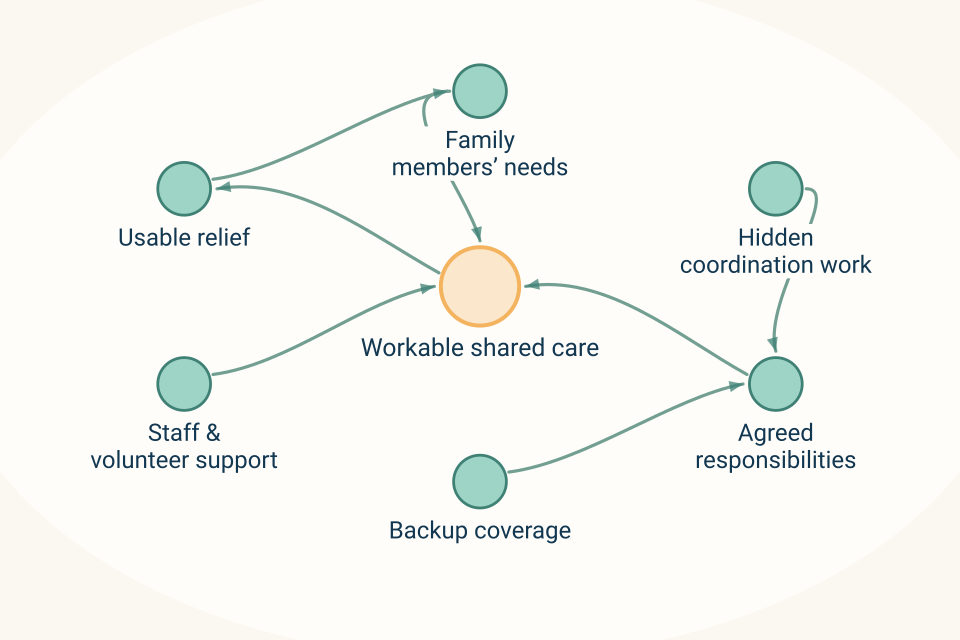
Listen to family members’ separate needs when planning workable shared care. Include the hidden preparation, travel and coordination in agreed responsibilities. Bounded, accepted responsibilities contribute to workable shared care. Backup coverage supports agreed responsibilities when arrangements change. Staff and volunteers need time, training, roles and workable conditions behind the plan. Check whether the shared-care arrangements produce usable relief in practice. Ask the person whether that relief fits their own needs and life. Relief is something to examine, not something established by a booking or a completed training module.
The visible task | The support that makes it workable |
An agreed responsibility | Prepare, travel, deliver, communicate changes, and close the loop. |
Shared care | Name the owner, boundaries, resources, and backup; do not default every gap to the caregiver. |
Time of one’s own | Ask whether the arrangement provided usable relief, not only a booking. |
In context
In Context — Time that belongs to Ellen
The continuing family and team scenes are fictional illustrations. They show proposed care arrangements and design choices, not documented cases or measured product outcomes.
When Maya called that evening, she began with a different question.
“Did you have lunch with your friend?”
“Yes,” Ellen said. “We talked about her for a change.”
“Was that good?”
“It was very good. I’d forgotten how much she has going on.”
Pat was reading nearby.
“Did you bring back anything interesting?”
“Several things. None of them appointments.”
“That sounds promising.”
The Day Center had given each of them something different. Pat had people to talk with and an activity he wanted to attend. Ellen had time that was not organized around the next care task.
But when she later met with Sam, she did not describe the week as solved.
“The days at the center help,” she said. “It’s everything around them that still takes some working out.”
“What is still landing with you?”
“The meals. The calls. Remembering what we need to ask. Sometimes I’m not doing something, but I’m still making sure someone else is.”
Sam asked which part she most wanted to change.
“Evenings,” Ellen said. “By then I would like us to be finished arranging things.”
Pat looked up.
“I would support that proposal.”
They were not asking for a life without responsibility.
They were asking whether responsibility could be shared in a way that left them more room to be husband and wife.
Support has to reach the people expected to give it
Our approach includes family relationships, resources, education, and capacity within whole-person care. That means asking not only what support the person needs, but what the people around them can realistically provide.
A care plan that depends on one exhausted person carrying everything is not a strong care plan.
The same question belongs inside an organization.
Does the plan depend on a staff member staying late to complete the record? On a volunteer accepting responsibilities beyond their preparation? On a manager being available whenever something goes wrong?
Goodwill matters. It should not conceal an unsupported arrangement.
Family caregiving, paid professional work, and volunteering are different roles. They involve different obligations, skills, boundaries, and resources. We should not treat them as interchangeable.
But each deserves a similar design question:
What must we provide so this person can carry their agreed responsibility without being left alone with the rest?
Love should not require Ellen to absorb every uncertainty. Professional commitment should not require Lena’s team to make an under-resourced process work through personal sacrifice.
Support becomes practical when it changes the work, the resources, or the responsibility—not only how someone is encouraged to feel about it.
Respite is more than an empty space on the calendar
For this chapter, usable respite means time during which appropriate support has actually been provided and the caregiver can use that time for something of their own choosing.
The distinction is important. A service may be booked without being received. Attendance may require substantial preparation, travel, and coordination. A caregiver may remain unsure who is responsible if something changes.
Ask about the whole arrangement.
Ellen might use the time for her own appointment, a friend, household work she chooses to do, or rest. None needs to be more productive than another to count.
The Daily Stress and Health study found that caregivers reported fewer care-related stressors on adult-day-service days, but more stressors unrelated to care. Its findings support examining what happens during the time provided rather than assuming that every service hour becomes rest.43
Pat’s experience remains equally important. Ellen’s relief should not depend on persuading him to tolerate a poor fit. His enjoyment should not erase her need for help outside program hours.
When those needs conflict, discuss the conflict. Explore the support available rather than making one person responsible for protecting the other from disappointment.
The additional Tuesday requested in earlier chapters illustrates that boundary. Until the responsible people confirm an arrangement, it is not respite Ellen can rely on. An open request should remain visible as an unmet need.
Make the hidden work discussable
Do not begin by handing the caregiver an exhaustive form asking them to document everything they do.
Start with a manageable part of the week.
“What happened between getting home yesterday and going to bed?”
Listen for the work inside the answer: noticing, deciding, arranging, doing, confirming, and responding when something changes.
Someone else may drive to an appointment while Ellen still checks the time, prepares the information, contacts the driver, and asks whether the visit happened. The visible task has moved; much of the coordination has not.
NIA’s guidance on sharing caregiving responsibilities recommends discussing needs together, choosing tasks that fit people’s abilities and interests, recognizing limits, and revisiting arrangements as circumstances change.81
Our application is to make the scope of an offer clear.
“I can help with dinner” is a beginning.
“I can plan, bring, and clear up dinner on these four evenings, within the food requirements we agree” describes something the family can consider.
Not every task can be handed over. Some require professional expertise, preparation, permission, or a relationship the person receiving care accepts. Some should be removed because they are unnecessary. Others reveal a need for services beyond what the family can provide.
The aim is not equal task totals.
It is an arrangement that respects everyone’s circumstances and reduces the need for one person to keep the whole plan functioning.
A commitment can be generous and bounded
In context
In Context — A smaller promise that includes the work
At the next family conversation, Daniel offered to handle Wednesday dinner for the following four weeks.
“I can plan it, bring it, and clear up,” he said. “Let’s agree on what works for you both.”
“Does that include deciding what we’re having?” Ellen asked.
“Yes. Unless you have a request.”
Pat had one.
“Nothing that requires a presentation.”
Daniel smiled.
“I was planning food.”
Maya offered something different.
“I can help prepare the questions for the planning conversation you’ve mentioned. Once you decide whom you want to speak with, I can make that one contact next week, with your permission.”
Sam checked the scope.
“Not taking over all the family planning?”
“No,” Maya said. “I can do this part.”
“That would help,” Ellen replied.
Daniel also agreed to tell them promptly if a Wednesday became impossible and to work with them on an acceptable alternative. The family did not automatically assign that alternative to Ellen.
They would review the arrangement after four weeks.
A single medical-appointment ride from an earlier chapter had not become a standing transport commitment. One planning call had not made Maya responsible for every future decision.
The new offers were useful because people understood what had—and had not—been accepted.
Build the Shared-Care and Backup Plan
A Shared-Care and Backup Plan can extend the agreement the family already uses. It does not need to become another competing record.
Begin with what Pat and Ellen want the support to protect. Record only the responsibilities and information needed to make that support dependable.
Part of the plan | What should be clear |
|---|---|
What matters | Pat’s preferences, Ellen’s support needs, and the ordinary activities they want to preserve |
Accepted responsibility | The person, task, dates, and limits—including who makes the arrangements and confirms completion |
Preparation and permission | Relevant instructions, skills, access, and information-sharing authority |
Backup | Who has actually agreed to help, what they can provide, and which arrangements still need confirmation |
A changed situation | Who should be contacted, what can safely wait, and the approved route for a concern requiring prompt attention |
Review | Who maintains the plan, when it will be discussed again, and how anyone can request a change |
A name in the backup column is not enough.
Has that person agreed? Are they available? Do they know what the task involves? Can they provide the required assistance? Does the person receiving care accept the arrangement?
For a service, verify eligibility, availability, cost, and the support it can provide. A contact for investigating help is not yet a substitute caregiver.
Where no suitable backup exists, write that plainly and assign responsibility for exploring it. Do not make the document look complete by writing “family” or “community support.”
The clinical team remains responsible for clinical guidance. Sam can help coordinate the agreed support discussion within his role, but he does not become the owner of every task.
The grandchildren have a different place in the plan: enjoyable contact, stories, games, and affection with adult support. They are not backup caregivers, safety monitors, or responsible for keeping their grandparents well.
Give the caregiver a conversation of their own
Ellen should not have to translate every personal need into a benefit for Pat.
“How are you managing?” is a different question from “How is Pat doing?”
Offer an appropriate private setting to discuss the caregiver’s health, strain, relationships, practical concerns, and the support they would welcome. Explain who can see the information and what any limits on confidentiality mean.
Do not collect a sensitive answer in a shared family record and assume that discretion in a summary will protect it. Use an appropriately governed private route where the system’s permissions do not provide the necessary separation.
Support may include a conversation, skills training, navigation, peer contact, counseling, or help reaching the caregiver’s own healthcare professional. Choose with the person and confirm that the service exists.
A group is not the right answer for everyone. Some people prefer an individual conversation, a trusted community connection, or practical assistance before discussing feelings.
The research review informing this book makes the underlying distinction clear: guilt, cost, access, exhaustion, trust, and family circumstances are different barriers. More information is not an adequate response to all of them.
In the ADS Plus trial, the added support included education, validation, problem-solving, referrals, and caregiver self-care strategies delivered by trained staff over time. It was not simply a handout advising people to take a break.44
That is the organizational question here: what support follows the invitation to speak?
Caring for Caregivers: identify, understand, assist
RUSH University Medical Center’s Caring for Caregivers (C4C) program makes caregiver support an explicit part of healthcare. Its public resources describe identifying caregivers, assessing their circumstances, and connecting them with assistance—including skill-building, Planning for What Matters sessions, and care-team planning. The program was developed with philanthropic support, including the RRF Foundation for Aging and The John A. Hartford Foundation, and has worked with IHI on wider implementation.8
In the published model, Planning for What Matters Sessions are brief psychotherapy delivered by a designated clinician. A general planning conversation, an activity discussion, or an AI-generated prompt is not the same clinical service. Partners must identify the qualified professional and actual support available before using that name.76
We can learn from that structure without treating a Day Center as a complete clinical C4C service. The following is a CarePhysics adaptation for a partner-supported caregiver pathway.
Identify. Recognize the person doing the caring and invite them into support in their own right. Being listed as a relative or emergency contact does not tell us what they carry or what help they want. Explain the offer, the private route, and the appropriate alternatives.
Understand. Give the caregiver space to describe their health, strain, practical needs, understanding, and available support. Qualified people select and interpret suitable assessments where indicated. Ask what would make life more manageable for the caregiver, not only what would make them more useful to someone else.
Assist. Agree on a response with an accepted owner and an achievable next step. That may involve practical help, professional skills support, a planning conversation, a relevant community service, or the caregiver’s own clinician. Check whether help was received and whether it addressed the stated need.
Follow-up is part of the work. The 2025 C4C case study describes follow-up one and three months after completion, or at other predetermined times; RUSH’s implementation resource allows a schedule suited to the adopting system. Those are examples, not a universal baseline/one/three/six-month requirement. A local plan should state both the timing and the event from which it is counted.82
Protect time, training, interpretation, response capacity, and coverage for the people providing this support. If a service is unavailable, keep the need open and explain who will investigate another route. A completed assessment should never become the organization’s reason to stop asking whether help followed.
Protect the caregiver’s private account
A public Center for Health Care Strategies profile of RUSH’s implementation describes caregivers registering as patients with their own electronic records. That is a useful example of recognizing their separate needs. It is not evidence that a shared family record in another system provides the same protection.83
Our proposed design distinguishes three uses of information. The private caregiver record holds sensitive disclosures and assessments for the caregiver and appropriately authorized professionals. The shared support plan carries only the information agreed and appropriate for that purpose, such as a request for practical help. The family-facing Daily Summary concerns the participant’s day and authorized follow-up; it does not automatically inherit the caregiver’s private answers.
Explain the actual confidentiality limits and access arrangements before collecting the information. Protect it at collection and retrieval, not only when a summary is published. An assistant preparing a family meeting should not receive private caregiver material merely because it has been told not to mention it.
Check printed packets, exports, notifications, search results, meeting drafts, and personalized tips as well as the main screen. Even a helpful-sounding suggestion can disclose something private by implication. A “Caring for yourself” heading in a shared note is not permission to draw on a confidential assessment.
Where those boundaries cannot yet be enforced, use an approved, separately restricted process for sensitive assessment. Do not promise a private route that depends entirely on someone remembering to remove a paragraph. Appropriate professionals remain responsible for urgent concerns and for explaining any lawful limits to confidentiality.
Supporting the family does not mean giving the whole family access to everything each person has shared. The practical checks appear in Appendices B, C, F, and J.
Make tomorrow discussable without taking over today
Future planning belongs alongside current support, but it should not arrive as a demand to settle every difficult question at once.
Pat can begin with what matters to him, whom he wants involved, and what he wants explained. Ellen can raise concerns about her own capacity. Maya and Daniel can describe what they are able to undertake.
NIA’s planning guidance encourages discussing preferences early and continuing the conversation as circumstances change. It treats planning as preparation for future decisions, not a single form that anticipates every situation.84
An initial conversation might identify questions for the appropriate professionals:
“What kinds of support might we need to consider later?”
“What should we understand about who can make which decisions?”
“Which legal or financial arrangements should we review with a qualified professional?”
The family need not answer those questions themselves. An assistant should not produce a legal decision, determine Pat’s decision-making ability, or infer that a diagnosis transfers authority to relatives.
Maya’s agreed role is to help prepare and arrange a conversation—not decide its outcome.
Planning should also leave room for needs exceeding the current arrangement. A higher level of support is not evidence that the family did not care enough. Nor should anyone promise that one program will keep every person at home indefinitely.
The purpose is to make future choices more informed while preserving participation now.
A useful outcome of an early planning conversation may be a short question list and an accepted professional contact—not a completed legal document. Keep questions about costs, assistance, future care, and decision-making arrangements distinct. Ask what can be shared, and check whether the intended professional conversation actually happened. Chapter 1 and Appendix B offer a practical concern-to-follow-through aid.
Staff need workable conditions, not another message about resilience
The support around Ellen depends partly on Lena’s team.
If the team cannot prepare, take breaks, ask for help, or finish essential work within a workable day, a better family-facing experience may rest on hidden staff effort.
Begin by asking staff where the work becomes difficult.
What gets repeated? Which responsibilities are unclear? What happens when someone is absent? What information is missing at the moment it is needed? Which tasks require more practice, and which require more people?
In context
In Context — The earlier conversation needs a place in the day
Lena brought Pat’s suggestion to the team: discuss actual afternoon choices before lunch.
A staff member raised a practical concern.
“We can do that, but we need to know which options we can offer. Otherwise we’ll promise one thing and change it later.”
Another colleague pointed to an existing preparation conversation.
“Could we confirm the options there, instead of creating another checklist?”
Lena agreed to try that approach. The person leading the activity would confirm the available choices, and the existing preparation conversation would identify who would discuss them with Pat.
They would review both his experience and the work the change created.
Nobody was asked to squeeze a new task into the day and call it a small favor.
The team had helped design the response.
This is one application of the lesson from Chapter 10. A participant’s suggestion and a staff member’s operational knowledge can improve the same experience.
Neither contribution replaces the other.
Make training something people can use
A training library is a resource. It becomes practical support when people have time to use it, assistance with questions, and an opportunity to practice.
Teach the actual task.
A family member learning a consequential care skill needs appropriate professional instruction, demonstration, practice, and a check of readiness—not merely a completed video. A staff member preparing for a difficult conversation may benefit from rehearsal with a colleague. A volunteer needs clear boundaries and a named person to contact.
The Day Center materials describe short paired huddles and branching simulations, including practice around dignity, communication, safety, and documentation. The huddle’s chosen personal commitments are not collected or compared. These are documented training designs, not proof of competence or improved outcomes in every setting.
Protect the difference between practice and required competency assessment. People should know which is occurring, who sees the result, and what support follows.
Do not require staff to do “optional” learning in personal time while implying that declining signals a lack of commitment. Plan appropriate paid preparation and coverage.
Training cannot create capacity that does not exist. A respectful way to explain a service limit is useful. It does not remove the need to address that limit.
Give volunteers a clear and supported place
A volunteer may bring warmth, language skills, local knowledge, creativity, or time for a conversation. Those contributions deserve preparation and support.
Begin with a bounded role: welcome participants, help with an activity, prepare materials, or offer agreed companionship.
Explain what the volunteer may do, what requires staff assistance, which information they may access, and who will respond when they have a concern. Do not let an informal favor expand into medication decisions, personal-care duties, or responsibilities beyond the person’s preparation and the service’s arrangements.
A volunteer who asks for help should not feel they have failed.
Offer a brief debrief when useful. They may have noticed a confusing entrance, an activity instruction that does not work, or something a participant would like to try. Carry those ideas into review with permission and credit.
Purpose makes contribution meaningful. It must not become pressure to accept more than someone can sustain.
Volunteer confidence, role clarity, staff preparation, workload, and implementation costs deserve attention alongside participant outcomes.
When one person is carrying too much, examine the arrangement around them. Constraint-focused improvement should remove unnecessary work or supply missing support, not make exhaustion more productive. The caregiver’s own well-being matters regardless of its effect on the service, and the private C4C-informed conversation remains separate from an operational review. See R2.5.
Build the Staff and Volunteer Support Plan
Keep this plan separate from the family’s care information. Staff well-being and private concerns do not belong in a participant’s shared record.
Support area | Organizational commitment |
|---|---|
Workload and coverage | Identify the work, protect essential preparation and breaks, provide absence coverage, and address demand beyond capacity |
Training and practice | Provide task-specific instruction, supported rehearsal, appropriate competency checks, and time to learn |
Clear responsibility | Name who receives questions, handles exceptions, and makes decisions beyond someone’s role |
Personal support | Explain confidential professional-support routes and their limits; do not require public disclosure of distress |
Voice and improvement | Invite staff and volunteer ideas, credit contributors, explain decisions, and test changes without hidden personal rankings |
Review | Examine total workload, after-hours work, access to support, unresolved concerns, and whether the plan survives changes in personnel |
Appreciation belongs in this plan, but it is not a substitute for the other commitments.
A thank-you means more when a person can also take a break, obtain help, and see an unnecessary task removed.
Design invitations that offer help—not homework
The content surrounding support should make the offer easier to use.
A caregiver message can begin with the person’s situation rather than a list of recommended behaviors:
Support for your week
We can help you look at one part of the week that feels difficult to carry.
That might be an arrangement, a question about available support, a skill you would like to practice, or something you would prefer to discuss privately.
You do not need to prepare a complete account. You can begin with: “This is the part I would like help with.”
We will explain what support is available, what needs checking, and who will follow up. You can choose a conversation, receive information, or take more time.
Before using this invitation, add the real responder, contact route, availability, privacy arrangements, and what happens after a request.
The supporting formats should have different jobs. A short video can demonstrate a bounded offer of help. An article can explain practical choices and service limits. A tile can collect the relevant material and a question route. A call can address an individual concern.
A feedback question can ask, “Did this reduce the work you were carrying, or create something else to manage?” Explain who reviews the answer and how to request a response.
Keep familiar labels and expectations across these formats. Consistent meaning does not require identical wording, as the communication approach used here emphasizes.
Adapt language, format, timing, and examples with the people involved. A caregiver working shifts, a family without reliable transport, and a household seeking faith-related support may need different arrangements. Ask rather than infer.
An urgent concern follows its appropriate route immediately. A validated instrument retains its required wording and scoring. An invitation to rest should not end with another required activity.
AI can help remove the work around support
An assistant could help Ellen prepare the question she wants to ask, Maya organize a limited planning task, or Lena’s team turn a useful explanation into reviewed guidance.
The opportunity begins with the work already identified—not with a requirement to use AI.
In a proposed workflow, Sam selects the approved guidance, verified local resources, and personal information authorized for the task. The assistant prepares options. Sam checks whether they reflect the actual agreements and what the services can provide.
Suppose a draft says:
“Maya will coordinate future care planning.”
That is not what she accepted.
The corrected version says:
“Maya will help prepare the agreed questions and make one approved contact next week. Further responsibilities have not been assigned.”
The draft has become useful by staying within the commitment.
For staff, an assistant could assemble current materials for a huddle, prepare a demonstration outline, or organize voluntary suggestions. It could retrieve a relevant explanation during agreed coaching and help someone reflect afterward. It should not score compassion, infer burnout from a voice, or present itself as an impartial authority in a family disagreement.
A practical assignment might be:
Using CarePhysics and our approved local guidance, help us identify one part of this support process that creates repeated work. Prepare options that respect the person’s preferences, staff roles, resources, and privacy. Distinguish accepted commitments from suggestions. Identify who must review each option and how we could test whether it reduces burden.
Keep research, design guidance, current service facts, fiction, and permissioned personal context distinguishable. Retain source owners, review dates, allowed uses, and corrections. The book is a reference for that work; uploading it is not model training or proof of reliable performance.
With reliable knowledge, clear guidelines, practical rules, and accountable people, AI can be a gift: less routine assembly and more attention for the person.
Families may also revisit approved routine information or prepare questions outside office hours. State when human help is available and make that route easy to reach. Around-the-clock AI access is not continuous professional care.
Private caregiver or staff concerns must not automatically become shared summaries or training examples. For generic content development, use generic examples rather than private records.
Measure the whole task against the local baseline, including checking, corrections, and work outside scheduled hours. A drafting tool does not necessarily measure or reduce the time required to finish the work.
What the organization must provide
A support initiative needs more than educational content and a coordinator’s name.
Confirm service capacity, staffing, costs, accessible formats, language assistance, training, privacy, and coverage. Assign an owner who can change the process when it adds work or leaves needs unanswered.
Do not solve Ellen’s coordination burden by transferring it without agreement to Maya. Do not solve family uncertainty by making frontline staff continuously available. Do not rely on one enthusiastic leader to hold the entire arrangement together.
The same principles apply beyond dementia care.
A person supporting a relative through rehabilitation may need a professionally taught skill and an affordable way to attend appointments. A home-care worker may need reliable supervision between visits. A volunteer in an independent-living community may need clear boundaries around assistance and a prompt staff response.
Community and state groups can help identify recurring shortages and resource appropriate services. They should not assume that a resource listed in a directory is available to every household.
Genus supplies technology. Partners retain responsibility for their care, staffing, programs, relationships, and voice.
Relationships can reveal a missing service. They cannot replace it.
How would we know it helped?
Use the measurement discipline from Chapter 10 without making the support plan another reporting burden.
Choose one manageable change, establish a baseline, and name the review period and owner. A short local test can identify practical problems; it does not establish lasting clinical benefit.
For the family plan, distinguish tasks accepted from tasks completed. In the defined review period, record completed agreed tasks out of those due, and keep cancellations, unresolved needs, and unknown outcomes visible.
Then ask whether the arrangement reduced the caregiver’s work. Did someone else handle preparation and changes, or only the visible task? Did the caregiver gain usable time? Did the person receiving care find the arrangement acceptable?
For staff, examine preparation, documentation, review, corrections, and after-hours work. For volunteers, ask about role clarity, confidence, and access to assistance. Do not treat training completion as proof that someone can perform the task.
Keep educational delivery, understanding, booked and attended days, and initial versus repeated assessment distinct. A support process needs evidence for the particular result it claims; see the dated field limitations in Appendix J.
Use suitable measures for formal claims about caregiver strain or workforce well-being, preserving their wording, privacy requirements, and interpretation.
Include people using telephone, print, interpretation, or personal assistance. Report how many were offered support, used it, and provided feedback. A family unable to afford or reach a service should not be recorded simply as uninterested.
Keep reach, understanding, first action, adoption, useful participation, outcomes, and attributable impact separate. Willingness to recommend, an actual referral, and another person receiving help are also different results.
Most importantly, give the findings somewhere to go. If the new process increases duplicate work, exposes private information, or depends on unsafe coverage, change or pause it.
We are asking whether the support became sustainable—not whether people became better at enduring its absence.
Models and Evidence Behind This Chapter
This chapter applies the CarePhysics principles through fictional arrangements and proposed support plans. The studies below examine caregiver support and workforce interventions in their stated settings.
COM-B, autonomy, and social support
Match the help to the actual need
COM-B directs attention to capability, opportunity, and motivation. Self-Determination Theory emphasizes autonomy, competence, and relatedness. Here, they inform task-specific preparation, feasible roles, and the right to limit or decline a responsibility.
Our commissioned review grades COM-B strongly as a conceptual framework and the broader Self-Determination Theory intervention evidence as Moderate. It describes several specific family-role applications as Plausible or supported by mechanisms rather than direct feature trials.
Where we used them: Daniel and Maya choose bounded responsibilities; a resource gap is not answered with another motivational message.
Local question: Did the support make a chosen responsibility manageable, or merely make it harder to refuse?
Adult day services and daily caregiver experience
Examine what the service day makes possible
Steven Zarit and colleagues’ Daily Stress and Health study, published in the 2014 volume of The Gerontologist, followed 173 family caregivers of people with dementia over eight consecutive days. Caregivers reported fewer care-related stressors, more positive experiences, and lower anger on service days, alongside more noncare stressors.43
Evidence boundary: This was a within-person observational study, not randomized attendance. It concerns daily experience, not proof that every center reduces long-term strain or that a digital tool produces the effect.
Where we used it: Ellen’s usable time is evaluated directly rather than inferred from a booking.
Local question: What did the caregiver gain, and what preparation or coordination remained?
ADS Plus
Support the caregiver alongside the participant
Laura Gitlin and colleagues’ multisite trial included 203 caregivers across 34 adult day-service sites. Sites were randomized to usual services or services plus trained-staff support involving education, validation, referrals, problem-solving, and self-care strategies.
At 12 months, adjusted caregiver depression scores were lower in the added-support group. 22.7 percent were lost to follow-up; the sample was predominantly female and college educated. The attendance comparison did not reach the conventional statistical-significance threshold.44
Evidence boundary: The trial tested a structured, multicomponent program over time—not a brochure, occasional check-in, or AI companion.
Where we used it: The caregiver receives a conversation and support process of their own.
Local question: What trained human support follows the invitation to ask for help?
RUSH C4C: a defined pathway for caregiver support
Carbonell, Mariani, and Golden’s 2025 organizational case study describes caregiver support that can be adapted across organizations. It reports reductions in caregiver depressive and anxiety symptoms and caregiver burden at one- and three-month follow-up after intervention. These are encouraging uncontrolled observations. They do not establish that C4C caused the changes or that Day Center attendance, an AI assistant, or a Genus implementation would reproduce them.76
Where we use it: recognition of the caregiver’s own needs, an organized support pathway, and planned reassessment. R1 separates this implementation model from the controlled caregiver-intervention studies; our proposed privacy and follow-through requirements remain requirements to verify locally.
Implementation research
A program must fit the people delivering it
Gitlin and colleagues’ 2025 analysis examined implementation in 16 ADS Plus sites serving 102 caregivers. Some caregiver outcomes differed by implementation level at three and twelve months, but not six months.
Sites were not randomized to implementation levels. Missing and irregular documentation made it difficult to distinguish incomplete delivery from incomplete recording. The authors also identified training and local-fit challenges. The paper disclosed that Gitlin co-founded a company entitled to fees for ADS Plus training.85
Evidence boundary: These associations do not show that more documentation causes better care. The commissioned review classifies this implementation evidence as Emerging.
Where we used it: Staff participate in adapting the work and receive preparation, coverage, and review time.
Local question: Can the team deliver the essential support under its actual working conditions?
Workforce interventions
Change the work as well as supporting the worker
As supplementary evidence, Maria Panagioti and colleagues’ 2017 systematic review and meta-analysis included 19 studies, 20 comparisons, and 1,550 physicians. Interventions produced small average reductions in burnout, focused on emotional exhaustion. Organization-directed approaches had larger average effects than physician-directed approaches.86
Evidence boundary: The studies included randomized and controlled before-and-after designs, with different interventions and settings. The subgroup comparison does not establish which change will work in a Day Center, and the findings cannot simply be transferred to volunteers or family caregivers.
Where we used it: The staff-support plan addresses workload, coverage, role clarity, and work processes—not only individual coping.
Local question: What has the organization changed about the conditions creating the difficulty?
Shared responsibility and future planning
Prepare without deciding everything at once
NIA’s guidance recommends identifying needs, discussing who can undertake which tasks, recognizing limits, and revisiting the plan. Its advance-care-planning guidance emphasizes conversations about preferences and preparation for future decisions. These are practice resources, not trials of this chapter’s tools.81
Where we used them: Accepted responsibilities remain specific, and planning questions go to the relevant professionals.
Local question: Does the plan preserve the person’s voice and reduce uncertainty without placing every unanswered question on one relative?
One thing to try
Choose one recurring part of care that depends heavily on one person.
Ask that person to describe a recent example—not to reconstruct their entire week. Identify the work of noticing, arranging, doing, confirming, and handling changes.
Together, select one responsibility to share, one unnecessary step to remove, or one resource gap to address. Name the person who will act and when you will review the result.
Do the same with one staff member or volunteer involved in the service.
Your team’s question is:
Have we offered support—or made it possible for someone to set part of the work down?
Shared care should leave room for ordinary company
In context
In Context — Dinner includes clearing up
On the first Wednesday of the new arrangement, Daniel brought dinner.
Pat inspected it.
“No presentation?”
“Not unless you ask.”
Afterward, Ellen began gathering the plates.
“I included that part,” Daniel said.
She stopped.
“So you did.”
Pat returned to the table with his book. Ellen sat beside him while Daniel cleared up.
“What are you reading?” she asked.
Pat turned the cover toward her.
“Something with very few appointments.”
The arrangement had not solved the whole week. It had completed one agreed piece of work without Ellen having to direct it.
That was enough to notice—and something to review before assuming it would remain workable.
Families can share meals, calls, and other responsibilities. Staff and volunteers can be better prepared and supported. But some parts of care still depend on separate organizations keeping their commitments.
A family cannot supply a missing service simply by communicating more clearly.
The next chapter examines what happens at those boundaries: who accepts responsibility, who responds when an arrangement fails, and how a community learns to follow through.
Notes
RUSH Center for Excellence in Aging. Caring for Caregivers Across U.S. Public implementation resource for the C4C model. Source (opens a new tab)
Zarit SH, Kim K, Femia EE, Almeida DM, Klein LC (2014). The effects of adult day services on family caregivers’ daily stress, affect, and health: outcomes from the Daily Stress and Health (DaSH) study. The Gerontologist. 54(4):570–579. DOI: 10.1093/geront/gnt045. Source (opens a new tab)
Gitlin LN, Roth DL, Marx KA, et al. (2024). Embedding Caregiver Support Within Adult Day Services: Outcomes of a Multisite Trial. The Gerontologist. 64(4):gnad107. DOI: 10.1093/geront/gnad107. Source (opens a new tab)
Carbonell E, Mariani D, Golden R (2025). Caring for Caregivers Within Age-Friendly Health Systems: An Organizational Case Study of National Scale and Spread. INQUIRY. 62:00469580251325660. DOI: 10.1177/00469580251325660. Source (opens a new tab)
National Institutes of Health (2017). Coping With Caregiving: Take Care of Yourself While Caring for Others. NIH News in Health. December. Source (opens a new tab)
National Institute on Aging. How to Share Caregiving Responsibilities With Family Members. Caregiving guidance. Source (opens a new tab)
Carbonell E, Mariani D, Golden R (2025). Caring for Caregivers Within Age-Friendly Health Systems: An Organizational Case Study of National Scale and Spread. INQUIRY. 62:00469580251325660. DOI: 10.1177/00469580251325660. See also RUSH Center for Excellence in Aging, Caring for Caregivers Across U.S., for local implementation and follow-up planning. Source 1 (opens a new tab) · Source 2 (opens a new tab)
Opthof E (2022). Rush Caregiver Intervention: Advancing Age-Friendly Health Systems by Prioritizing Family Caregivers. Center for Health Care Strategies. January 13. Source (opens a new tab)
National Institute on Aging. Advance Care Planning: Advance Directives for Health Care. Public planning guidance; legal arrangements depend on applicable law and qualified local advice. Source (opens a new tab)
Gitlin LN, Marx KB, Roth DL, et al. (2025). Fidelity matters: implementing ADS Plus, an evidence-based program, in multiple adult day service sites. Innovation in Aging. 9(8):igaf074. DOI: 10.1093/geroni/igaf074. Source (opens a new tab)
Panagioti M, Panagopoulou E, Bower P, et al. (2017). Controlled Interventions to Reduce Burnout in Physicians: A Systematic Review and Meta-analysis. JAMA Internal Medicine. 177(2):195–205. DOI: 10.1001/jamainternmed.2016.7674. Source (opens a new tab)