R2
R2 — The Models Behind CarePhysics — Ideas We Can Put to Work
At a Glance
The central idea: Use models to understand a situation—not to place a label on a person.
What you’ll explore: How different ideas help explain barriers, motivation, learning, relationships, and organizational change. Understand COM-B, Self-Determination Theory, the Fogg Behavior Model, Social Cognitive Theory, social support, diffusion, and Social Physics. Distinguish these from communication methods and tools for designing learning.
Design and AI: Turn an idea into a practical choice about a video, article, survey, message, conversation, or pathway. Explore how an approved assistant could help apply reviewed guidance and local wisdom without deciding what a person believes or which outcome they should want.
Put it to work: Use the model-selection guide and a Model-to-Design Brief to identify the question, proposed response, responsible person, and appropriate test.
Evidence and evaluation: Keep each model’s purpose and evidence limits visible. R1 supplies fuller study summaries. A theory can justify investigating an approach; it cannot establish the effectiveness of the care or technology built around it.
“In this conception, people are contributors to their life circumstances, not just products of them.”
— Albert Bandura, psychologist, “Toward a Psychology of Human Agency,” 2006.110
In context
In Context — Three invitations, three different needs
This is a hypothetical planning exercise using the book’s fictional professionals. It does not add events or outcomes to the family’s chronology.
Lena and Sam are reviewing a proposed introduction to a Day Center.
“Suppose someone receives the guide but doesn’t arrange a conversation,” Lena says. “What should happen next?”
“A reminder?” a colleague suggests.
Sam puts three fictional responses on the table.
“I don’t understand what happens there.”
“I’m interested, but I can’t manage the journey.”
“I would like some help. I’m not sure this is the right help.”
“Which of those does the reminder answer?” he asks.
The group looks again at the proposed sequence.
The first person may need an explanation. The second needs practical assistance. The third may need a conversation, a different option, or more time.
They have not discovered three kinds of difficult people.
They have identified three different design questions.
R2.1 — Why We Use More Than One Model
Different ideas do different jobs
Methods and theories do different jobs. Demonstration and goal setting are techniques; motivational interviewing structures a conversation; learning design organizes an experience. Do not treat them as interchangeable evidence for a single theory of engagement.
A theory or behavioral model offers an explanation to investigate. Self-Determination Theory asks about the quality of motivation. Social Cognitive Theory examines the interplay of people, behavior, and environment.
A communication method guides something a person does. Motivational interviewing structures a collaborative conversation. Teach-back checks how an explanation was understood.
A design or improvement framework organizes work. Backward design connects a learning purpose with evidence and instruction. ADDIE structures development. Plan–Do–Study–Act helps a team examine a change.
These categories describe their roles in this chapter; they are not rigid boundaries. The entries below explain the particular concepts and sources.
No single model should be asked to do every job.
A clearer message cannot supply an unavailable vehicle. A small first step cannot establish that the destination is appropriate. A trusted messenger cannot make an incorrect claim true.
The research review informing this book therefore begins with barriers, then considers motivation, manageable action, relationships, and learning. It calls that combination a synthesis—not a separately validated theory.
Begin with a question people can recognize
Describe the action specifically: who is trying to do what, in which circumstances, and why it matters to them.
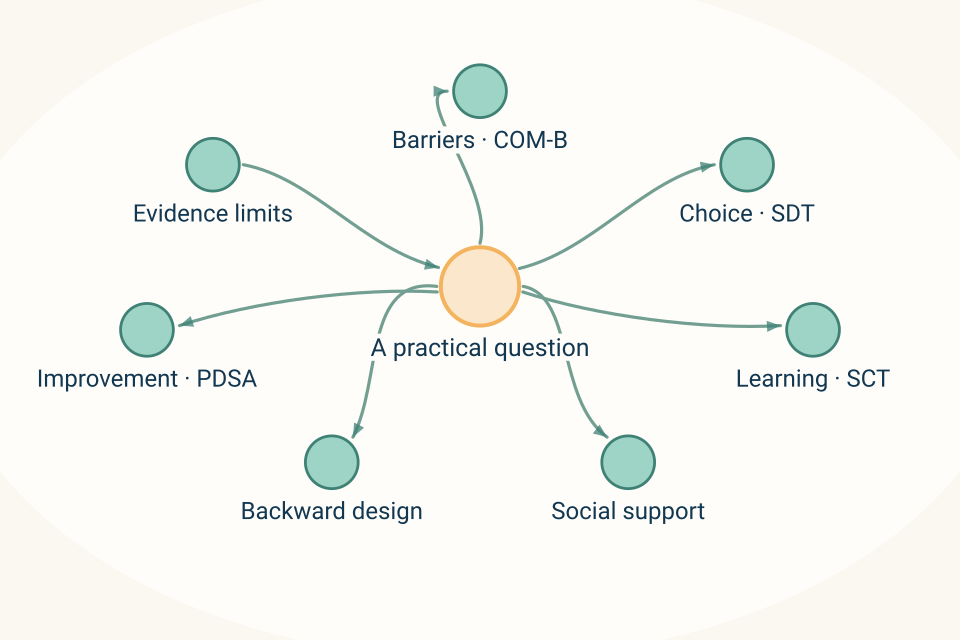
Use COM-B to examine capability, opportunity and motivation around the practical question. Use Self-Determination Theory to examine autonomy, competence and relatedness. Social Cognitive Theory helps examine learning through interactions among the person, behavior and environment. Social-support ideas direct attention to what someone can actually rely on. Backward design starts with what the experience should make possible. Plan–Do–Study–Act supports a small, reviewed test of change. Evidence limits bound what any selected model can establish about the practical question. These are selected examples from the chapter, not its complete model list. SDT means Self-Determination Theory; SCT means Social Cognitive Theory. Models direct questions rather than label the whole person.
Method or perspective | The question it helps ask |
COM-B and self-endorsed choice | What makes the action feasible and worthwhile to this person? |
Journey mapping and social learning | What do people experience, and how does useful knowledge travel? |
TOC and PDSA | What is limiting the agreed result, and what did an appropriate test teach us? |
4Ms and C4C-informed support | What should older-adult care attend to, and what support does the caregiver need in their own right? |
“Improve engagement” leaves too much open.
“Help someone who wants an introductory conversation reach the appropriate person without repeating their story” gives the team a design task.
Ask whether the behavior needing change belongs to the individual, the family, the professional, or the organization. Several may be involved.
The entries that follow preserve the models’ concepts while labeling care examples as proposed applications. Evidence judgments attributed to the research review informing this book are its judgments, not a new GRADE assessment. R1 explains those distinctions and the relevant study findings.
R2.2 — Understanding Barriers and Supporting Choice
COM-B and the Behaviour Change Wheel
What must become possible before this action can happen?
Foundational idea. Susan Michie, Maartje van Stralen, and Robert West’s COM-B model examines capability, opportunity, and motivation in relation to a specified behavior. The components interact; behavior can also change them. It is not a personality test or a clinical diagnosis.2
Component | Meaning in the model | A proposed care-design question |
|---|---|---|
Capability | Relevant physical abilities and psychological capabilities, including knowledge and skills | Does the person understand the task, and can they perform it with appropriate assistance? |
Opportunity | Physical and social conditions outside the person | Are time, transport, access, resources, and a supportive setting actually available? |
Motivation | Reflective processes, such as intentions and plans, and automatic processes, such as habits and emotional responses | Is this wanted? What concerns, routines, or competing demands should we explore? |
These subdivisions belong to the model. They should generate questions, not invite staff or AI to infer someone’s inner state from silence or an unopened message.
What the wheel adds. The Behaviour Change Wheel links the analysis to intervention functions and enabling policy choices. Education addresses understanding; training develops skills; environmental restructuring changes the setting; enablement addresses obstacles beyond information alone. Its complete taxonomy also includes persuasion, incentives, modeling, restriction, and coercion. Describing those categories does not authorize their use in care. Our proposed applications prioritize informed choice and appropriate professional boundaries.
In the opening exercise, the transport problem is not repaired by another article. Someone must investigate a workable arrangement. If staff cannot return requested calls, the organizational response may involve coverage, time, or a different assignment—not another lesson about compassion.
Evidence and limits. The 2011 development paper reviewed 19 frameworks and tested classification in tobacco-control and obesity-policy contexts. It called for research on whether the approach leads to more effective interventions. This supports an organizing framework, not a promised engagement increase.2
Use with Chapters 3, 7, 8, 12, and 15. Ask: Which barrier have we actually established, and who can change it?
Self-Determination Theory
Does participation feel chosen, manageable, and connected?
Foundational idea. Richard Ryan and Edward Deci’s Self-Determination Theory distinguishes the amount of motivation from its quality. It identifies three psychological needs: autonomy, or acting with a sense of volition; competence, or experiencing effectiveness; and relatedness, or meaningful connection with others.3
Applied here, autonomy includes choosing whom to involve and when to accept help. It does not require a person to carry everything independently. Competence is not a certificate or proof that a consequential task can be performed safely. Relatedness is not the number of people copied into a message.
The theory also distinguishes intrinsic motivation, doing something because it is enjoyable or interesting, from actions undertaken for another valued result. Externally useful actions can still be personally endorsed; they are not all equivalent to pressure or reward-seeking.3
Pat’s interest in reading can be worthwhile in itself. A family member may undertake an appointment task because it supports someone they love, even when scheduling is not enjoyable.
Design for both without turning either into obligation. Offer genuine choices, appropriate assistance, and relationships that permit disagreement. A request to contribute should not imply that belonging must be earned.
Common misuse. “Do this for your family” can sound purposeful while making refusal feel like a failure of love. A choice between two unsuitable options is not meaningful simply because the interface displays two buttons.
Evidence and limits. Our commissioned review grades SDT-informed health-intervention evidence Moderate, noting modest, variable effects and less favorable results in some disease-specific reviews. R1.3 summarizes the broader intervention evidence. It does not establish that a particular activity, reward, or care-circle feature improves health.
Use with Chapters 1, 3, 5, 6, and 11. Ask: Does the person recognize their own reason for taking part—and remain free to choose differently?
R2.3 — Making a Chosen Beginning Manageable
The Fogg Behavior Model
Is the requested action workable at the moment we invite it?
Foundational idea. BJ Fogg’s model focuses on motivation, ability, and a prompt coming together at the moment of an action. Here, ability concerns how easy or difficult the behavior is in context, not a judgment about intelligence or character. Stanford’s model description also notes the interaction between motivation and ease.4
An invitation to “organize your care network” asks for substantial work. An offer to request one conversation may be more manageable—provided it serves something the person actually wants.
For the proposed introduction, put the verified contact and response option beside the explanation. Avoid sending someone to another page to search for a number. Offer a telephone or paper route when appropriate.
A request for a callback remains a request. The receiving service must still accept and complete it.
Fogg and COM-B are complementary, not interchangeable. Fogg directs attention to the immediate action and prompt. COM-B makes the broader capability, resource, and social conditions explicit. Neither replaces asking whether the action is wanted.
Evidence and limits. Our commissioned review grades the named Fogg approach Emerging, while distinguishing more developed evidence for some component practices. A small action is not automatically a meaningful habit or health outcome.
Use with Chapters 3, 7, and 8. Ask: Can we remove unnecessary effort without removing informed choice?
Tiny habits, routines, and prompts
What is worth repeating—and does it need to be repeated?
The Tiny Habits approach uses small behaviors, existing routines as anchors, and positive reinforcement. It is related to, but not identical with, Fogg’s explanatory model. The research review informing this book also cautions that habit formation varies substantially; it does not support one deadline for everyone.
A proposed staff routine might place a brief preparation check within an existing paid huddle. The team still needs time, an owner, and a useful result.
Not every care action needs to become a habit. Requesting an introduction may happen once. A family reading evening can remain spontaneous. Do not turn it into a streak the grandchildren must maintain.
When routines change, ask what now fits. A prompt should support the person’s plan, not keep an obsolete activity alive.
Choice architecture and nudges
Can the arrangement make a useful choice easier?
Choice architecture concerns how options are organized: their wording, order, defaults, visibility, and the effort involved in acting. The research review informing this book discusses Thaler and Sunstein’s Nudge in these terms and distinguishes specific tested interventions from claims about a universal nudge effect.
A relevant care example is placing “Ask the team to contact me” beside an explanation, with the recipient and expected response made clear. That changes the route to help, not the person’s beliefs.
Some friction protects people. Understanding a consequential choice, confirming a recipient, or authorizing access should not disappear in pursuit of fewer clicks.
Do not preselect family sharing, imply a service is reserved when it is not, conceal costs, or make declining unnecessarily difficult.
Evidence and limits. The review reports disagreement about broad pooled nudge effects and more useful evidence for particular interventions in particular settings. Test the actual design; do not use a clever label as evidence.
Social influence, recognition, and contribution
Are we offering useful reassurance—or creating pressure?
Cialdini’s expanded framework groups influence around reciprocity, commitment and consistency, social proof, liking, authority, scarcity, and unity. The research review informing this book treats these as context-dependent mechanisms, not reliable buttons for changing people.
For our purposes, a documented peer experience may be offered as one perspective. A professional’s expertise can explain a recommendation. A contribution can be acknowledged with permission.
None justifies invented testimonials, manufactured urgency, or “families like yours always choose this.” Actual service scarcity should be explained honestly, not used to pressure enrollment.
Purpose is also not a debt. Someone may want their feedback to help the next family; they should not be told the center’s future depends on their participation.
The review classifies symbolic community points as Plausible, not demonstrated care impact. Positive and negative feedback deserve equal recognition; points must not rank families or imply funding without an actual, applicable arrangement.
R2.4 — Learning Through Other People
Social Cognitive Theory
Can people see a workable example and practice with support?
Foundational idea. Albert Bandura’s Social Cognitive Theory examines reciprocal influences among personal factors, behavior, and the environment. In his health-promotion account, self-efficacy—belief in one’s ability to perform an action—works with goals, expected consequences, and environmental barriers or supports. 111
Observing another person is one route into learning. The care-design task is to show what matters and provide appropriate opportunity to try—not assume that watching creates competence.
For a fictional rehabilitation lesson, a qualified professional demonstrates the agreed skill, supports practice, checks performance, and adapts the instruction. For a digital task, a staff member could show where a question goes, then let the person try with chosen assistance.
Do not use confidence as a substitute for observed skill. Do not interpret difficulty as insufficient belief when the equipment, instructions, or support are wrong.
Evidence and limits. Bandura’s 2004 article is a theoretical account of health promotion, including the need to change social systems. It is not a trial of this proposed lesson. R1 distinguishes demonstrations, training packages, and the outcomes tested.
Use with Chapters 2, 4, 6, and 11. Ask: What can the person practice safely, and what must the environment provide?
Social support and the buffering hypothesis
What can someone actually rely on?
Foundational idea. Cohen and Wills’ social-support review distinguishes the structure of relationships from their functions. Their buffering hypothesis concerns support responsive to the needs created by stress; their analysis also considers broader associations with social integration.41
For planning, ask separately about someone who listens, someone who explains, someone who offers practical assistance, and someone who helps think through a concern. These roles may overlap. They should not be assumed from the number of relatives available.
The family’s bounded responsibilities in the main chapters illustrate the distinction. An accepted task can be checked against what happened; “the family is supportive” leaves its practical meaning unclear.
Being surrounded by people is not proof that the needed support exists. Nor should access to an appropriate service depend on having a large personal network.
Evidence and limits. This is a family of concepts and research findings, not one standardized care package. R1.3 examines direct caregiver-support studies; their service components cannot be replaced by adding names to an app.
Use with Chapters 1, 5, 11, and 12. Ask: What help is available, acceptable, and dependable for this particular need?
Diffusion of Innovations
What makes a new approach worth considering?
Foundational idea. Everett Rogers’ diffusion framework examines an innovation, the communication channels through which it becomes known, the social setting, and adoption over time. Five useful attributes are relative advantage, compatibility, complexity, trialability, and observability.
Translated into design questions: Is it better for something that matters? Does it fit the person’s life or team’s work? How difficult is it? Can it be explored before a larger commitment? Can people see what it actually involves?
A hypothetical independent-living service might let a resident discuss and observe an appropriate support option before deciding. A clinical team might try a referral process with protected time and a colleague who can demonstrate it.
Trialability is not permission to bypass eligibility or safety requirements. Observability does not justify exposing private information. Do not turn adopter categories into labels such as “difficult families” or “resistant staff.”
Evidence and limits. The research review informing this book identifies durable conceptual value and Moderate healthcare intervention evidence, including local opinion-leader research. Professional adoption and patient outcomes remain different endpoints.
Use with Chapters 5, 8, 13, and 15. Ask: What would make the offer understandable and realistically worth trying here?
Centola’s network research and complex contagion
Does receiving information settle the decision?
Damon Centola distinguishes spreading information from adopting behaviors that may require reinforcing signals from more than one social contact. His randomized online-network experiment found that clustered networks supported greater adoption of the studied health behavior than networks organized around more long-range connections.27
The proposed care application is not to surround a person with agreement. It is to make relevant, independent perspectives available when the person wants them: a professional explanation, a candid peer account, and an appropriate opportunity to explore.
Give room for unfavorable experiences and disagreement. Repeating the same message through three relatives does not make it three independent pieces of evidence.
Evidence and limits. The research review informing this book judges the network mechanisms Moderate, with strong causal evidence for some experimental findings but indirect transfer to many caregiver situations. It explicitly rejects the assumption that every group is an effective support network.
Use with Chapters 3, 5, 12, and 14. Ask: Would another perspective help this person decide—or only add pressure?
Pentland’s Social Physics
How does useful knowledge travel and become usable?
Alex Pentland’s Social Physics emphasizes idea flow and social learning. Two concepts matter particularly here: exploration, discovering ideas and people beyond the familiar circle; and engagement, interacting enough to interpret and work with what is discovered.5
This use of engagement is not identical to CarePhysics’s name for a designed encounter, nor does it mean clicking on content. Keep the meaning clear.
In the family’s story, finding a community resource represents discovery. Speaking with someone who can explain its actual conditions moves the information toward practical use. At the organizational level, a volunteer’s suggestion or a participant’s question may lead a team to try a better approach.
That suggests a learning practice: invite ideas, review them with the people affected, credit contributors, try appropriate changes, and report what happened.
Evidence and limits. Our commissioned review grades the broader perspective Emerging-to-moderate. Workplace and network research does not establish that more communication always improves care. Social learning can spread mistakes. This application does not require badges, continuous recording, or hidden staff analysis.
Use with Chapters 5, 10, 13, and 14. Ask: Who discovered something useful, who can help interpret it, and who can act on it?
R2.5 — Conversation, Learning, and Improvement Methods
Motivational interviewing
Can the person find and discuss their own reasons?
Motivational interviewing, developed by William Miller and Stephen Rollnick, is a collaborative communication method—not a personality theory or a script for obtaining agreement. The fourth-edition presentation names four tasks: engaging, focusing, evoking, and planning. These concern establishing a working relationship, agreeing what to discuss, exploring the person’s reasons, and preparing action when appropriate.112
Core skills include open questions, affirmations, reflective listening, and summaries. Information can be exchanged by first exploring what the person knows, offering relevant information with permission, and asking how they understand it. MINT emphasizes practice, self-awareness, and respect for informed choice.30
In context
In Context — A question that leaves room for the answer
This fictional conversation is a reference example, not a new event or a complete motivational-interviewing intervention.
Suppose Ellen says, “I would like more help, but I don’t want every family conversation to become a request.”
Sam could ask, “What would useful help look like without turning you into the person who manages all the offers?”
The answer might concern a specific task, a service, or time to talk privately. The question does not decide which solution Ellen should choose.
Evidence and limits. The supplied review supports MI for appropriate conversations while recognizing variable effects and the limits of resolving structural barriers through dialogue. R1.3 summarizes intervention evidence. AI rehearsal is not equivalent to trained MI practice.
Use with Chapters 3, 4, and 11. Ask: Are we helping someone explore a decision—or guiding them toward an answer already chosen for them?
Teach-back
Did I explain this in a way the person can use?
Teach-back asks someone to explain relevant information in their own words. AHRQ distinguishes it from asking “Do you understand?” and from testing memory. People can use their written materials; if a misunderstanding appears, explain differently and check again. A related demonstration can examine a practical skill.24
For a service arrangement, a proposed question might be: “Using this page, how would you find out whether the visit is confirmed?”
The aim is not perfect recitation. It is a workable understanding with the support the person will actually have. Repeated difficulty calls for a different explanation or assistance, not shame.
Do not use a family storybook as a disguised comprehension test. Enjoyment and conversation are legitimate purposes without a teach-back requirement.
Evidence and limits. This is practice guidance, not a universal effect claim. R1.3 preserves the low and very-low certainty reported for different outcomes in the reviewed single-encounter literature; R2 assigns no new overall grade. CarePhysics_R1_Research_Summary
Use with Chapters 2, 4, 6, and 15. Ask: What misunderstanding did the check reveal, and what did we change in response?
Backward design
What should the learning make possible?
Associated with Grant Wiggins and Jay McTighe, backward design begins with desired learning results, then acceptable evidence, then learning experiences and instruction. McTighe’s account explains that sequence rather than beginning with an attractive activity and finding a purpose afterward.47
For a fictional volunteer orientation, the purpose could be knowing when to ask the activity lead for help. Evidence might be a supported response to a realistic practice situation. The lesson then provides the explanation, demonstration, and rehearsal needed.
A video completed is not that evidence.
For recreation, borrow the discipline of naming a purpose without turning the activity into a curriculum. Shared enjoyment calls for a different review from clinical skill development.
Use with Chapters 6, 11, and 13. Ask: What would show that the learning was usable beyond the lesson?
ADDIE
What work is needed to develop and maintain the experience?
ADDIE names Analyze, Design, Develop, Implement, and Evaluate. Robert Maribe Branch’s 2009 text presents it as an organizing approach to instructional design. It is a development framework, not a predicted outcome.48
For the proposed introduction, analyze audience questions and service conditions. Design the learning purpose and response route. Develop reviewed content. Prepare staff and provide the experience. Evaluate what people understood and what the process required.
Return to earlier decisions when the test reveals a problem. Finding that no one has time to answer the questions is a reason to change the implementation—not simply shorten the article.
The following primary-source descriptions explain ADDIE, ARCS, and backward design as distinct planning approaches.
Use with Chapters 6, 13, and 15. Ask: Who owns development, delivery, review, and the next update?
ARCS
Why would this learning be worth beginning and continuing?
John Keller’s ARCS model organizes motivational design around Attention, Relevance, Confidence, and Satisfaction. These categories also appear in the Day Center educational-design materials.
For care education, attention might begin with a recognizable question rather than a dramatic warning. Relevance connects the lesson with something the person wants to understand. Confidence is supported by clear expectations, manageable practice, and assistance. Satisfaction concerns the value of what was accomplished, not a requirement to award points.
Keller’s 1987 paper describes field tests in two teacher-education programs and calls for further controlled research. It does not establish that an ARCS-shaped tile improves caregiver outcomes.50
Use with Chapters 2, 6, and 11. Ask: Does the encounter return useful value for the attention it requests?
Put the methods together without making every format identical
For one proposed first-visit engagement, the tools can inform different parts of the same experience:
Format or encounter | Its practical job |
|---|---|
Video | Demonstrate the welcome and one genuine choice or exception. Identify staged examples and secure appropriate permissions. |
Article | Explain the actual service, limits, costs, and available next steps at a comfortable reading pace. |
Survey or interactive question | Ask what would help prepare the conversation, explain who receives the answer, and allow skipping or another route. |
Message | Offer the relevant item or confirm an actual arrangement, using consistent labels and accurate status. |
Call, virtual meeting, or visit | Address the person’s questions, confirm accepted responsibilities, and establish what happens next. |
A tile may collect the related media, article, questions, and interactive elements. A pathway places it alongside contacts, calls, meetings, and planned encounters in an adaptable sequence. Neither is itself a theory of behavior.
The proposed CarePhysics pattern is why it matters → main idea → demonstration → chosen next step → questions or connection → what follows. It connects the design work without requiring six visible headings everywhere. Urgency overrides the sequence; validated instruments retain required wording and scoring; recreation can end with rest or enjoyment.
The communication guide contributes another useful discipline: begin with the human situation, make one idea clear, demonstrate honestly, and preserve the necessary detail. That is an adapted communication approach—not evidence that Apple’s commercial success validates a care intervention.
Adaptive pathways
What information should change the next offer?
Just-in-time adaptive-intervention research describes decision points, tailoring information, intervention options, decision rules, and near- and longer-term outcomes. It also considers the fatigue that an intervention can create. This is a design framework, not proof that more frequent automated contact improves care.58
In our proposed human-reviewed application, a stated transport difficulty changes the next offer from another preparation tile to practical assistance. A request to pause optional material means pausing, not intensifying reminders.
Define who checks the information and authorizes a consequential change. A missing response is not a diagnosis, and a service not confirmed remains unconfirmed.
Use with Chapters 7, 9, and 15. Ask: What changed, and does it justify different support—or no additional message?
Caring for Caregivers: give assessment somewhere to lead
RUSH’s C4C model provides a practical sequence: identify the caregiver, understand their circumstances, and assist through an agreed plan. Its public implementation resource includes professional skill-building, Planning for What Matters, and care-team planning. It is a care-delivery model, not another theory of motivation.8
The published Planning for What Matters Sessions are clinician-delivered brief psychotherapy. The ordinary support conversations proposed in this book should not be presented as that clinical component. See Chapter 11 and R1, public source CG1.
Our application asks who will hold the private conversation, what needs professional assessment, which support has actually been accepted, and when the caregiver will hear again. Read the measurement and source limits in R1 and the practical application in Chapter 11. Do not turn the invitation into a mandatory battery for every family.
The Age-Friendly 4Ms: assess and act together
The Hartford Foundation/IHI initiative organizes attention to What Matters, Medication, Mentation, and Mobility. Its contribution is not four new intake headings, but care that assesses and acts on the four elements together.18
In our 4Ms-informed application, connect each relevant need to an agreed action, an appropriately qualified owner, and a review point. Use Chapters 1 and 11 together so the caregiver’s own needs do not disappear inside the participant’s plan. R1 supplies public evidence and Appendix B a brief planning aid; neither the mapping nor use of software confers Age-Friendly recognition.
Journey mapping and experience-based co-design
What does the route through care look like from the people living and delivering it?
A process map identifies steps and responsibilities. A human-experience map adds the accounts of people receiving and providing support: what they understand, want, encounter, and need at each stage. In our proposed method, record who supplied an observation and which interpretations still need checking. Keep private accounts separate from the shared map.
Experience-based co-design brings patient or service-user experience and staff experience into joint service improvement. The Royal College of Physicians’ published interview with a patient-centred care programme manager describes gathering patient and staff accounts and working together on service redesign. CarePhysics borrows the discipline of listening before redesigning; the compact worksheet in Appendix D is not a complete EBCD project or evidence of effectiveness.54
Use with Chapters 4, 7, 12, and 15. Let the experience inform content, timing, human contact, and practical support—not only a smoother interface. A pathway is the response we design; the map gives us something to question and test.
Theory of Constraints: focus improvement where it can help the whole process
What is currently preventing the agreed support from working?
Eliyahu M. Goldratt’s Theory of Constraints is a management approach that focuses attention on what limits a defined system goal. Its Five Focusing Steps are identify, exploit, subordinate, elevate, and repeat while resisting inertia. Start by defining the system, goal, and measures.9,29
In our care application, define the result with the people affected. A timely introductory conversation, a dependable journey, and usable caregiver time are different objectives. A barrier makes an action harder; a system constraint limits the agreed result across the chosen process. A bottleneck is a capacity-limited stage. A queue is evidence to investigate, not proof of which cause governs it.
COM-B already asks about capability, opportunity, and motivation. TOC contributes a way to prioritize changes across the supporting process. PDSA helps test and refine the change. These are complementary questions, not rival explanations or a separately validated combined intervention.
The Five Focusing Steps, translated for care
The step names below are Goldratt’s; the care questions are our adaptation. They are not a clinical protocol or instructions to maximize what an exhausted person can produce.
Formal step | CarePhysics interpretation | Question for the team |
|---|---|---|
1. Identify | Find the condition currently limiting the agreed result. | What observations support that explanation? What else could explain the delay or unmet need? |
2. Exploit | Protect existing capacity from avoidable loss. | Which missing inputs, interruptions, duplication, or rework can we remove without cutting needed rest or care? |
3. Subordinate | Coordinate surrounding work to support the change. | Can schedules, preparation, and response promises align with the available service while unmet demand stays visible? |
4. Elevate | Provide more capacity or redesign the arrangement. | What staffing, funding, training, equipment, partner, or policy decision is genuinely needed—and who can authorize it? |
5. Repeat | Reassess the system after a change. | Did the intended support improve? Has the limit moved? Which former rules or assumptions now need revisiting? |
Start with safety and appropriate care. These steps do not justify postponing urgently needed resources, removing clinical review, or eliminating breaks. A care plan can involve several interacting limits, and different objectives may expose different constraints. Narrow the project enough to investigate without pretending the household has one problem.
Optimize the arrangement—not the person
Making a nonlimiting step faster may leave the overall result unchanged. Yet work elsewhere can still help: clearer, accurate source material may reduce the demand on a constrained reviewer. Privacy, accessibility, comfort, and the quality of an encounter can also improve without increasing service volume. These are reasons to define more than a rate target.
Do not label a caregiver, nurse, or participant “the bottleneck.” Describe the arrangement: for example, an essential decision is assigned to one role without coverage, or requests exceed the capacity of the agreed response route. Ask about working conditions and realistic support, not how to press that person harder. More favorable numbers must not come from hiding demand or choosing only easier cases.
Chapter 7’s hypothetical callback example shows one way to apply this method. R1.3 provides a public home-care research example, with its limits. Neither establishes that a particular Genus workflow, reminder, or assistant will relieve the constraint.
Use with Chapters 3, 7, 8, 10–12, and 15, and Appendices C, D, and F. Ask: What can the organization change so the next person does not have to carry the same unnecessary work? See public sources TOC1–TOC5 in R1.
Plan–Do–Study–Act and the Model for Improvement
How will we learn whether the change helped?
The Model for Improvement, developed by Associates in Process Improvement and used by IHI, connects an aim, measures, and possible changes with Plan–Do–Study–Act tests. A team plans a test and prediction, tries it appropriately, examines the findings, and decides what to change next.55
For the introductory guide, test one revision with intended users and available staff. Examine clarity, unanswered questions, and preparation effort. Keep the result that did not improve. Scale the evidence to the claim: a useful local test is not proof of a regional health effect.
Use with Chapters 10, 14, and 15. Ask: What did we learn that changed the next version?
Donabedian’s quality framework
Are we measuring the conditions, the work, or the result?
Donabedian distinguishes structure, the resources and setting; process, what people do; and outcomes, what happens to health and experience. His methodological discussion cautions against assuming the relationships among them.77
A staffed response route is a structural condition. A completed conversation is a process result. Whether the person receives useful support and experiences meaningful improvement requires further examination.
An attractive portal does not establish any of the later results by itself.
Use with Chapters 10 and 14 and R1.6. Ask: Which kind of evidence do we have, and what conclusion does it support?
R2.6 — Other Foundations and Choosing a Useful Starting Point
Health Belief Model
Question: How does the person understand the concern and the possible response?
The model examines perceived susceptibility, severity, benefits, barriers, and cues to action. Rosenstock, Strecher, and Becker’s 1988 paper explicitly proposes self-efficacy as an additional independent element. 113
Use it to explore someone’s understanding, not to manufacture fear. Believing that a service could help does not make it affordable. A value-focused opening may borrow one question from the model; it is not necessarily a complete Health Belief Model intervention.
Theory of Planned Behavior
Question: What shapes intention, and what could prevent intention becoming action?
Icek Ajzen’s framework links attitudes toward a behavior, perceived social expectations, and perceived behavioral control with intentions and behavior. His account distinguishes perceived control from actual control; the former helps predict behavior to the extent it reflects real conditions.114
A caregiver might favor a support conversation and intend to attend but have no one available to provide the needed care during it. Ask about the conditions, not only the intention. Do not record an intention as service use.
Transtheoretical Model and stages of change
Question: Is the person considering, preparing, trying, or maintaining this particular change?
The original CarePhysics summary lists precontemplation, contemplation, preparation, action, and maintenance. The primary 1997 account by Prochaska and Velicer also includes termination and describes change processes, decisional balance, self-efficacy, and temptations—not stages alone. 115
Do not turn the vocabulary into fixed labels for people. Someone may want one service and decline another. Inability to travel is not evidence of being psychologically unready, and an informed refusal is not an earlier stage that staff must move someone beyond.
The model’s categories do not establish that a new stage-matched care program works. Its application needs its own evaluation.
Social marketing
Question: Is the whole offer useful, reachable, and worth what it asks of people?
Social marketing is treated here as an approach to planning for social benefit, consistent with Kotler and Zaltman’s foundational account—not merely advertising or posting on social media. 116
For our care application, examine the offer, its financial and practical costs, access, communication, and alternatives with intended users. A campaign cannot repair incompatible hours or an unavailable service.
Evaluate the benefit people receive, not only campaign response or enrollment.
Choose the question before choosing the model
This is a proposed decision aid, not a diagnostic algorithm. The model names point back to their explanations above.
Situation | Useful starting point | What to examine in practice |
|---|---|---|
Someone wants help but cannot reach it | COM-B and social support | The resource, access barrier, responsible person, and received service |
Someone has mixed feelings | Motivational interviewing and SDT | Their reasons, preferred options, informed choice, and perceived pressure |
A chosen next step is unnecessarily difficult | Fogg and choice architecture | Necessary versus unnecessary effort; whether the step led to useful support |
A skill needs to be learned | Social Cognitive Theory, backward design, ADDIE | Demonstration, supported practice, appropriate performance check, and later use |
A new approach is unfamiliar | Rogers and appropriate social learning | Fit, truthful demonstration, optional exploration, and actual implementation needs |
Information travels but nobody helps use it | Social support and Social Physics | Who interprets the information, accepts the next action, and follows through |
A promising approach needs adaptation | Adaptive-pathway design, PDSA, and Donabedian | The reason for the change, local conditions, results, burden, and safety |
Start with the smallest combination that helps make the decision. Adding model names does not make an intervention stronger.
Create a Model-to-Design Brief
For one proposed change, write a short account of the human purpose, established barrier, selected concept, design response, practical support, and test.
For example:
Purpose: Help someone who requests an introduction reach an appropriate conversation.
Established difficulty: The current process asks the person to locate a separate contact and initiate another call.
Concepts: COM-B directs attention to the practical route; choice architecture suggests reducing unnecessary steps; SDT preserves the person’s choice.
Proposed change: Offer to request a callback, explain who receives it, and retain self-contact and nondigital alternatives.
What must exist: A staffed receiving service, accepted responsibility, suitable permissions, realistic response expectations, and a fallback.
Test: Establish the baseline, count requests and completed conversations over a defined period, include unresolved needs, and examine family effort, staff workload, access, and safety.
This brief is a proposed planning tool. It is not a validated instrument or an automatic recommendation.
Before development, ask staff, participants, caregivers, and volunteers what the description misses. Name an owner and budget for preparation, interpretation, training, review, and coverage. A model cannot supply unavailable resources.
At community or state level, the same discipline can expose a repeated gap without ranking unlike organizations. A resource shortage may require a funding or service decision, not a more persuasive message.
Give AI a defined part of the work
An approved assistant could retrieve these model explanations, combine them with verified local guidance, and prepare options for the team. It could help a staff member turn an effective explanation into a reviewed article, demonstration, or training exercise.
A practical assignment is:
Use the evidence reviewed here, model entries, and verified local facts to examine this stated need. Distinguish what people have told us from what remains unknown. Recommend a small number of relevant concepts and explain the design decision each informs. Draft options that preserve choice and identify resources, reviewers, and measures. Do not infer beliefs, diagnose reluctance, or claim that theory proves the application will work.
Keep research, design guidance, local facts, fictional examples, and permissioned personal context distinguishable. Retain sources, owners, review dates, permitted uses, and corrections. Follow the proposed sequence: retrieve → add local context → draft options → human review → test → revise. A book upload is not model training, and a source collection is not proof of reliable retrieval or care.
With appropriate knowledge, rules, and review, AI can be a gift: less repeated preparation, more useful material within reach, and more attention for the person. Measure the complete task after checking and correction.
Where configured and tested, an assistant could make approved routine information available around the clock and help someone prepare questions. State actual human response hours and keep the route to a person visible. Clinical or urgent concerns go to the appropriate professional service; the assistant does not inherit care decisions.
Optional live assistance and post-encounter feedback can help capture a question or proposed improvement. Consent, privacy, accuracy, and distraction need examination. A patient, participant, caregiver, volunteer, or frontline worker may supply the useful idea; preserve their contribution and permission rather than crediting the model.
WHO’s guidance emphasizes defined tasks, stakeholder participation, human responsibility, and risks from inaccurate outputs and overreliance. A plausible prompt is not a neutral judgment of a person or family.1
Genus supplies technology. Partners remain responsible for their care, staffing, programs, relationships, and voice. The AI examples here describe proposed tasks, not verified deployment or product-specific outcomes.
Keep the evidence attached to the result
R1 examines the studies; R2 explains how their concepts can inform a decision. Keep those roles separate.
For a local test, specify the baseline, unit, denominator, time window, data source, version, and owner. Measure the intended benefit alongside burden, safety, privacy, and access. Preserve validated instruments’ wording and scoring; label local feedback questions as local questions.
Distinguish reach, understanding, a first chosen action, adoption, useful participation, outcomes, and attributable impact. Also distinguish willingness to recommend, an actual referral, and another person receiving a service.
The distinctions matter in any system: delivery is not completed learning, a booking is not attendance, and sending information to a referring practice is not the same as the practice reviewing it. Appendix J records the dated implementation examples.
Keep disagreements and unfavorable results. Do not rank families by participation or staff by inferred kindness. A useful finding should have authority to change the content, workflow, staffing, or offer—including stopping an approach that creates more difficulty than support.
One thing to try
Choose one recurring request such as “read this,” “join this,” or “contact this service.”
Ask an intended recipient what they believe the request means and what would make it useful or difficult. Select one relevant model, identify one practical change, and name the support it requires.
Complete this sentence:
This model helps us notice ______. We will change ______, with ______ responsible, and examine whether ______ improves without increasing ______.
Then try the change appropriately and ask what happened.
Your team’s question is:
Are we using the model to understand the person—or using the person to demonstrate the model?
The person supplies what the model cannot
A model can direct attention toward a question. The person explains which belief, relationship, routine, or concern matters today.
Ask about language, format, timing, chosen companions, and help. Learn from the person rather than assigning a cultural script. The next reference chapter brings that curiosity into practice.
Notes
World Health Organization (2024). WHO releases AI ethics and governance guidance for large multi-modal models. January 18. Source (opens a new tab)
Michie S, van Stralen MM, West R (2011). The behaviour change wheel: A new method for characterising and designing behaviour change interventions. Implementation Science. 6:42. DOI: 10.1186/1748-5908-6-42. Source (opens a new tab)
Center for Self-Determination Theory. The Theory. Official account of the work of Edward L. Deci and Richard M. Ryan on autonomy, competence, and relatedness. Source (opens a new tab)
Fogg BJ. Fogg Behavior Model. Stanford Behavior Design Lab. The model describes motivation, ability, and a prompt converging for behavior. Source (opens a new tab)
Massachusetts Institute of Technology, Industrial Liaison Program. Social Physics: How Ideas Turn into Action. Book description of Alex Pentland’s work on idea flow, exploration, and engagement. Source (opens a new tab)
RUSH Center for Excellence in Aging. Caring for Caregivers Across U.S. Public implementation resource for the C4C model. Source (opens a new tab)
Goldratt Research Labs. Introduction to Theory of Constraints (TOC). Description of the Five Focusing Steps. Source (opens a new tab)
Institute for Healthcare Improvement (2026), Age-Friendly Health Systems: Guide to Using the 4Ms in the Care of Older Adults in Hospitals. Public IHI 2026 hospital guide (PDF) [R1 source CG4]. Source (opens a new tab)
Agency for Healthcare Research and Quality (2024). Use the Teach-Back Method: Tool 5. Health Literacy Universal Precautions Toolkit, 3rd edition. Source (opens a new tab)
University of Pennsylvania, Network Dynamics Group. Spreading Behavior Online. Research summary of Damon Centola’s 2010 online-network experiment. Source (opens a new tab)
Theory of Constraints International Certification Organization (TOCICO) (n.d.). Masterclass Series: Introduction to Theory of Constraints. Public presentation description and learning summary; Alan Barnard. Public source [R1: TOC2; checked October 1, 2026]. Source (opens a new tab)
Motivational Interviewing Network of Trainers. Understanding Motivational Interviewing. Source (opens a new tab)
Cohen S, Wills TA (1985). Stress, social support, and the buffering hypothesis. Psychological Bulletin. 98(2):310–357. DOI: 10.1037/0033-2909.98.2.310. Source (opens a new tab)
McTighe J (2019). The Fundamentals of Backward Planning. Educational Leadership. 77(1). ASCD. September 1. Source (opens a new tab)
Branch RM (2009). Instructional Design: The ADDIE Approach. Springer. DOI: 10.1007/978-0-387-09506-6. Source (opens a new tab)
Keller JM (1987). Development and use of the ARCS model of instructional design. Journal of Instructional Development. 10:2–10. DOI: 10.1007/BF02905780. Source (opens a new tab)
Royal College of Physicians (2016). Experience-based co-design: designing the future of hospital services. Interview with Catherine Dale. March 30. Source (opens a new tab)
Institute for Healthcare Improvement. Model for Improvement. Improvement guidance developed by Associates in Process Improvement. Source (opens a new tab)
Nahum-Shani I, Smith SN, Spring BJ, et al. (2018). Just-in-Time Adaptive Interventions (JITAIs) in Mobile Health: Key Components and Design Principles for Ongoing Health Behavior Support. Annals of Behavioral Medicine. 52(6):446–462. DOI: 10.1007/s12160-016-9830-8. Source (opens a new tab)
Donabedian A (2005; originally published 1966). Evaluating the quality of medical care. The Milbank Quarterly. 83(4):691–729. DOI: 10.1111/j.1468-0009.2005.00397.x. Source (opens a new tab)
Bandura A (2006). Toward a Psychology of Human Agency. Perspectives on Psychological Science. 1(2):164–180. DOI: 10.1111/j.1745-6916.2006.00011.x. Source (opens a new tab)
Bandura A (2004). Health promotion by social cognitive means. Health Education & Behavior. 31(2):143–164. DOI: 10.1177/1090198104263660. Source (opens a new tab)
Miller WR, Rollnick S (2023). Motivational Interviewing: Helping People Change and Grow. Fourth edition. Guilford Press. Source (opens a new tab)
Rosenstock IM, Strecher VJ, Becker MH (1988). Social learning theory and the Health Belief Model. Health Education Quarterly. 15(2):175–183. DOI: 10.1177/109019818801500203. Source (opens a new tab)
Ajzen I. Theory of Planned Behavior: Frequently Asked Questions—Subjective Norm. University of Massachusetts Amherst. Author’s methodological guidance. Source (opens a new tab)
Prochaska JO, Velicer WF (1997). The transtheoretical model of health behavior change. American Journal of Health Promotion. 12(1):38–48. DOI: 10.4278/0890-1171-12.1.38. Source (opens a new tab)
Kotler P, Zaltman G (1971). Social Marketing: An Approach to Planned Social Change. Journal of Marketing. 35(3):3–12. Author-hosted copy, Kellogg School of Management, Northwestern University. Source (opens a new tab)