Chapter 13
Shared Tools, Local Wisdom
At a Glance
The central idea: Share useful knowledge without erasing the judgment, relationships, and local understanding that make it useful.
What you’ll explore: How a health system, care organization, Day Center, or community group can combine CarePhysics with its own experience and resources. Follow Lena’s team as a thoughtful welcome becomes a reviewed resource another organization can adapt. Learn what should remain consistent, what should change locally, and what must never be copied without permission.
Design and AI: Build a small knowledge collection that connects research, practical guidance, current service information, and approved examples. Use it to prepare articles, videos, surveys, messages, training, and pathways—with clear sources, review responsibilities, and routes for corrections.
Put it to work: Create an Organization Knowledge and Configuration Brief and one complete, reusable knowledge entry.
Evidence and evaluation: Examine evidence-based practice, local opinion leadership, adaptation research, and responsible-AI guidance. Evaluate whether the knowledge improves understanding and useful support, how much work maintaining it requires, and whether local adaptations preserve essential facts and safeguards.
“Good doctors use both individual clinical expertise and the best available external evidence, and neither alone is enough.”
— David L. Sackett, physician and clinical epidemiologist, “Evidence-based medicine,” 1997.92
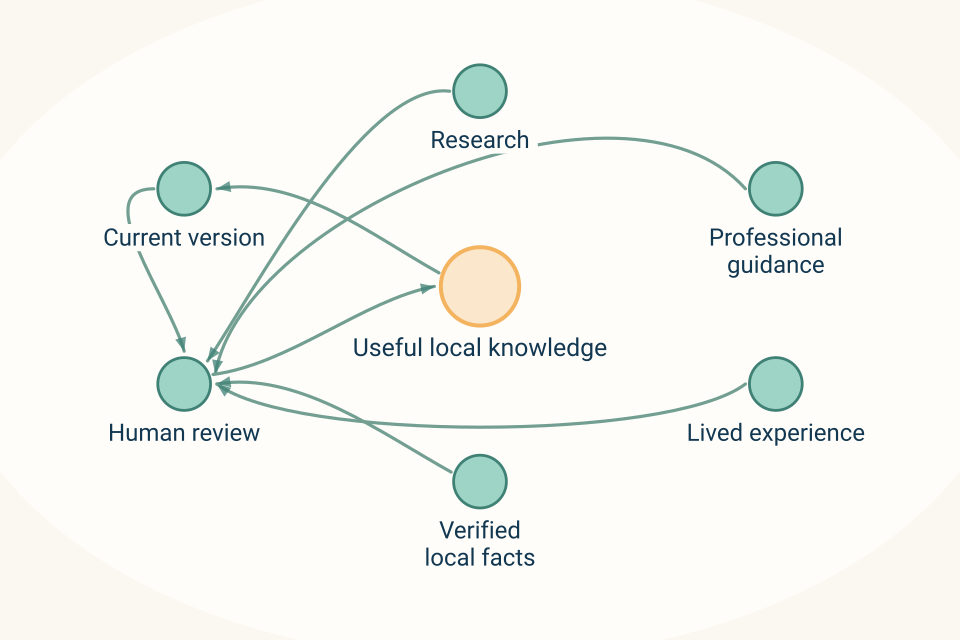
Bring research into human review with its source and limits. Bring the relevant professional guidance into the review. Bring lived experience into the review without treating it as equivalent to research evidence. Verified local facts allow reviewers to check practical fit. Accountable human review prepares knowledge for local use. Maintain a current version of the knowledge in use. Source or version changes return to review, including what depends on them. Shared knowledge does not erase local ownership, contributor credit or professional responsibility.
Knowledge | Its role in the work |
Research and professional guidance | Preserve findings, populations, methods, limits, and source dates. |
Local facts and design choices | Confirm actual services, resources, permissions, and who acts. |
Personal context | Use only what is appropriate and authorized; do not put private encounters into a common library. |
Human review | Resolve conflicts, credit contributors, test the application, and revise. |
In context
In Context — “Could you write down that part?”
The continuing family and team scenes are fictional illustrations. The resources and workflows describe proposed applications, not documented outcomes or universally available software capabilities.
A new team member had watched Lena welcome a family to the Day Center.
Afterward, she asked where to find the introduction Lena had used.
“The guide is in the resource folder,” Lena replied.
“I found that. I meant the part before the guide.”
Lena thought for a moment.
The visitor had asked whether coming to look around meant agreeing to attend. Lena had answered that question before explaining the program. She had asked what the person hoped to see and whether they preferred to begin with a conversation or a short look around.
None of it had required an elaborate speech.
But it had required choices.
“You didn’t start with the schedule,” the colleague said.
“They weren’t asking about the schedule yet.”
“Could you write down how you decide where to start?”
Later, another community organization asked whether Lena’s team had introductory material it could use.
Sending the document would be easy.
Sharing the useful part required more thought.
The other organization had different rooms, different staff, different services, and different arrangements for first visits. Some of Lena’s wording would fit. Some would make promises the other team could not keep.
What needed to travel was more than a script.
It was the reason behind the script—and a way for another team to make it true in its own setting.
A shared framework should not create identical care
The original CarePhysics manuscript describes a framework that brings an organization’s values, expertise, and resources into its engagements and pathways. It also recognizes the contributions of families, patients, caregivers, clinicians, and other professionals to that work.
This chapter makes that relationship practical.
Share useful knowledge without erasing local judgment, ownership, or the community’s voice.
The ten principles provide common questions. They do not supply every local answer.
A health system needs its own clinical guidance and professional responsibilities. A home-care organization needs to explain what its workers provide in someone’s home. A Day Center needs to describe its actual program. A community network needs current information about services people can reach.
Even within one organization, different people may need different explanations, formats, or assistance.
The aim is neither complete uniformity nor constant reinvention.
It is a dependable foundation that people can adapt thoughtfully.
At Genus, the research and working materials behind CarePhysics are used to inform development, content, training, and support. The August 31, 2026 export describes a shared knowledge foundation for development teams, wording decisions, and AI-assisted work. That is an internal working approach—not evidence that every resulting feature or answer improves care.
The same opportunity is available to other organizations: bring your own wisdom into a reviewed collection and use the relevant parts of this book to help examine and apply it.
You do not need to reproduce Genus’s voice or adopt every tool to begin.
Preserve the purpose; adapt the expression
Before sharing a resource, identify what must remain intact and what another organization should reconsider.
For Lena’s welcome, the purpose is to help someone explore the service without feeling that decisions have already been made for them.
The essential commitments include speaking directly to the person, explaining the scope of the visit, presenting actual options, and providing a way to ask questions.
The wording, setting, length, and delivery may change.
One team might begin with a telephone conversation. Another might offer a planned in-person introduction. A person may prefer to read beforehand, bring someone they trust, or ask questions privately.
Those differences need not weaken the approach. They may make it usable.
But changing the expression is different from changing the promise.
An informational visit must not quietly become enrollment. A request must not be presented as a confirmed service. “Someone will respond” needs a person and a realistic response arrangement behind it.
The communication approach used here makes this distinction central: consistency means preserving the underlying meaning, qualifications, and next step across channels—not repeating identical wording.
The unfamiliar-remote analogy applies here too. We want recognizable controls and ways to find help, not identical lives on the other side of the screen.
Keep the way through familiar. Adapt the support people find there.
Make practical wisdom explainable
A useful contribution may begin as something a person does almost without thinking.
Ask them to slow it down.
What did they notice? What question did they ask? Why did they choose that response? When would they do something different? What preparation or assistance made the encounter possible?
For Lena, the knowledge is not simply, “Use a warm greeting.”
It is that the visitor’s first concern may determine where the explanation should begin. A question about commitment deserves an answer before an account of activities. Someone asking about access needs practical information before being invited to imagine a pleasant day.
Capture exceptions too.
The approach may need to change when someone has an urgent concern, requires interpretation, wants privacy, or needs a clinical explanation outside the staff member’s role.
Invite contributions from everyone who experiences the service. Patients, participants, caregivers, volunteers, and frontline staff may identify different parts of the same problem.
Their experience gives us information to investigate. It does not automatically establish a general rule.
In context
In Context — The family identifies what mattered
Lena asked Pat and Ellen what they remembered about their introductory visit.
“Knowing I could look first,” Pat said.
“Look at the rooms?”
“Look at the whole arrangement. Without everyone deciding I’d joined.”
Ellen remembered another part.
“You told us what you could answer and what still needed checking.”
Lena asked whether those ideas could help the team prepare its introduction for other families.
“Share the part about being asked,” Pat said.
“Not your private information,” Lena replied.
“Good. The book group has enough material.”
Their feedback could inform a general design lesson without turning their family history into a training case.
Lena’s team would record the contribution and the permission attached to it. If another organization used the resulting resource, it should know that participants and families helped shape the approach—not assume the insight came from the software.
Build a small collection around real questions
A knowledge bank does not need to begin with hundreds of documents.
Begin with a question the team encounters often:
How do we help someone understand what an introductory visit does—and does not—mean?
Gather only what helps answer it.
That may include a relevant CarePhysics section, approved communication guidance, the organization’s actual first-visit arrangements, a reviewed explanation from staff, and a fictional demonstration.
Keep those materials distinguishable.
Research addresses what has been studied. Design guidance proposes how to structure an experience. Local facts establish what the organization provides. An example shows what a conversation might look like.
Private personal context belongs under separate permissions, not inside the shared resource collection.
Organize knowledge-bank entries around human needs and design decisions, with sources, limitations, local facts, owners, review dates, and a way to test usefulness.
A proposed entry could look like this:
Knowledge-entry field | Example: Welcoming someone without deciding for them |
|---|---|
Question and purpose | Help a person understand the introductory options and choose whether to explore further. |
Relevant foundations | Holistic Care, Awareness, Behavioral Influence, Communications, and Community; the applicable sources remain attached. |
Practice insight | Answer the concern the person brings before presenting the whole program. Identify this as a proposed practice to test, not a guaranteed result. |
Verified local facts | Available introductory arrangements, eligibility process, costs, accessibility, contacts, and who can confirm a next step. |
Demonstration | A clearly labeled fictional conversation showing an invitation, a question, a choice, and one exception. |
What may change | Language, examples, format, pace, location, timing, and appropriate assistance. |
What must remain | Accurate service information, meaningful choice, privacy, professional boundaries, and responsibility for follow-up. |
Ownership and reuse | Named author or contributors, local reviewer, version, review date, permitted audiences and uses, and correction route. |
How to test it | Can intended users explain what the visit involves and whom to ask? What effort, confusion, or pressure does the resource create? |
This entry is not a new clinical instrument or another intake form. It is a working aid for the people designing and delivering support.
The collection should include a source’s important qualifications near the usable guidance. A confident summary separated from its limitations is easy to reuse incorrectly.
It should also distinguish “not reviewed” from “reviewed and not suitable.” Those are different reasons not to use an item.
Let culture and community shape the application
Local wisdom includes language, relationships, customs, beliefs, service history, and what people consider respectful. It also includes transport routes, working hours, costs, and the practical conditions of an ordinary day.
These are things to learn—not labels to assign.
AHRQ’s cultural-humility guidance recommends recognizing each person’s expertise about themselves, examining organizational assumptions, and asking rather than inferring preferences from identity or appearance.13
A person may want family members involved from the beginning. Another may want a private introduction. Someone may welcome faith-related support; someone else may prefer a secular setting or not want that subject introduced at all.
Record relevant preferences in the person’s terms and with appropriate permission. Do not create an automatic script for everyone assigned to the same cultural group.
Language needs its own planning. Ask about preferences for conversation and written material, arrange appropriate assistance, and use reviewed translations. Consequential care conversations require qualified language support rather than assuming a generated translation or an available relative is sufficient.14
The organization’s resources also change the design.
Consider three illustrative adaptations of the same introductory approach.
A health system may use it to explain a community referral after a clinical visit. Its version must distinguish the clinical recommendation from the receiving organization’s acceptance and service assessment.
A home-care organization may use it to prepare for a first visit at home. Its version needs to explain who will arrive, what the worker can help with, privacy expectations, and what happens if the arrangement changes.
A Day Center may use it to introduce the environment and program. Its version needs current information about activities, support, attendance requirements, and arrival arrangements.
All three can preserve the same purpose: informed exploration with a dependable route to questions.
None can simply change the logo on the other’s document.
Know who can settle a conflict
A shared collection will eventually contain information that does not agree.
An older welcome page may describe drop-in visits. A current service procedure may require appointments. A staff member may recall an exception. An AI draft may combine all three into a promise that sounds generous and is not reliable.
Define who can resolve the question.
For clinical instructions, the appropriate clinical authority reviews the conflict. For service facts, the responsible program owner confirms the arrangement. For information-sharing questions, the designated privacy or governance lead determines the authorized route. A design preference cannot overrule those responsibilities.
Do not tell an assistant simply to use the newest document. A recent informal message may not supersede an approved instruction.
In context
In Context — A sentence that went too far
The team’s draft invitation included:
“Come by whenever it suits you, and we will show you around.”
Lena stopped at that sentence.
“We need to arrange the visit. Otherwise we may not have someone available to welcome them properly.”
The colleague preparing the guide changed it.
“Contact the team to arrange an introductory visit. We will explain the available times and any assistance we need to prepare.”
The wording was less effortless.
It was also something the team could stand behind.
That correction belongs in the knowledge entry, along with the reason. It can help the next reviewer recognize the same problem before publication.
Where authority remains unresolved, hold the affected content and use the approved human route. Do not smooth over the conflict to keep the resource moving.
Use AI to prepare the work around judgment
A reviewed collection gives an assistant a better starting point. It does not make review unnecessary.
For the welcome resource, the team could ask:
Using the approved sources and current local arrangements, prepare an introductory article, a short demonstration outline, and an optional question set. Preserve the distinction between asking for information, visiting, assessment, and enrollment. Identify the source for factual statements, mark missing information, and show which parts another organization would need to replace or verify.
The proposed workflow is:
Define the need → retrieve relevant approved material → add verified local context → prepare options → review → try with intended users → revise.
Use the reviewed knowledge to prepare a response, not to decide in advance what the person must want.
Keep a reusable entry complete enough to stand on its own: the source and date, the task it can inform, the difference between evidence and proposal, the local facts still needed, the permitted audience, the reviewer, and essential reasons to stop or escalate. A shortened excerpt should not become an instruction after its limits and responsibilities have been left behind.
Creative expression can be adapted within those boundaries. The practical menu in Chapter 6 helps a local team choose a demonstration, photograph, story, question, or other form that fits its audience without inventing personal history or a therapeutic promise.
The assistant can reduce repetitive assembly. It can help a team find relevant guidance, prepare alternative explanations, identify inconsistent terminology, and organize a review.
It can also help preserve the connection between a piece of content and the reason it was designed that way.
But an assistant may retrieve the wrong passage, omit a qualification, or generate a statement the sources do not support. WHO’s guidance identifies inaccurate or biased outputs and overreliance as risks, while supporting well-defined tasks and involvement of the people affected.1
Review should therefore check both what appears and what is missing.
The person responsible for the program verifies the service facts. An appropriate professional reviews clinical material. A content reviewer checks clarity and accessibility. Intended users help determine whether the result makes sense in practice.
The assistant prepares. Those responsibilities remain with people.
Distinguish a collection, retrieval, and training
A source-linked collection and an AI system that reliably retrieves from it are separate things.
Putting files in a folder does not establish that an assistant can find the appropriate passage, distinguish versions, or respect the permissions attached to them. Uploading this book does not train the underlying model or guarantee that it will apply the framework correctly.
A reviewed knowledge collection, a working retrieval system, and evidence of better care are three different things. Each needs its own verification.
Test the actual configuration.
Can it identify the current local source? Does it expose uncertainty? Does it keep fiction separate from facts? Does it refuse to invent a response time when none has been approved?
Permissions must be enforced before restricted information is made available for a task. A sentence instructing an assistant not to disclose something is not a substitute for appropriate access controls.
An organization can begin with ordinary approved documents and human review. More elaborate retrieval or publishing functions can be added when their value and requirements are understood.
The knowledge-bank companion described in this book remains proposed. It should help organizations structure the work—not be presented as a completed service they already have.
Make one source set useful in several ways
Once approved, the welcome entry can inform a collection of materials without requiring every person to use all of them.
The article can explain the purpose and practical arrangements:
Your introduction, at your pace
An introductory conversation can help you decide whether our service is worth exploring further.
Begin with what matters to you. You may want to understand the activities, assistance, costs, or what a first visit involves.
For example: “I would like to see the setting before deciding whether to attend. What introductory options do you offer?”
Our team will explain the options currently available and what needs to be arranged or assessed. Asking for information is not an agreement to enroll.
Use the contact information provided with this guide to ask a question or request another format. We will explain who responds and what happens next.
Before use, the organization inserts its verified contact and response arrangements.
The video demonstrates rather than reads the article aloud. A staff member addresses the visitor directly, answers a concern, and explains a real option. Include an exception: the requested visit time is unavailable, so the team discusses another arrangement without pretending the service can accommodate everything.
Use consented footage or clearly labeled demonstration scenes.
The survey asks what remains unclear and which support would help. Explain who receives the answer, offer a human route, and allow the person to skip it. It is an improvement question, not an enrollment test.
The message offers only the relevant piece: “Here is the information you asked about before your call.” It does not automatically enroll someone in a stream of unrelated content.
The pathway connects those elements with an actual contact, call, meeting, or visit. It identifies who responds when a question arrives. A tile can bring related material together; the pathway makes the next responsibility visible.
The pattern remains familiar: why it matters, the main idea, demonstration, chosen next step, questions or connection, and what follows. Urgent instructions lead with the urgent action. Validated questionnaires retain their required wording and scoring. Recreation may end with enjoyment rather than another task.
The benefit of reuse is not producing more material.
It is avoiding the need to rediscover the same reasoning each time while leaving room for the current person and situation.
Credit the contribution without taking the story
A reusable lesson does not need the full encounter that produced it.
Pat’s request to be asked before decisions are made can inform a welcome guide. The guide does not need his diagnosis, home circumstances, or private family concerns.
A volunteer’s demonstration can become a training example with their agreement. That does not authorize recording every future interaction.
A staff member can contribute an explanation without accepting responsibility for maintaining every version indefinitely.
Specify the permitted use. Does the contributor agree to internal training, public education, adaptation by other organizations, or a named quotation? Who reviews an edited version? How should credit appear?
Permission to use a service is not permission to use a person’s story. Nor is attribution a substitute for permission to reproduce material.
Where a generic example can serve the purpose, use one and identify it as fictional. Do not present a generated scene as a testimonial or a reconstructed memory.
The export’s proposed knowledge commons includes an important boundary: contributed guidance may shape wording and emphasis, but it must not add facts about a person. It also preserves the center’s option to decline contributed material.
That applies to funders and technology suppliers as well as care professionals.
A contribution should earn its place through relevance and review, not through the contributor’s influence over funding or purchasing.
Updating a source means updating what depends on it
Approval is not permanent.
A contact leaves. A service changes. New evidence qualifies an earlier claim. A participant points out that a phrase has an unintended meaning.
Give each entry a review owner, a backup, a review date, and reasons for earlier review. The appropriate interval depends on what is likely to change and the consequence of being wrong.
Maintain a simple record of where the entry is used: articles, videos, tiles, training, scripts, pathways, and approved assistant resources.
When a material fact changes, identify the affected versions. Withdraw outdated guidance from active use, replace or clearly mark it, and contact the people who need to act differently. Printed copies and exported documents need attention too; updating a central file does not recall them.
Preserve the historical version for appropriate records without allowing it to appear current.
After updating an AI source set, test whether the configured assistant still retrieves or repeats the withdrawn instruction. Do not assume that editing the original document immediately changes every cached answer or previously prepared draft.
These are proposed maintenance requirements—not features to assume a platform already provides.
Local editing and cross-organization reuse depend on the actual authoring tools, permissions, and release process. Verify which changes a partner can make directly and which require technical work. Appendix J preserves the dated implementation limits; they should not be inferred from a proposed knowledge-bank design.
This chapter describes the stewardship an organization needs. The available tools must be checked against it.
Keep the benefits of assistance connected to people
With reliable knowledge, clear guidelines, practical rules, and accountable review, AI can be a gift to this work.
It can help turn a useful staff explanation into a draft resource, prepare local alternatives, and identify what needs checking. It can help a family revisit approved routine information or prepare a question at a time that suits them.
That assistance should give people more room for human attention—not create an expectation that every available minute produces more content.
Around-the-clock information is not around-the-clock professional care. State actual response hours, provide the appropriate urgent route, and make reaching a person straightforward.
Optional live assistance and post-encounter feedback, described in Chapter 10, can also contribute to learning. A useful idea may come from the clinician, patient, participant, caregiver, volunteer, or staff member.
Before reusing it, separate the lesson from the private encounter, confirm permission, and have the appropriate person review it. The assistant is not an inherently neutral judge of which account should prevail.
Feedback may improve a source, a template, a prompt, a service arrangement, or the decision not to offer something. Those changes should be recorded explicitly. “The system learns” should describe a real process, not a hope that every correction automatically changes future behavior.
Maintain a record of the finding, the decision, the actual change, and remeasurement. Assign ownership even when this record must be kept outside the software. Appendix J distinguishes the proposed learning process from the functions described in the dated export.
Create an Organization Knowledge and Configuration Brief
This chapter’s practical output brings the decisions together.
It should be short enough for the people maintaining the collection to use, but specific enough that another reviewer can identify what is authorized.
Area | What the brief establishes |
|---|---|
Purpose and audience | The human need, intended users, local setting, and what the collection is meant to help people understand or do |
Shared commitments | Evidence, dignity, choice, accessibility, familiar structure, privacy, and accountable follow-through |
Approved knowledge | Sources, evidence types and limits, local facts, professional guidance, approved examples, and material excluded from the collection |
Local configuration | Services, contacts, languages, formats, timing, access assistance, capacity, and partner responsibilities |
Authority | Who approves each kind of content, resolves conflicts, and covers an absent owner |
Reuse and privacy | Contributor permissions, credit, permitted audiences, restrictions, and separation of personal records |
AI role | Permitted tasks and sources, required review, human response routes, and actions the assistant cannot take |
Maintenance | Versions, review dates, change triggers, dependent resources, withdrawal, correction, and notification |
Evaluation | Baseline, intended benefit, burden and safety checks, denominator, review period, and authority to revise or stop |
The brief is a proposed planning tool, not certification that the knowledge or technology is reliable.
It should also make the arrangement sustainable when the person who started it is absent.
A collection that only Lena knows how to maintain has preserved documents without fully sharing the knowledge.
Resource the work behind the collection
Someone must select sources, check permissions, verify local facts, review drafts, prepare accessible formats, test materials, and maintain updates.
Budget for that work.
Provide staff with time to contribute and review—not an expectation to write resources at home. Involve intended users in ways that respect their time and circumstances. Keep practice and contribution separate from hidden performance scoring.
A trusted colleague can help explain a new approach, but no organization should depend entirely on one champion. A Cochrane review found that local opinion-leader interventions probably improved professional adherence to evidence-based practice, while effects on patient outcomes remained uncertain. The evidence supports examining how knowledge is introduced, not assuming that an enthusiastic advocate guarantees results.93
At community or state level, shared resources can reduce the need for every team to begin alone. Local organizations still need authority to assess fit, identify gaps, and decline unsuitable material.
A shared library cannot create an interpreter, an available appointment, transport, or staffing. When the proposed experience depends on a resource that is missing, record that requirement rather than editing it out of the explanation.
Genus supplies technology. Partners retain their care, staffing, programs, relationships, and voice. The legal ownership or governance of a broader shared collection requires its own documented arrangements; it should not be inferred from a product description.
How would we know it helped?
Choose one recurring task, such as preparing a first-visit explanation.
Record the existing process, then test a reviewed source-linked resource over a defined period. A four-week local test is an illustrative starting point, not a study design sufficient to establish long-term benefit.
Measure more than how quickly the first draft appears.
Can reviewers trace factual statements to the appropriate source? Are local arrangements accurate? Does the explanation preserve choice? Can the intended reader identify the next step and the person who responds?
Count all preparation and maintenance work: searching, drafting, checking, correction, translation review, publication, and responding to feedback.
For a defined sample, report how many items were reviewed and how many contained unsupported or outdated information. Keep significant errors visible rather than averaging them into a favorable overall score.
Test a change as well. Can the team find and replace the materials affected by a deliberately changed fictional test fact, without introducing errors into live care information?
Ask about access and burden. Who could not use the format? Who preferred a conversation? Did the revised guide reduce confusion or simply move the explanation work to the family?
Separate reach, understanding, first action, adoption, useful participation, outcomes, and attributable impact. Willingness to recommend, actual referrals, and services received by referred people remain different questions.
AHRQ’s materials guidance supports evaluating understandability and actionability with intended users rather than relying on appearance or readability alone.26
Record what changed because of the findings, including a decision to remove material or stop an unhelpful workflow.
A large library is not the outcome.
A better starting point—accurate, usable, maintained, and worth the effort—is.
Models and Evidence Behind This Chapter
The research and guidance below help examine the proposed knowledge-bank and local-adaptation approach. They address evidence-informed judgment, adaptation, professional learning, and responsible assistance—not the effectiveness of the complete design.
Evidence-based practice
Neither research nor experience should stand alone
Sackett’s 1997 discussion describes evidence-based medicine as combining research evidence with clinical expertise and attention to the individual patient’s circumstances, rights, and preferences. It is a conceptual account of practice, not a trial of a knowledge bank.92
Where we used it: Research, local professional judgment, and the person’s priorities inform different parts of a decision.
Evidence boundary: This chapter extends that discipline to organizational content and support design. It does not turn a local preference into clinical evidence.
Local question: Are we using both relevant evidence and the knowledge needed to apply it appropriately?
Local opinion leaders
Knowledge often needs a credible human route
Flodgren and colleagues’ 2019 Cochrane review included 24 randomized studies of local opinion-leader interventions. Eighteen studies contributed to the main estimate: a median adjusted absolute improvement of 10.8 percentage points in professional adherence to evidence-based practice, with moderate-certainty evidence.
All studies were conducted in high-income countries, and the targeted professionals were usually physicians. Evidence about patient outcomes was very low certainty; costs were not reported.93
Where we used it: Staff explain, demonstrate, discuss, and help adapt knowledge rather than merely receive a folder.
Evidence boundary: The review did not test this welcome guide, a Day Center knowledge bank, or AI-generated content.
Local question: Who helps people understand and use the resource, and what changes beyond distribution?
FRAME: documenting adaptations
Make local changes inspectable
Shannon Wiltsey Stirman, Ana Baumann, and Christopher Miller’s 2019 paper developed the expanded Framework for Reporting Adaptations and Modifications, known as FRAME. Its development drew on literature, qualitative interviews, and stakeholder refinement.
It asks what changed, when, by whom, why, and whether the change preserves the intervention’s essential elements.94
Where we used it: The proposed record distinguishes a change in wording or delivery from a change in service content or responsibility.
Evidence boundary: FRAME is a reporting and research framework—not proof that adaptation improves outcomes. The chapter’s knowledge-entry tool is not a validated substitute for it.
Local question: Can another team understand exactly what we changed and why?
Cultural humility and understandable materials
Adapt with the audience, not merely for it
AHRQ recommends learning from people about their preferences and circumstances, providing appropriate language support, and assessing whether materials are understandable and actionable. These are practice resources, not trials of the proposed collection.13
Where we used them: Language, examples, format, involvement, and assistance are discussed with intended users while facts and responsibilities remain clear.
Local question: Does the adaptation reflect what people told us, or what we assumed about them?
Social Physics, autonomy, and responsible AI
Help knowledge travel without taking over the decision
The research review informing this book uses Social Physics to examine discovery and social learning, while warning that people can share mistakes as well as useful ideas. It grades the broader perspective Emerging-to-moderate. Self-Determination Theory adds attention to chosen participation, with Moderate intervention evidence in the review.
WHO’s AI guidance supports defined tasks, stakeholder involvement, privacy, and human responsibility while warning about inaccurate outputs and inappropriate delegation. It is governance guidance, not evidence that this assistant improves care.1
Where we used them: Contributors retain a voice, organizations can decline material, and AI helps prepare reviewed options rather than deciding what everyone should adopt.
Local question: Does sharing increase people’s ability to understand and choose—or simply spread the same answer farther?
One thing to try
Choose one explanation, demonstration, or practical approach your team finds useful.
Ask its contributors what makes it work, when it does not fit, and what another team would need to know. Obtain permission for the intended reuse.
Create one knowledge entry with its sources, local facts, limits, owner, and review date.
Then ask a colleague unfamiliar with the approach to use the entry to prepare a small draft. Review what they misunderstood and what the entry failed to explain.
Your team’s question is:
Could someone use this knowledge well without needing the original contributor to explain everything again?
Sharing the resource begins another question
In context
In Context — “The question can travel”
When the other organization received Lena’s material, it received more than the invitation.
The packet explained its purpose, the sources used, the choices that should remain with the visitor, and the local facts that needed replacing. It included the review history and a contact for questions about the approach.
The receiving team had a different first-visit arrangement. It would begin by telephone and offer an in-person introduction when the appropriate staff were available.
Lena reviewed their questions.
“The wording will be different,” her colleague said.
“It should be,” Lena replied. “Their service is different.”
Later, she told Pat and Ellen that the general lesson was being considered elsewhere.
“What lesson?” Pat asked.
“Ask what someone wants to understand before deciding where the introduction begins.”
“That seems worth taking along.”
“They will need to try it with their own participants,” Lena said.
“Of course,” Pat replied. “We haven’t met them.”
The resource had traveled. The judgment had not been outsourced.
Now a new question remained: what would the next organization discover when it used the adapted approach?
Jordan’s forthcoming shared-learning conversation would need those answers—including what did not work, what required more support, and whose experience had not yet been heard.
A resource shared is a beginning.
Learning across communities requires knowing what happened after it arrived.
Notes
World Health Organization (2024). WHO releases AI ethics and governance guidance for large multi-modal models. January 18. Source (opens a new tab)
Agency for Healthcare Research and Quality (2024). Consider Culture, Customs, and Beliefs: Tool 10. Health Literacy Universal Precautions Toolkit, 3rd edition. Source (opens a new tab)
Agency for Healthcare Research and Quality (2024). Address Language Differences: Tool 9. Health Literacy Universal Precautions Toolkit, 3rd edition. Source (opens a new tab)
Agency for Healthcare Research and Quality (2024). Assess, Select, and Create Easy-to-Understand Materials: Tool 11. Health Literacy Universal Precautions Toolkit, 3rd edition. Source (opens a new tab)
Sackett DL (1997). Evidence-based medicine. Seminars in Perinatology. 21(1):3–5. DOI: 10.1016/S0146-0005(97)80013-4. Source (opens a new tab)
Flodgren G, O’Brien MA, Parmelli E, Grimshaw JM (2019). Local opinion leaders: effects on professional practice and healthcare outcomes. Cochrane Database of Systematic Reviews. CD000125. DOI: 10.1002/14651858.CD000125.pub5. Source (opens a new tab)
Wiltsey Stirman S, Baumann AA, Miller CJ (2019). The FRAME: an expanded framework for reporting adaptations and modifications to evidence-based interventions. Implementation Science. 14:58. DOI: 10.1186/s13012-019-0898-y. Source (opens a new tab)