Chapter 14
From Local Experience to Shared Learning
At a Glance
The central idea: The most valuable findings often reveal not who failed, but where the system makes useful care unnecessarily difficult.
What you’ll explore: How families, frontline teams, organizations, and communities can learn from one another without treating every difference as a ranking. Join Jordan as participating organizations examine transportation problems, unanswered requests, and the experience of using shared resources. Learn to distinguish an encouraging example from a finding another community can responsibly apply.
Design and AI: Use common definitions, clear explanations, and appropriate information sharing to make findings understandable. Explore how an approved AI assistant could organize feedback, identify questions, retrieve relevant knowledge, and prepare locally adapted options while preserving privacy, uncertainty, and contributor credit.
Put it to work: Create a Shared Learning Brief that records what was offered, who could use it, what happened, what it required, and what should be tried next.
Evidence and evaluation: Examine collaborative improvement, structured comparisons, social learning, and responsible reporting. Measure whether learning changes support—not merely whether organizations exchange reports.
“Everyone in healthcare really has two jobs when they come to work every day: to do their work and to improve it.”
— Paul B. Batalden, MD, and Frank Davidoff, MD, “What is ‘quality improvement’ and how can it transform healthcare?”, 2007.95
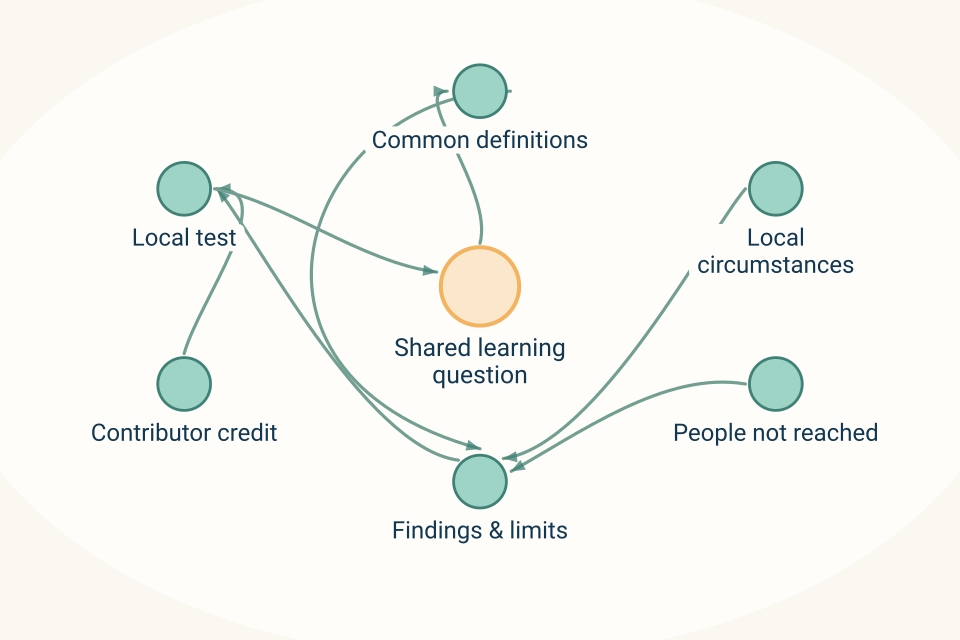
Agree common definitions around the shared learning question. Common definitions help establish whether findings can reasonably be compared. Local circumstances qualify the meaning of findings. The experience of people not reached belongs beside the findings. Findings and their limits inform a proposed local test. Carry contributor credit with the idea being tested. Return learning from the local test to the shared question. An encouraging example does not establish that the same result will transfer to another setting.
From one setting | To another |
A local experience | Record the people, need, setting, actual change, result, effort, and uncertainty. |
A reviewed lesson | Share permitted knowledge with its sources, limits, and contributor credit. |
A new application | Check local fit, resources, and responsibilities; test rather than assume the same result. |
In context
In Context — “What did the next organization learn?”
The continuing family and regional-learning scenes are fictional illustrations. They are not reports of measured results from actual organizations or a deployed regional platform.
Lena’s welcome resource had reached another organization.
That was worth noticing. It was not yet an answer to whether the resource helped.
Before the next shared-learning conversation, Lena asked Pat and Ellen whether the general lessons they had agreed to contribute still represented what they wanted understood.
“Ask people what they want to know,” Pat said.
“And tell them what still needs checking,” Ellen added.
Their private care information would not accompany the lesson.
Jordan, who helped participating organizations learn together, was preparing a meeting about access to community support. The group had agreed to review appropriately prepared service summaries and general lessons—not open individual family records.
Lena brought two subjects: the welcome approach and what the team had changed after a confirmed ride did not arrive.
Another organization brought a different concern. Families were receiving information, but staff did not know whether the requests for a conversation were reaching the right person.
On the first page of the meeting materials, several reports used the phrase referral completed.
“What does that mean in each report?” Jordan asked.
“For us, it means we spoke with the family,” one representative said.
“We use it when the person attends,” another replied.
Lena looked at the page.
“Those are both worth knowing. They aren’t the same thing.”
Jordan set the comparison aside.
“Then our first job is to understand the accounts we’re comparing.”
The group had not discovered which organization was doing best.
It had discovered why it could not yet answer that question.
Sharing is the beginning of learning
Chapter 10 examined how to learn from an encounter and improve a local process. Chapter 13 showed how to preserve useful knowledge so another team can understand and adapt it.
This chapter asks what happens after that knowledge travels.
Was the resource used? What did the receiving organization change? Did the intended people find it useful? What support was needed? What happened differently?
The most valuable findings often reveal not who failed, but where the system makes useful care unnecessarily difficult.
Shared learning connects community, feedback, and continued refinement across organizations while keeping recorded activity distinct from demonstrated benefit.
A shared-learning group is not simply a larger dashboard.
It is an arrangement through which people can bring questions, compare appropriately, discuss possible explanations, try changes, and return with what happened.
The learning can move in both directions. A regional group may help a local team find a useful approach. A participant’s observation may reveal a problem that several organizations have overlooked.
Purpose gives this work a boundary. We are not collecting information because it might someday be interesting. We are trying to make a particular part of care more useful, reachable, or dependable.
For Ellen, that may mean fewer calls to establish whether a service is arranged. For Pat, it may mean reaching the people and activities he wants to see.
Those purposes should remain recognizable even when the discussion moves to a regional meeting.
Choose the shared question before collecting the reports
Begin with a need that participating organizations recognize.
“Improve engagement” is too broad to guide the first comparison.
“Help people who request an introductory conversation receive a useful response” identifies something the group can examine.
So does:
“Help people with confirmed transportation reach the service they have chosen, and receive a timely human response when the trip is interrupted.”
These are related questions, but they require different information and possibly different solutions.
Ask the people experiencing the problem to help define it. Include those receiving care, caregivers, staff, volunteers, and partners responsible for relevant services. They may not describe the difficulty in the same terms.
A navigator may see an uncompleted referral. A caregiver may describe a week of unanswered calls. A provider may describe requests it lacks capacity to accept.
Each account helps establish what must be investigated.
COM-B provides a useful discipline here: before choosing a response, consider whether the barrier concerns understanding, skills, opportunity, motivation, or a combination. The research review informing this book specifically cautions against sending more reminders when the actual problem is cost, transport, exhaustion, or unavailable support.
The shared question should also identify who can act on the answer.
If a group can revise an article but has no authority over transport, it can improve the explanation and document the remaining gap. It should not present the clearer article as a solution to the missing ride.
Make the measures mean the same thing
Before comparing percentages, agree what is being counted.
A person, household, referral, journey, visit, and service day are different units. A return trip may involve two journeys but support one attended day. Several contacts may concern one unresolved request.
For each shared measure, write down its definition, starting event, ending event, time window, data source, and what happens when information is missing.
The dated Day Center materials call for shared definitions of instruments, denominators, and time windows before centers compare findings. They describe this as a document the field can use—not a feature that must wait for new software.
A small definition set might distinguish:
Shared term | What must be established |
|---|---|
Request received | The service received a specific request, with an actual receipt date. |
Human contact completed | An appropriate person and the intended recipient had the agreed conversation—not merely that a message was sent. |
Service accepted | The responsible provider accepted a defined action, subject to any conditions still identified. |
Service received | The agreed support actually occurred. A booking alone is insufficient. |
Need still unresolved | Appropriate support has not been secured, even if one provider answered or declined. |
Usefulness reported | The identified respondent described the experience, using the stated question and time period. |
These are proposed working definitions. Partners should refine them for the task without changing their meaning silently between reports.
Do not manufacture a missing starting date. Intake, referral, acceptance, and attendance are different events. A regional report cannot rename one as another to make a measure appear complete. Check the field definitions and coverage before comparing services.
When definitions differ, retain the separate results until they can be compared appropriately.
A blank comparison is more honest than a precise comparison of different things.
Put the circumstances beside the result
Even shared definitions do not make different organizations interchangeable.
One center may serve people over a large geographic area. Another may have transport nearby but insufficient program capacity. One team may have interpretation available during introductions; another may need to arrange it. The support needs of the people referred may also differ.
Ask what was available, what was offered, and what was actually delivered.
Record the relevant pathway and content versions. A comparison becomes difficult to interpret if one team used a new welcome guide, another changed its staffing, and a third changed its eligibility process during the same period.
SQUIRE 2.0, a reporting framework for healthcare improvement, emphasizes the importance of explaining the local setting, the reasons for a proposed change, and how the change was studied. These are supplementary reporting principles—not evidence that the proposed CarePhysics network improves care.96
In context
In Context — Similar numbers, different problems
Jordan asked the group what might explain differences in access besides the quality of a welcome message.
“Distance,” a transport representative said.
“Whether there is a place available after the conversation,” another participant added.
“Whether we recorded everyone who asked,” Lena said. “Not only those who completed intake.”
They examined the service conditions beside the reports.
One organization wanted to test an earlier telephone introduction. Another already called promptly but could not offer enough suitable places. A third needed to establish whether requests made outside office hours reached the following day’s responder.
The group did not choose one message and send it everywhere.
It identified different next actions.
That is the practical value of comparison: not deciding who deserves praise before understanding the work, but finding a question worth investigating.
Differences can reveal an approach worth learning from. They can also reveal unequal resources, incomplete records, or a mismatch between the service and the people seeking it.
Do not use context to excuse every failure. Use it to identify which change could plausibly help.
Learn from the people who never reached the service
A service can look successful when the report includes only people able to use it.
Ask what happened to those who requested information but did not reach a conversation, were found ineligible, could not afford the service, could not travel, withdrew, or chose something else.
Keep unknown separate from declined.
A person who understands an option and decides against it has made a decision. A person who wants the service but cannot obtain it faces an unmet need. The research review informing this book preserves that distinction and warns against equating continuing digital activity with benefit.
Offer appropriate ways to hear from people without repeatedly pursuing those who do not want contact. Ask permission for follow-up and respect the route they prefer.
Language, culture, beliefs, family arrangements, disability, work schedules, and resources may shape the experience. Ask how; do not infer the answer from a name, neighborhood, or group label.
When comparing reported experiences, keep the respondent clear. Pat’s account, Ellen’s account, and staff observations are not interchangeable. Standardized instruments require suitable versions, consistent administration, and appropriate interpretation. An improvised translation or AI rewrite is not automatically equivalent.
Collect only the additional information justified by the evaluation and its permissions. Missing demographic information cannot be inferred from names, appearance, address, or unrelated records. State which comparisons the available record cannot support.
A shared-learning group should ask who is missing from the discussion as well as who is missing from the data.
Make room for solutions from every direction
The strongest proposal may come from someone without a management title.
A patient may identify a confusing preparation step. A participant may explain why the timing of a choice matters. A caregiver may recognize that several organizations are all asking the same question. A volunteer may find a more comfortable way to demonstrate a tool. Staff may know which task repeatedly extends beyond the shift.
Provide routes for those contributions before, during, and after a shared-learning meeting.
An optional conversation, short written response, accessible survey, or agreed voice note can serve different people. Explain who receives it, what it may influence, and whether the contributor wants a reply or acknowledgment.
Do not require people to attend a long regional meeting to have a useful idea considered. Where participation requires time, travel, interpretation, or substitute support, plan and resource those needs.
With agreement, limited real-time AI assistance could help a facilitator retain an unanswered question or retrieve an approved resource. Immediate post-meeting feedback could help participants describe what helped and what remained unresolved.
Neither process should become hidden evaluation of staff or a mechanism for deciding which person is right. An organization-operated assistant is not an independent referee.
Credit contributions with permission. A general lesson can travel without the private encounter that produced it.
Pat’s contribution in an earlier chapter was that he wanted to know when he could stop waiting. The regional group can examine the design question—how people receive a dependable update during a disruption—without receiving Pat’s household records.
A contribution deserves attention because it may improve care, not because the contributor agrees to become a public story.
Protect the people while sharing the lesson
Shared learning does not require universal access to individual records.
For many questions, organizations can begin with agreed definitions, locally checked totals, descriptions of their process, and carefully prepared general lessons.
More detailed analysis may require controlled access to additional information. Establish the purpose, authorization, access, retention, review, and permitted reporting before moving it.
Information prepared for direct care is not automatically appropriate for regional analysis, publication, supplier development, or model training.
Removing names is not a complete privacy method. NIST’s de-identification guidance emphasizes evaluating disclosure risks and choosing an appropriate data-sharing model; tools that merely mask personal information may not provide sufficient protection.97
For this proposed collaboration, the privacy reviewer should examine whether combinations of details, small groups, or repeated reports could reveal a person. The appropriate response may be to withhold a breakdown, use a broader description, or keep the analysis in a restricted setting.
Do not invent a universal “safe” group size. The context and information matter.
A public report needs a different level of detail from a restricted working discussion. Exact quotations, unusual circumstances, and recognizable stories require particular care.
Privacy should not become an excuse to ignore inequity. It is a reason to design a responsible way to investigate it, with appropriate expertise and involvement from the people affected.
Give AI the preparation work—not authority over the conclusion
Jordan’s group may have several kinds of material to consider: approved local briefs, data definitions, general feedback, current resource information, and relevant research.
An approved assistant could help organize those materials before the meeting.
It might identify that two reports use different starting dates, that a claim of reduced workload lacks time data, or that a proposed solution depends on a service unavailable in one community. It could retrieve relevant CarePhysics guidance and prepare questions for human review.
A useful assignment would be:
Using the approved local briefs, definitions, and research, prepare a comparison of what was offered and what happened. Preserve differences in populations, resources, timing, and measurement. Show missing information and alternative explanations. Identify suggestions contributed by people receiving or providing care. Propose questions and possible adaptations—not rankings or causal conclusions.
Each organization checks the facts attributed to it. A qualified analyst checks calculations and comparisons. The relevant service leaders assess feasibility. The privacy reviewer checks what may be shared. Jordan facilitates the discussion but does not inherit every professional responsibility.
In context
In Context — The draft makes the uncertainty visible
The assistant’s first comparison used the heading:
“Successful referral approaches.”
Jordan changed it to:
“Approaches being examined.”
One organization had reported completed conversations. Another had reported attended visits. Neither comparison yet established which approach produced better access.
Lena asked the assistant to show the source behind a claim that the revised introduction reduced staff work.
There was no time measure in the approved brief. Staff had described the guide as useful, but the total preparation and review effort had not been measured.
They kept the reported usefulness.
They removed the time-saving claim.
The corrected draft gave the meeting a better starting point because it did not pretend to know the answer.
AI can also help after review: draft a revised article, prepare a demonstration outline, or organize a local test. It can capture a useful explanation and reduce repeated assembly.
With reliable knowledge, clear guidelines, practical rules, and accountable people, that assistance can be a gift. It leaves more of the meeting for interpretation, ideas, and decisions.
The workflow remains retrieve → add verified local context → prepare options → human review → test → revise. Keep research, design guidance, local facts, fiction, and permissioned personal information distinct. Uploading the book is not model training, and a corrected draft does not automatically change future system behavior.
An assistant may make approved routine explanations available outside office hours. It should state when human help is available and provide the appropriate urgent route. A shared-learning channel is not an emergency or care-coordination service.
This chapter proposes a shared-learning arrangement. Check actual reporting boundaries, partner permissions, and the authority to combine data before implementing it; automated regional analysis is not assumed. Dated examples and planned functions remain separate in Appendix J.
Create a Shared Learning Brief
A Shared Learning Brief helps another organization understand the result without needing access to the original people or records.
It should be readable enough for a partner meeting, with methods and supporting detail available to reviewers. Organize the brief around these questions: what was offered, who could access it, what was used, what changed, what burden occurred, what remains uncertain, and what will be tested next.
Brief section | What it should make clear |
|---|---|
The human question | What difficulty or opportunity prompted the work, and whose priorities shaped it? |
The setting | Who was served, who was not reached, and which services, resources, languages, and access conditions mattered? |
The approach | What content, encounters, support, and staff preparation were actually provided? Identify versions and local adaptations. |
The comparison | Baseline, time window, units, definitions, data sources, missing information, and any comparison group or alternative approach |
The findings | What changed, what did not, and what people reported—keeping process, experience, outcomes, and attribution separate |
The cost and burden | Family effort, staff time, training, travel, review, technical work, and any safety or access problems |
The interpretation | Plausible explanations, limitations, disagreements, and what the evidence does not establish |
The next decision | Continue, adapt, test further, narrow, stop, or address a resource gap—with a named owner and review point |
Sharing and credit | Contributors, sources, permissions, funding or supplier interests, and the version approved for reuse |
This is a proposed planning and reporting tool, not a validated assessment.
A brief can conclude that the original idea was not useful. It can report that families liked the explanation but still could not reach the service. It can identify a promising result that requires further testing.
Do not force every brief to end with an expansion recommendation.
Return the learning in forms people can use
The people who contributed should not need to read a technical report to discover what happened.
Use a familiar explanation: what prompted the review, the main finding, an example, what will change, how to ask a question, and what follows.
In an illustrative update about the transport process, the team might say:
What we are changing about interrupted journeys
People told us that waiting without an update made it difficult to decide what to do next.
The partners have agreed to test an earlier human update when a confirmed journey is disrupted, even when a replacement has not yet been found.
The update should explain what is known, what remains uncertain, and who is checking the next option.
This does not create additional transport capacity. We will examine whether the change improves clarity, what work it requires, and which needs remain unmet.
You can ask about your own arrangements through the service contact provided. Feedback on the revised process goes to the named review lead.
A video could demonstrate the new conversation, including the case in which no suitable replacement is available. An article could explain the partnership’s actual responsibilities. A short survey could ask whether the update arrived and whether it helped. A tile could collect those materials; a pathway could connect them with the appropriate call and follow-up.
These formats should carry the same facts while performing different jobs. The communication approach used here calls for consistency of meaning, qualification, and next step—not identical wording.
Adapt language, format, examples, and assistance with local users. Keep critical service information accurate. Preserve validated instruments rather than rewriting their questions to match a preferred style.
Most importantly, do not use a better explanation to disguise a resource shortage.
Try what travels—do not assume it transfers
A finding at one organization can justify interest elsewhere. It does not establish the result the next organization will obtain.
Identify what appears essential to the approach and what can be adapted. Then document what was actually changed.
For a shared welcome resource, the common purpose may be informed exploration without pressure. One local version begins with a call; another begins with a planned visit. Each needs its own service facts and response capacity.
Compare the intended experience, not superficial resemblance.
For a learning test, state the expected benefit and a burden or safety concern in advance. Use repeated observations and an appropriate comparison for the strength of claim intended. Obtain the relevant professional, privacy, and research review when the design requires it.
A small improvement test can reveal a confusing message or an unowned task. It cannot by itself establish that an intervention reduces hospital use or caregiver strain across a state.
When a result is uncertain, say whether the main problem is limited data, inconsistent implementation, an unsuitable measure, or findings that do not favor the approach.
“No clear improvement” does not always mean “proven ineffective.” It also does not justify a claim that success is merely waiting to be confirmed.
The receiving organization needs the unsuccessful attempts and the costs as much as the attractive example.
Make the collaboration sustainable
The opening quotation is an invitation to improve the work, not an instruction to add an unpaid second shift.
Provide time for preparation, interpretation, testing, and review. Fund accessible participation, language assistance, necessary technical work, and appropriate recognition for contributors.
Ask smaller organizations what reporting they can sustain. A group with the most polished data may simply have more analytic staff. Do not make production of an elaborate report the price of having its needs heard.
Agree how decisions are made, how disagreements are recorded, and who can stop an unsafe or burdensome test. Disclose funding and supplier interests. A funder can contribute knowledge without receiving a private channel to shape what families read.
The dated materials explicitly propose voluntary contribution, local choice, and reporting null findings alongside wins—even when the contributed material comes from a funder.
At regional or state level, learning may point toward changes in service hours, transportation, workforce preparation, language access, or funding. Those require responsible resource decisions, not an algorithm allocating support according to unadjusted scores.
The same approach can serve health systems, rehabilitation programs, home-care organizations, and independent-living communities. The shared question may differ; the need to understand what happened and what it required remains.
Genus supplies technology. Partners retain their care, staffing, programs, relationships, professional decisions, and voice.
A learning network should strengthen that responsibility, not obscure it.
How would we know shared learning helped?
Evaluate the collaboration as well as the local projects.
A resource shared is an output. Another organization trying it is adoption. A sustained, useful change is a further result. Improved experience or health requires its own evidence.
Choose a small set of measures with a baseline, denominator, time window, source, and owner.
For example, among agreed improvement actions due during a review period, how many were carried out and examined again? Report actions delayed, abandoned, or still unresolved. Count the staff and family effort required to reach those decisions.
Then follow the relevant human outcome. Did a requested conversation occur? Did a confirmed service arrive? Was the caregiver’s time usable? Could the participant influence the day? Did a clearer process reduce uncertainty without creating excessive work?
Include organizations that withdrew and their reasons. A collaboration may lose a participant because its purpose no longer fits, because reporting is too costly, or because capacity has changed. Do not silently remove those experiences from the account.
Retain the nine CarePhysics outcome areas as questions to evaluate: culture of care, integration of social needs, care equity, community connections, stronger relationships, quality of life, reduced burnout, improved care outcomes, and organizational sustainability. They are not nine guaranteed effects of sharing information.
Keep willingness to recommend, actual family or partner referrals, and received services separate. Track available capacity beside demand. More referrals into an unchanged queue may increase unmet need.
Repeated reports also require careful interpretation. An apparent improvement may reflect a changed population, season, recordkeeping process, or service elsewhere. Use appropriate analysis rather than treating every before-and-after difference as the effect of the shared approach.
Finally, ask whether contributors heard what happened to their ideas.
A network that gathers experience without returning useful learning has completed only part of its work.
Models and Evidence Behind This Chapter
The CarePhysics outline supplies the chapter’s purpose and proposed Shared Learning Brief. The following sources support particular design questions. The improvement-collaborative review, SQUIRE reporting framework, and de-identification guidance are supplementary external foundations, not evidence that a CarePhysics network has been tested.
Improvement as shared work
Include the people who experience and provide care
Batalden and Davidoff’s 2007 editorial describes improvement as a combined effort involving professionals, patients, families, researchers, planners, and others. It also emphasizes leadership, support, and learning how to test changes. This is a conceptual account, not an intervention trial.95
Where we used it: Contributions can come from patients, participants, caregivers, volunteers, and frontline teams, while organizations provide the resources needed to act.
Local question: Who can influence the work—and who is expected only to supply information?
Quality-improvement collaboratives
Collaboration can help, but its label does not establish effectiveness
Susan Wells and colleagues’ review, published in 2018, included 64 studies meeting its design criteria: 10 cluster-randomized trials, 24 controlled before-and-after studies, and 30 interrupted time-series studies. The search covered research through December 2014.
The studies covered varied settings and populations. Eighty-three percent reported improvement in at least one primary measure, but many inadequately described implementation and important local conditions. That percentage is not a pooled effect size or an expected success rate for a new collaboration.98
Evidence boundary: The review does not establish that sharing a dashboard, holding meetings, or adding AI improves care.
Local question: What did the collaboration help its members change, and what happened when they changed it?
Comparing alternatives under common conditions
Test ideas rather than relying on confident predictions
Katherine Milkman and colleagues’ 2021 megastudy compared 54 four-week digital programs among 61,293 members of a U.S. fitness chain.
Forty-five percent of the programs significantly increased weekly gym visits during the intervention, by 9–27 percent. Only 8 percent produced statistically detectable changes after the four-week intervention. Forecasts did not reliably identify the strongest approaches.99
Where we used it: Shared definitions, comparable time periods, and deliberate tests make differences more informative.
Evidence boundary: This was exercise research, not dementia care or community-service navigation. The research review informing this book rates the experiment Strong in its own setting; that grade does not transfer to a proposed care pathway.
Local question: What would distinguish a promising idea from a result worth carrying forward?
SQUIRE 2.0
Explain the setting and the limits with the finding
Greg Ogrinc and colleagues developed SQUIRE 2.0 through evaluation, consensus work, and pilot testing. The reporting guidance emphasizes the rationale for a change, the context in which it occurred, and how the intervention was studied.
It distinguishes undertaking improvement from studying whether and why the change worked.100
Where we used it: The Shared Learning Brief includes the setting, actual intervention, methods, unintended effects, missing information, and limitations.
Evidence boundary: A reporting framework improves the questions a report addresses; it does not establish the effectiveness of the intervention being reported.
Local question: Could another team understand the result well enough to judge whether it applies?
Social learning and responsible AI
Let knowledge travel with its qualifications
The research review informing this book gives the broader Social Physics perspective an Emerging-to-moderate judgment. It emphasizes discovery and interpretation through relationships while warning that social learning can also spread mistakes.
WHO’s guidance addresses inaccurate outputs, bias, privacy, overreliance, and stakeholder participation. NIST’s AI Risk Management Framework organizes ongoing work through Govern, Map, Measure, and Manage. These are governance foundations, not proof of an assistant’s effectiveness.1
Where we used them: AI prepares comparisons and possible adaptations; people verify the sources, preserve differences, and decide what to test.
Local question: Does the assistance help the group understand its evidence—or make an uncertain conclusion sound more convincing?
One thing to try
Choose one finding your organization is considering sharing.
Before presenting it as an approach others should adopt, ask a partner to identify three explanations for the result other than “our approach is better.”
Then examine which explanations the available information can address.
Prepare a short Shared Learning Brief, identify one locally appropriate next test, and decide who will report what happened—including an unchanged or burdensome result.
Your team’s question is:
What would another organization need to know before this finding could help its people?
A shared lesson needs somewhere to begin
In context
In Context — One question carried forward
After the regional conversation, Lena explained the next step to Pat and Ellen.
“The group is looking at how people receive a human response when an arrangement changes. Different services are checking different parts of the process.”
“Will there be another form?” Ellen asked.
“Only where it answers something we cannot already establish—and participation in feedback remains your choice.”
Pat looked at the brief.
“Have they worked out what ‘completed’ means?”
“They are being more specific.”
“That should keep them occupied.”
The group had not announced that one center had solved access. It had agreed on a clearer question, better definitions, and a way to examine possible changes.
At the next planning meeting, Jordan brought the discussion back to what the partners could actually provide.
“We have enough ideas for a very large project,” Jordan said. “Which need can we address with the people, support, and responsibility we have?”
Shared learning now becomes an invitation to act: choose one meaningful situation, make the support dependable, and learn enough to decide what belongs next—not launch everything at once.
Notes
World Health Organization (2024). WHO releases AI ethics and governance guidance for large multi-modal models. January 18. Source (opens a new tab)
Batalden PB, Davidoff F (2007). What is “quality improvement” and how can it transform healthcare? Quality and Safety in Health Care. 16(1):2–3. DOI: 10.1136/qshc.2006.022046. Source (opens a new tab)
Ogrinc G, Davies L, Goodman D, Batalden P, Davidoff F, Stevens D (2016). SQUIRE 2.0 (Standards for QUality Improvement Reporting Excellence): revised publication guidelines from a detailed consensus process. BMJ Quality & Safety. 25(12):986–992. DOI: 10.1136/bmjqs-2015-004411. Source (opens a new tab)
Garfinkel S (2023). De-Identifying Government Datasets: Techniques and Governance. NIST Special Publication 800-188. DOI: 10.6028/NIST.SP.800-188. Source (opens a new tab)
Wells S, Tamir O, Gray J, Naidoo D, Bekhit M, Goldmann D (2018). Are quality improvement collaboratives effective? A systematic review. BMJ Quality & Safety. 27(3):226–240. DOI: 10.1136/bmjqs-2017-006926. Source (opens a new tab)
Milkman KL, Gromet D, Ho H, et al. (2021). Megastudies improve the impact of applied behavioural science. Nature. 600:478–483. DOI: 10.1038/s41586-021-04128-4. Source (opens a new tab)
Ogrinc G, Davies L, Goodman D, Batalden P, Davidoff F, Stevens D (2016). SQUIRE 2.0 (Standards for QUality Improvement Reporting Excellence): Revised Publication Guidelines From a Detailed Consensus Process. American Journal of Medical Quality. 31(1):65–72. DOI: 10.1177/1062860615605176. Source (opens a new tab)