Chapter 7
Pathways — Turn Good Intentions into Supported Progress
At a Glance
The central idea: A pathway connects useful information, human relationships, and practical support into a planned sequence that can change as people’s needs change.
What you’ll explore: What a pathway can contain: a tile with a video, article, survey, or interactive element; a contact added to a phone book; a telephone call; a virtual meeting; a planned visit; or a shared activity. Learn how these elements work together rather than becoming another collection of things for a family to manage.
Design and AI: Plan what comes next, why it matters, who responds, and what happens when circumstances change. Explore how reviewed knowledge and AI assistance can help teams prepare and adapt pathways to different people, communities, and available resources.
Put it to work: Build a Supported Pathway Map that identifies the sequence, responsible people, decisions, confirmations, alternatives, and measures.
Evidence and evaluation: Examine coordinated-care research, adaptive-intervention design, and improvement methods. Learn to distinguish adjusting one person’s plan from improving a reusable pathway—and to measure useful support rather than content completion alone.
“We know that good health care must align with the goals of the individual.”
— Mary D. Naylor, PhD, RN, transitional-care researcher, quoted by Penn Nursing, August 2, 2021.53
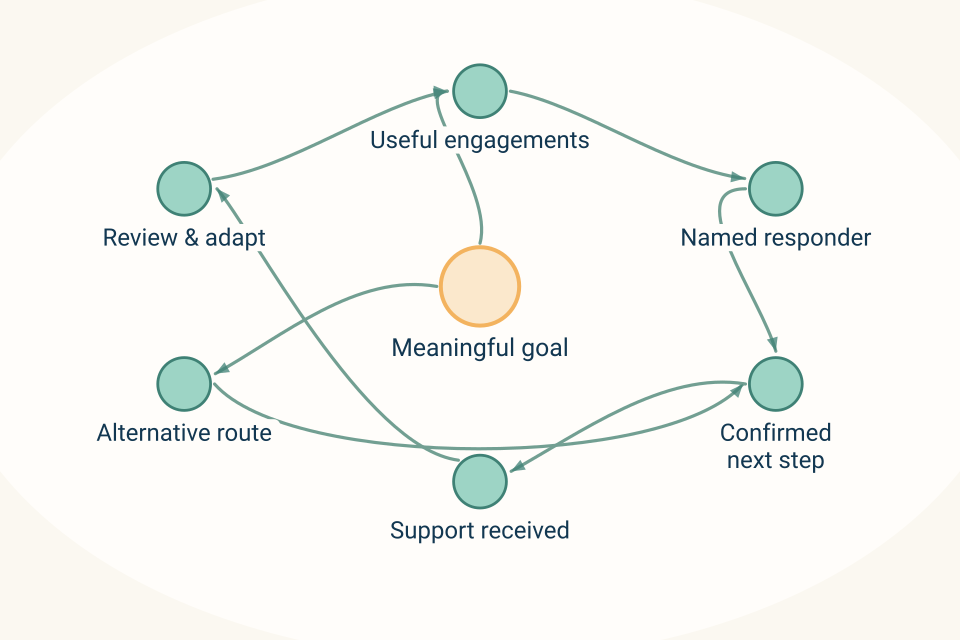
Plan useful engagements around a meaningful goal. Each engagement that asks for a response identifies who will respond. The named responder accepts responsibility and confirms the next step. Check whether the confirmed step led to support actually being received. Plan an alternative route when the usual route cannot support the goal. The alternative route changes the next arrangement. Review what the received support made possible and what burden remained. Adapt the engagements and sequence from what is learned. This is a proposed working sequence; a request or referral does not establish that service was received.
1 · Request A need is raised. | 2 · Acceptance A receiving person accepts the next action. | 3 · Arrangement Details are confirmed. | 4 · Service received The agreed support actually occurs. | 5 · Review People discuss what helped and what remains open. |
If a step is unconfirmed, changes, or cannot proceed → contact the named responder → discuss alternatives → confirm any new arrangement. | ||||
In context
In Context — “Is Tuesday arranged?”
Ellen brought three things to the next meeting with Sam: the Day Center calendar, a note about a clinical follow-up, and the reading guide the family had tried.
“The story worked,” she said. “The rest of the week still takes some figuring out.”
Pat pointed at the calendar.
“I thought that was what the calendar was for.”
“It tells me what we’ve written down,” Ellen replied. “Not always what has actually been arranged.”
She had asked whether Pat could attend the Day Center on an additional Tuesday so she could keep an appointment of her own. It was not one of his agreed regular days.
Maya, joining by phone, had seen Tuesday mentioned in the family’s messages.
“I thought that was confirmed.”
“I asked,” Ellen said.
“Did the center answer?”
“They said they would check.”
Sam looked at the note.
“Then we have a request, not a confirmed day.”
Pat leaned toward the calendar.
“And I’d still like to know what’s happening there on Tuesday.”
“That belongs in the conversation too,” Sam said.
The family had made progress. Pat had received clinical assessment. They had met Lena and found activities he enjoyed. Ellen had begun using dependable time for herself. Daniel and Maya had accepted particular responsibilities.
But this new request exposed a gap.
Who was checking? When would the family hear? What would happen if the center could not offer the day?
The information, conversations, and arrangements needed to work together.
They needed more than a calendar.
What a pathway actually is
A pathway is a planned, adaptable sequence of engagements, resources, and human support, organized around a meaningful goal.
It describes what is offered, when it becomes relevant, who participates, who responds, and how the next step is chosen.
An engagement is one encounter. A pathway connects encounters over time.
A short video may help someone understand a service. A question attached to that video may reveal what they want to discuss. A telephone call can address the concern. A planned visit can help them assess whether the service fits. A later conversation can establish what worked and what should change.
The value lies in how those elements connect.
The original CarePhysics manuscript describes pathways in this broader way: combining content with phone calls, social connections, reminders, virtual visits, and responses to feedback. It also proposes manageable segments that teams can review and improve individually.
A pathway can be short. It might help someone move from one unanswered question to a completed conversation.
It can also extend over weeks or months, supporting a transition, participation in a program, family coordination, or continuing learning.
It is not simply a playlist, a calendar, or a sequence of automated messages. Nor does it replace a clinician-approved care plan. It organizes the information, interactions, and support through which the relevant plan can become understandable and workable.
A referral is not help until someone actually receives the help.
The same distinction applies throughout a pathway. Information offered is not necessarily understood. A contact saved is not a conversation completed. A meeting held is not an agreement carried out.
We plan the sequence so that each useful beginning has somewhere to go.
Map the work—and the experience of it
A pathway describes the support we intend to offer. Before designing it, learn how the present journey actually unfolds. A sequence that looks simple on an organizational chart may require several calls, repeated explanations, or uncertain waiting at home.
Use three related views. A process map shows events, responsibilities, and transitions. A human-experience map records what the people involved say they understand, want, encounter, and find difficult. The designed pathway sets out the information, encounters, assistance, and follow-through arranged in response.
Keep the person’s account, a caregiver’s account, and staff observations distinguishable. Record the source and timing of each contribution. “She sounded worried” is an interpretation to check, not permission to record fear as a fact. An unanswered message does not establish low motivation.
Choose a manageable segment, such as asking about a first visit through receiving a substantive reply. Walk through it with intended users and the people doing the work. Notice what already helps as well as where they wait or repeat something. Ask about language, private concerns, preferred contact routes, cost, and practical assistance; do not require disclosure of every personal detail.
For each stage, ask: What happened? Whose experience do we know? What remains uncertain? What support or response is missing? Who can change it? Mark ideas as proposals until the appropriate person accepts the work. A private caregiver disclosure may explain a personal support need without belonging in the shared operational map.
Experience-based co-design provides a related, established way of bringing service users’ and staff members’ accounts into improvement. Our short mapping aid is a CarePhysics adaptation, not the complete co-design method or a claim that drawing a map improves outcomes.54
The map helps us choose the next question. TOC can focus attention on a suspected limiting condition in the process. People’s accounts help us understand what that limitation means in daily life. Then a reviewed change—and its effects—can be examined through the improvement cycle. Use the stage card and experience map in Appendix D.
The building blocks of a pathway
A pathway does not need every possible type of engagement. It needs the combination appropriate to its purpose.
A tile: one place for a useful topic
A tile is a clearly named digital item that brings related material together. Depending on the design and available capabilities, it may contain a video, article, audio recording, document, survey, questions, or interactive elements. The original CarePhysics description includes media, articles, questions, links, and opportunities to use material together.
A tile called Preparing for Your First Visit might contain a short welcome video, an article about what to expect, an optional question about access needs, and a way to request a conversation.
It should not contain everything simply because it can.
The tile’s job is to help someone with one recognizable need. The pathway determines when to offer it, what support accompanies it, and what happens after a response.
A contact: make the right person easier to reach
Adding a verified contact to a care phone book—or providing it on a printed contact sheet—can be a pathway step.
The entry should explain more than a name and number. What can this person help with? When are they available? Which route should be used when they are not?
Saving the contact should be offered with permission and supported where needed. It should not imply that a service has accepted the person or that the contact is continuously available.
The original pathway examples place phone-book resources alongside educational tiles and coaching calls, rather than treating resource information as a separate directory nobody helps people use.
A telephone call: provide an actual conversation
A call can clarify a concern, make an introduction, check an arrangement, or discuss something sensitive.
Plan who initiates it, its purpose, and what happens if the person cannot be reached. “Someone will call” leaves too much unresolved.
The call may also change the next step. After listening, the professional may offer different information, practical assistance, or another service instead of continuing with the original sequence.
A virtual meeting: bring chosen people together
A virtual meeting can connect people who cannot easily be in the same room. Its design still needs an agreed purpose, appropriate participants, accessible joining arrangements, privacy, and a person responsible for facilitating.
A link sent is not a meeting held.
Provide another route when the technology does not work or is not preferred. Recording and AI-assisted notes require their own appropriate explanation and permission; they should not be assumed merely because a meeting is online.
A planned encounter: make the service experience part of the pathway
A home visit, Day Center introduction, clinical appointment, skills demonstration, or family meeting can be a pathway element.
These encounters are not separate from engagement design. The invitation, preparation, welcome, conversation, and follow-up all belong.
The pathway must also include what makes the encounter possible: confirmed availability, eligibility where required, transportation, assistance, and the people providing the service.
A shared activity or check-in: support life between formal encounters
A pathway may include an optional story, conversation, activity, or invitation to contribute. It can also include a review of what has been helpful.
Not every element needs to advance a clinical task. Pat’s reading with Emma and Noah belongs because family life is part of what the support is intended to preserve.
These elements should leave room for enjoyment, quiet, pausing, and declining. Children remain family members, not monitors responsible for reporting progress.
Together, these building blocks allow a pathway to connect learning, relationships, services, and ordinary life.
Plan the sequence around the person’s next question
A useful sequence does not begin with “What can we send?”
It begins with “What would help now?”
Before a community introduction, someone may need to understand why the conversation could be useful. Before a visit, they may need practical details. Afterward, they may want to discuss whether the experience felt right.
Sending the same material at each stage misses that difference.
The proposed CarePhysics content pattern remains useful: explain why something matters, make the main idea clear, demonstrate where helpful, offer a chosen next step, identify a question route, and explain what follows. It is a flexible pattern, not a requirement to make every message equally long.
For a first-visit pathway, the sequence might begin with a human invitation. A tile then helps the person prepare. A call answers individual questions. A visit makes the service visible. Feedback shapes the next conversation.
The order can change. A person may need the call before the article. Someone else may want to read first. Neither should have to complete optional content before being allowed to speak with a person.
Some steps depend on time. Others depend on a decision, an event, or a stated need.
An appointment reminder follows a confirmed appointment. A post-visit question follows an actual visit. A request for support should prompt the appropriate response—not wait until the next scheduled educational message.
Planning is what allows that flexibility to remain dependable.
One pathway, several kinds of engagement
The following example shows how a team could plan a Day Center introduction and early-support pathway. It draws on the family’s experience without implying that every digital step already occurred.
In context
In Context — Looking back at what helped
Sam asked Pat and Ellen which parts of the introduction had made a difference.
“Talking to Lena before we went,” Ellen said.
“Seeing the place,” Pat added. “The description did not tell me who I might talk to.”
“And the reading guide?” Sam asked.
“That was useful later,” Ellen said. “Not something I needed in the first conversation.”
Their answers suggested a sequence—not simply a larger information package.
When or why | Planned pathway element | Responsibility and what comes next |
|---|---|---|
The person wants to explore support | A conversation about interests, concerns, and practical needs | Sam establishes what Pat and Ellen want to explore and what may be shared. Clinical questions remain with clinicians. |
They want a clearer picture of the service | A first-visit tile: welcome video, companion article, and optional questions | Lena’s team maintains the program facts. Questions requiring a person reach an identified responder. Print and conversation alternatives remain available. |
They need a dependable contact | Offer to add Lena’s verified details to the care phone book or provide a contact card | Explain Lena’s role, availability, and backup route. Confirm that the family can find the information. |
Individual concerns need discussion | An agreed telephone call | Lena answers program questions and identifies what must be assessed or confirmed. A call is not enrollment. |
Chosen family members need to plan together | An in-person or virtual meeting with a short preparation guide | Sam facilitates within his role. Pat is included, private matters stay private, and responsibilities are accepted rather than assigned by assumption. |
An introduction is wanted and appropriate | A confirmed visit, with arrival information and access arrangements | The center confirms who will welcome them. Subsequent assessment and eligibility requirements are addressed before attendance begins. |
Participation begins | The agreed service day, followed by reviewed communication | Record actual attendance separately from booking. Invite corrections and identify any follow-up. |
The family wants something useful between visits | An optional activity tile, conversation aid, or other relevant resource | Offer material connected with their interests. Participation is not a test or an obligation. |
It is time to review the experience | A brief feedback question, call, or review meeting | The responsible person discusses usefulness, burden, and changes. The next version of the person’s plan reflects that discussion. |
A working map also needs actual dates or response windows, names and coverage arrangements, information permissions, and confirmation requirements.
It does not need to be displayed to the family as a complicated diagram. The organization may need the full map; Pat may need only the next relevant part.
Let a response change what follows
An interactive element is useful when the organization has decided what a response can influence.
Suppose a first-visit tile asks:
What would you like to discuss before visiting? You may ask about activities, the support available, costs, getting here, or something else. You can also request a conversation instead.
The purpose is not to collect another answer. It is to prepare the appropriate response.
A question about activities may lead to an honest demonstration or a conversation with the activity lead. A question about affordability needs current cost information and someone able to explore available options. A transport problem needs practical help.
Those are different branches of the pathway.
COM-B provides a useful reason to make that distinction: an obstacle may concern understanding, skills, opportunity, motivation, or a combination. The research review informing this book specifically warns against sending the same prompt when the underlying barriers differ.
Do not infer that a person needs persuasion because they have not chosen a next step.
A question may lead to less content, a different medium, a human conversation, an alternative service, or a pause.
The respondent should know who reviews the answer and what response to expect. For urgent concerns, provide the appropriate immediate route rather than relying on an ordinary feedback form.
Keep a shared foundation, then adapt locally
Organizations do not need to start from a blank page for every person. They can maintain a reviewed pathway that serves as a starting point and adapt it deliberately.
There are three useful levels.
The shared foundation holds the purpose, essential information, design pattern, permission boundaries, and expectations for responsibility and review.
The local version identifies the services, contacts, capacity, costs, languages, access arrangements, and practices of the organization and community.
The person’s version reflects what the individual wants, which people they choose to involve, the assistance they need, and what has already happened.
This distinction keeps reuse from becoming uniformity. Share knowledge while preserving local judgment, voice, resources, and individual preferences.
Consider two hypothetical communities using the same introductory pathway.
One has a Day Center with its own transport arrangements. Its local version explains how transport is requested and confirmed.
The other depends on an external provider. Its pathway needs a separate contact and confirmation before attendance is treated as workable.
Changing the name and logo on the first community’s material would not make it accurate for the second.
The same is true of hours, fees, referral requirements, interpreter availability, and family-support services. Where a resource does not exist, mark the gap and determine who can explore alternatives. Do not leave an attractive but unusable option in the pathway.
Adapt communication with the people served. Ask about language, culture, beliefs, privacy, preferred decision-making, and the relationships they want involved. Do not assume that everyone in a neighborhood or cultural group wants the same approach.
For some people, a trusted community organization may be the best introduction. Others may prefer direct contact. A person may want a faith-based resource or explicitly prefer a secular one.
Preserve the same standard of evidence and care while adapting how support is offered.
Two kinds of learning: this person and the next person
Feedback can improve a pathway in two different ways.
First, adjust the current plan.
Ellen asks for a call instead of another long article. Pat wants a different afternoon activity. A family member’s availability changes. The team reviews the request and updates the relevant arrangement.
That is individual adaptation. It does not require waiting for a formal study before respecting a stated preference.
Second, improve the reusable pathway.
Several families may encounter the same confusing term. Staff may repeatedly explain the difference between requesting a day and receiving confirmation. A video may leave out the entrance people actually use.
The team can investigate whether the standard material or sequence needs revision.
The Model for Improvement, used by the Institute for Healthcare Improvement and developed by Associates in Process Improvement, combines clear aims and measures with small tests of change. Its Plan–Do–Study–Act cycle supports trying a change, examining the result, and deciding what to modify before broader implementation.55
For CarePhysics, the practical cycle is:
Plan the sequence → try it with appropriate support → listen and measure → review → adjust → try again.
A small adjustment might move the contact information earlier, shorten a preparation article, offer a call before a visit, or explain a service condition more clearly.
Sometimes the necessary change is larger: different service hours, additional staffing, or another community partner.
Learning should be allowed to change the service, not only its wording.
Record what changed—and why
In Chapter 6, Ellen explained that the optional reading prompts initially looked like instructions.
The immediate response was to clarify the guide for her family. A broader improvement would be for the activity lead to review the wording and prepare a revised version for other households.
The reason should remain visible: readers could mistake suggestions for required tasks.
The team could then ask whether the new wording is clearer, whether families still find the prompts useful, and whether the change creates any new difficulty. Ellen’s comment identifies a problem worth addressing; it does not prove that the revision works for everyone.
The dated Day Center export proposes a learning record containing the finding, decision, responsible person, actual change, date, and remeasurement. It explicitly says that this register is maintained outside the product described there.
Keep versions of the pathway and its content. Record which version was used, for which audience and period, and what local adaptations applied.
Otherwise, a team may see a change in results without knowing which materials or arrangements people received.
Not every revision needs an elaborate experiment. But every important claim needs evidence appropriate to it. A clearer explanation can be tested for understanding. A claim of reduced caregiver strain or fewer hospital visits requires a stronger evaluation than favorable comments about the new design.
Keep the next responsibility visible
The planned sequence still depends on people accepting and completing the work.
A resource can be shared without being reviewed. A contact can be added without a conversation occurring. A meeting can finish while its decisions remain unassigned.
The communication guide makes this distinction explicit: a message sent, a referral transmitted, and a service received are different events.
Use status language that reflects what is actually known.
“Requested” should not look like “confirmed.” “Accepted for review” should not imply “eligible.” “Appointment completed” should not automatically become “need resolved.”
A digital acknowledgment can confirm receipt. It should not sound as though a person has already acted.
The pathway needs a responsible person at the next step, a response expectation, and a fallback. Coordination also needs limits: Sam does not become the owner of every task simply because he helps the family see the overall plan.
Plan for the route that does not work
In context
In Context — An honest answer about Tuesday
Lena checked the request and called Pat and Ellen.
“The additional Tuesday is full. I can keep the request open for a cancellation, but I cannot confirm a place.”
Ellen looked at her own appointment.
“So I still need another arrangement.”
“Yes,” Lena said. “I don’t want you planning around a place we cannot promise.”
Pat asked what the program would include that day. Lena explained it. His interest did not create a space.
With Pat and Ellen’s agreement, Sam accepted responsibility for checking other appropriate support for the required period. They agreed when he would report back, including if he had not found an option.
Lena remained responsible for reporting any change in the center’s availability.
The pathway now held two separate matters: a Day Center request that could not yet be met, and a support need still being explored.
Ellen did not need another welcome video. She needed an answer about the arrangements.
The change in circumstances required a different response.
An alternative must still be checked for fit, cost, availability, and the person’s preferences. “There is another provider” is not yet a workable solution.
A compassionate pathway keeps the unresolved need visible rather than marking the matter complete because someone answered the telephone.
Allow pausing and returning
A planned sequence should make support dependable without making participation compulsory.
People may want fewer messages, time to consider, a different service, or no further optional content. They should be able to say so without losing the ability to ask for appropriate help.
Silence is not an answer to every question. A message may not have arrived, the person may prefer another route, or circumstances may have changed. Follow the agreed contact approach and the organization’s appropriate safety procedures.
Do not infer a medical crisis from an unopened article. Time-sensitive clinical follow-up belongs to the responsible clinical team’s process, not to a content-completion rule.
When someone returns, begin with what matters now. Review relevant changes and permissions rather than asking them to work through a backlog of material.
The pathway should retain useful knowledge without holding the person to an earlier version of their life.
AI can help prepare, adapt, and learn
Designing and maintaining this kind of sequence creates substantial preparatory work: selecting reviewed content, checking contacts, drafting invitations, organizing questions, comparing versions, and identifying missing information.
These are useful places for AI assistance.
In a proposed, organization-approved workflow, an assistant could combine relevant CarePhysics guidance with the organization’s verified services and permitted personal context. It could draft a sequence containing a tile, a contact, a call, a meeting, and a review—then explain why each element belongs.
A useful assignment would be:
Using our approved knowledge and current service information, draft a pathway for this need. Identify the purpose of each element, its audience, timing, responsible person, and response route. Offer adaptations for the preferences and access needs we have actually established. Mark missing resources and unverified assumptions. Propose measures that distinguish delivery, understanding, action, service use, and outcomes.
People then check the design.
The clinical team owns clinical instructions. The program lead confirms service information. The content owner checks accuracy, accessibility, and reuse permissions. The pathway owner verifies that staff and partners can deliver the proposed sequence.
The knowledge collection retains sources, contributors, review dates, approved uses, and corrections. Research, design guidance, local facts, fiction, and private personal context remain distinguishable. Chapter 13 explains how to maintain that knowledge and its permissions.
AI can also help organize permissioned feedback and prepare revision options. It might identify repeated questions about arrival or highlight where a summary has confused a request with a confirmation.
It should not silently rewrite clinical guidance, infer preferences from cultural identity, or declare that a service happened because a calendar entry exists.
Rules-based reminders may support agreed steps where configured. AI-generated revisions require review appropriate to their consequences. Neither process should create commitments that a person or partner has not accepted.
With reliable knowledge, clear guidelines, and accountable people, this assistance can be a gift: less routine assembly, more useful support, and more attention available for the human encounter.
An approved assistant may also let families revisit routine information around the clock. Human availability must remain honest, and people should have a direct route to request a person when needed.
Uploading the book does not train a model or prove that it will follow the material. The configured assistance must be tested.
Build a pathway the team can actually deliver
The pathway describes an organizational commitment, not simply a content schedule.
Budget for staff time, interpretation, accessible materials, content maintenance, calls, meetings, human review, and follow-up. Confirm capacity with the organizations receiving introductions.
The original CarePhysics checklist includes resources, workflow, accessibility, training, feedback, and budget alongside content and personalization. Those decisions belong in the design from the start.
Practice the ordinary route and an exception. Ask staff where the plan duplicates work or promises something they cannot reliably provide.
A useful local adaptation may be a different division of responsibility, not another interface. Make staff suggestions part of the learning process and credit what they contribute. Do not use pathway data to rank how much individual staff members care.
The approach also extends beyond family dementia support. A rehabilitation pathway may combine a professionally reviewed demonstration, supervised practice, follow-up, and a route for questions. A home-care pathway may introduce the visiting team, explain its role, arrange a first encounter, and review how the service fits household routines.
Community and state groups can help share reviewed starting points, definitions, and lessons. Local organizations still need to verify resources and adapt the sequence with the people they serve.
Genus supplies technology. Partners retain responsibility for their care, staffing, programs, relationships, and voice.
Find What Is Holding the Support Back
A family can understand an invitation, want the conversation, and still be waiting for someone to make it happen. Staff may want to respond just as much. The next useful improvement is the one that addresses what is holding the support back—not necessarily the one that produces more material.
Theory of Constraints asks teams to focus on the limiting condition in relation to a defined goal. Improving a faster step alone may not improve the whole result. Its Five Focusing Steps provide a way to investigate, coordinate, and revisit that decision.9
For a care pathway, agree what matters first. Reaching a useful introductory conversation is different from maximizing enrollment. Appropriate care, privacy, rest, and the freedom to decline remain requirements, not obstacles to remove.
In context
In Context — The invitation reached the family; the response did not
This is an original hypothetical service-design example, not a new event in Pat and Ellen’s story or a report of a deployed workflow.
A Day Center receives requests for introductory conversations. The guide is clear and the requests arrive, but several families are still waiting. The program lead asks staff and willing families to describe what happens after a request is sent.
“I knew what you offered,” one family member explains. “I didn’t know whether anyone was going to call.”
The team’s review suggests a problem with response capacity at the busiest part of the day. Requests arrive without a consistently assigned responder or a protected callback period. Some require staff to reconstruct information before they can make a useful call. These are working explanations to test, not conclusions about anyone’s commitment.
The lead arranges appropriate coverage, a named responder, and a callback window families can actually use. The team agrees what information is needed before a call and how absence or urgent concerns are handled. Where approved, an assistant can prepare a brief from permitted information; staff still check it and speak with the family.
In this fictional teaching scenario, the first review finds that more families receive the agreed conversation after response time and coverage are protected. Staff have less information to reconstruct. Yet some people who want a visit still cannot obtain a place on the day they need. The next limiting condition is available service capacity, not the clarity of the invitation.
The lead checks the accounts behind that conclusion: requests due, substantive replies, still-open cases, actual visits, and the effort experienced by families and staff. A better response count does not establish caregiver relief or a clinical benefit. The decision is to maintain the workable callback arrangement while the responsible service owner investigates capacity and alternatives.
If callbacks had remained unreliable, the team would not declare the method a success. It would examine whether the agreed coverage actually occurred, whether the contact times fitted families’ lives, and whether its first explanation was wrong. Either result can change the next version. Appendix F6 shows how to keep response, attendance, and unresolved demand distinct.
The example illustrates coordinated improvement, not a guarantee. Protect useful response time from avoidable rework, align surrounding tasks, provide the resources that are genuinely needed, and review what changed. Necessary staffing or safety support should not wait for every inexpensive option to be exhausted.
Some changes remain worthwhile even when they do not increase service volume. An honest update can protect someone’s time and understanding while a practical resource is still unavailable. See the full Five Focusing Steps in R2.5. See the planning and measurement tools in Appendices D and F.
Before asking people to do more, find what is preventing the support from working—and direct the next improvement there.
How would we know it helped?
Measure both the individual elements and the sequence they form.
A tile being delivered answers one question. Understanding its content answers another. A contact being saved does not establish that the person reached help. A completed call may clarify a decision without leading to enrollment.
The research review informing this book separates reach, understanding, first action, adoption, useful participation, outcomes, burden, equity, and safety. Those distinctions should remain visible in pathway evaluation.
For one defined pathway segment, establish a baseline, a review period, and a named owner. Record which pathway and content versions were used.
Then examine what you intended to improve. Did people understand the next step? Were questions answered? Did requested conversations happen? Did appropriate services become accessible? Did Pat find worthwhile participation? Did Ellen receive usable time?
Include the effort required: messages, calls, travel, paperwork, family coordination, staff preparation, and AI review.
Use accurate denominators and keep people still waiting in view. A favorable result among respondents should not become a claim about everyone offered support. Compare differing populations and local resources carefully.
Verify the record before selecting a measure: bookings, attendance, educational delivery, and understanding are different events. Required dates may be missing. Appendix J records the dated examples behind these checks; no field should be renamed to manufacture an answer.
A service received is still distinct from an outcome improved. An outcome change is distinct from a change credibly attributable to the pathway.
Likewise, willingness to recommend, an actual referral, and a referred person receiving useful services remain separate.
For improvements, make a prediction, try a manageable change, and examine benefits alongside burden, safety, and access. IHI’s testing guidance recommends repeated small tests under different conditions before making a change standard practice.56
Retain unsuccessful findings. A shorter tile may be easier to finish but omit something important. An earlier call may help some families while arriving at an inconvenient time for others.
The goal is not a universally winning sequence. It is a better-understood starting point, with appropriate variations and evidence about where each is useful.
Models and Evidence Behind This Chapter
The pathway definition, building blocks, and examples come from the CarePhysics source materials and the proposed applications in this chapter. The following research and guidance help examine those choices. They do not validate the entire pathway or a particular technology implementation.
Care-transition guidance
Connect preparation with practical follow-through
AHRQ’s IDEAL discharge-planning approach includes patients and families as partners, addresses life at home and follow-up, uses plain-language explanations, checks understanding, and listens to goals and concerns. It informs the hospital-to-home portion of the pathway. This is practice guidance, not proof that providing a checklist or tile produces better outcomes.15
Local question: Does the person leave with understandable information, workable arrangements, and an appropriate contact?
The Care Transitions Intervention
Human support can be part of the effective sequence
Eric Coleman and colleagues’ 2006 randomized trial included 750 community-dwelling adults aged 65 or older in a Colorado integrated delivery system. The intervention combined communication tools, support for expressing preferences, and guidance from a transition coach.
Thirty-day rehospitalization was 8.3 percent with the intervention and 11.9 percent with usual care; the adjusted comparison was statistically significant. Participants were required to speak English, have telephone access, and have no documented dementia in their medical record. The findings therefore cannot simply be applied to Pat’s later dementia-care situation.57
The trial tested a multicomponent support intervention—not the independent effect of a message sequence, contact list, or calendar.
Local question: Which people and services make the pathway more than information delivery?
Just-in-time adaptive intervention design
Use changing information to reconsider the next step
Inbal Nahum-Shani and colleagues’ 2018 paper describes adaptive interventions through longer-term and near-term outcomes, decision points, relevant tailoring information, available options, and decision rules. It also addresses the burden of repeated intervention.58
The chapter borrows that vocabulary for human-reviewed decisions: a stated preference, unanswered question, or changed service arrangement can lead to different support. No additional message may sometimes be appropriate.
Evidence boundary: This is a design framework, not proof that continuous AI adaptation improves care.
Local question: What information justifies changing the sequence, and who reviews that change?
The Model for Improvement and PDSA
Make revision a learning process
The Model for Improvement, developed by Associates in Process Improvement and used by IHI, links aims and measures with tests of change. Plan–Do–Study–Act asks teams to prepare a test, carry it out, examine what happened, and decide what to modify.55
Here, it informs the pathway’s learning cycle: revise a confusing tile, alter the timing of a call, or test a different introduction while examining consequences.
Evidence boundary: An improvement method does not guarantee improvement. A small local test can reveal practical problems without establishing long-term clinical effectiveness.
Local question: What did the team learn, what changed because of it, and what happened when the change was tried again?
Theory of Constraints
Focus the improvement, then test the whole experience
TOC supplies a management method for choosing where improvement effort may help. R2.5 explains the sequence; R1.3 examines a public home-care study. The proposed callback example is not a validated intervention. Local question: what evidence identifies the limiting condition, and did the change improve the intended support without moving the burden elsewhere? See R1.3’s operational research note.
Coordinated dementia care
Evaluate the actual program, not the label
The 2019 Care Ecosystem randomized trial included 780 people with dementia and their caregivers in California, Nebraska, and Iowa. Its collaborative program, delivered through telephone and internet support, showed benefits in caregiver-rated quality of life, caregiver depression and burden, and emergency-department use compared with usual care. Of the enrolled pairs, 571 completed the 12-month survey.59
The 2025 D-CARE randomized trial included 2,176 person–caregiver pairs, comparing health-system-based care, community-based care, and usual care over 18 months. It found no significant differences in its primary outcomes of patient behavioral symptoms and caregiver strain. Caregiver self-efficacy, a secondary outcome, was higher in both intervention groups than with usual care.60
These studies tested different programs and comparisons. Their results do not establish that coordination always works or never works. Neither tested this CarePhysics design or a Genus pathway.
Local question: Which outcomes improve under this particular combination of services, support, and implementation?
COM-B, autonomy, and Social Physics
Keep the human foundations inside the sequence
The research review informing this book contributes three continuing checks: investigate the barrier before selecting the response, preserve self-endorsed choice, and connect new information with appropriate human support.
Its evidence judgments differ: COM-B has strong conceptual support; Self-Determination Theory’s intervention evidence is moderate; the broader Social Physics perspective is emerging-to-moderate. These are not interchangeable grades or a combined rating for this chapter.
The chapter applies these ideas when a transport concern leads to practical assistance, optional content can be paused, and a resource introduction leads to a person who can explain its local relevance.
Local question: Does the pathway continue to serve the person’s goals, or has completing the sequence become the goal?
One thing to try
Choose one recurring need your organization supports.
Map the current sequence using the actual elements: tile, article, contact, call, meeting, visit, activity, and review. Leave out anything that does not serve the purpose.
At each step, identify who acts, what confirms the step occurred, and how feedback could change what follows.
Then choose one small adjustment and test it with the intended audience. Record the pathway version, the reason for the change, the result, and what you will do next.
Your team’s question is:
Are we sending a sequence of things—or providing a sequence of support?
A clearer pathway should leave people with less to carry
In context
In Context — “Could I have the useful part?”
At the end of the meeting, Sam separated the current arrangements from the unresolved request.
“The additional Tuesday is still not confirmed,” he said. “Lena owns the availability update. I own the alternative-support inquiry we agreed on. You will hear from me at the time written here, even if I have not found an option.”
Ellen looked over the summary.
“So I don’t have to call both places to find out whether someone is checking.”
“That is the arrangement.”
Maya wanted her permitted part of the plan where she could find it on her phone. Daniel needed the details of the responsibility he had accepted. Ellen preferred a short printed copy and a telephone call for changes.
Pat looked at the longer working document.
“Could I have the useful part?”
“What would that be?” Sam asked.
“Where I’m going, who I’m seeing, and whether I need to do anything.”
“And the next story?” Ellen asked.
“That can stay.”
The pathway held more than appointments. It held explanations, contacts, conversations, support, and something the family might enjoy.
The organization needed to understand how those pieces connected.
The family needed the useful part to be within reach.
That is the next design question.
Notes
Goldratt Research Labs. Introduction to Theory of Constraints (TOC). Description of the Five Focusing Steps. Source (opens a new tab)
Agency for Healthcare Research and Quality. Strategy 4: Care Transitions From Hospital to Home—IDEAL Discharge Planning. Guide to Patient and Family Engagement in Hospital Quality and Safety. Source (opens a new tab)
University of Pennsylvania School of Nursing (2021). Penn Nursing Offering Free Online Transitional Care Course to Clinicians. August 2. Public account quoting Mary D. Naylor. Source (opens a new tab)
Royal College of Physicians (2016). Experience-based co-design: designing the future of hospital services. Interview with Catherine Dale. March 30. Source (opens a new tab)
Institute for Healthcare Improvement. Model for Improvement. Improvement guidance developed by Associates in Process Improvement. Source (opens a new tab)
Institute for Healthcare Improvement. Model for Improvement: Testing Changes. Plan–Do–Study–Act guidance. Source (opens a new tab)
Coleman EA, Parry C, Chalmers S, Min SJ (2006). The care transitions intervention: results of a randomized controlled trial. Archives of Internal Medicine. 166(17):1822–1828. DOI: 10.1001/archinte.166.17.1822. Source (opens a new tab)
Nahum-Shani I, Smith SN, Spring BJ, et al. (2018). Just-in-Time Adaptive Interventions (JITAIs) in Mobile Health: Key Components and Design Principles for Ongoing Health Behavior Support. Annals of Behavioral Medicine. 52(6):446–462. DOI: 10.1007/s12160-016-9830-8. Source (opens a new tab)
Possin KL, Merrilees JJ, Dulaney S, et al. (2019). Effect of Collaborative Dementia Care via Telephone and Internet on Quality of Life, Caregiver Well-being, and Health Care Use: The Care Ecosystem Randomized Clinical Trial. JAMA Internal Medicine. 179(12):1658–1667. DOI: 10.1001/jamainternmed.2019.4101. Source (opens a new tab)
Reuben DB, Gill TM, Stevens A, et al. (2025). Health System, Community-Based, or Usual Dementia Care for Persons With Dementia and Caregivers: The D-CARE Randomized Clinical Trial. JAMA. 333(11):950–961. DOI: 10.1001/jama.2024.25056. Source (opens a new tab)