Chapter 6
Engagements — Make Each Interaction Worthwhile
At a Glance
The central idea: Do not ask for someone’s attention unless you have something worthwhile to give back.
What you’ll explore: How the first five principles become a video, article, survey, message, conversation, or shared activity. Follow Pat, Emma, and Noah as they read together without turning the evening into a lesson or memory test. Learn to distinguish teaching a skill, supporting a decision, gathering feedback, and simply making room for enjoyment.
Design and AI: Begin with a human purpose, choose one main idea, demonstrate where useful, and make questions and next steps easy to find. Explore how an approved AI assistant could turn reviewed knowledge and local experience into drafts while preserving sources, privacy, and human judgment.
Put it to work: Develop a complete Shared-Reading Engagement and a reusable Engagement Design Brief.
Evidence and evaluation: Examine backward design, ADDIE, ARCS, Self-Determination Theory, accessible communication, and research on personally tailored activities. Evaluate understanding, usefulness, choice, access, and effort—not screen time or completion alone.
“If we can infuse creativity into care, caregivers can invite a partner into meaning-making.”
— Anne Basting, PhD, creative gerontologist, TEDMED 2020.46
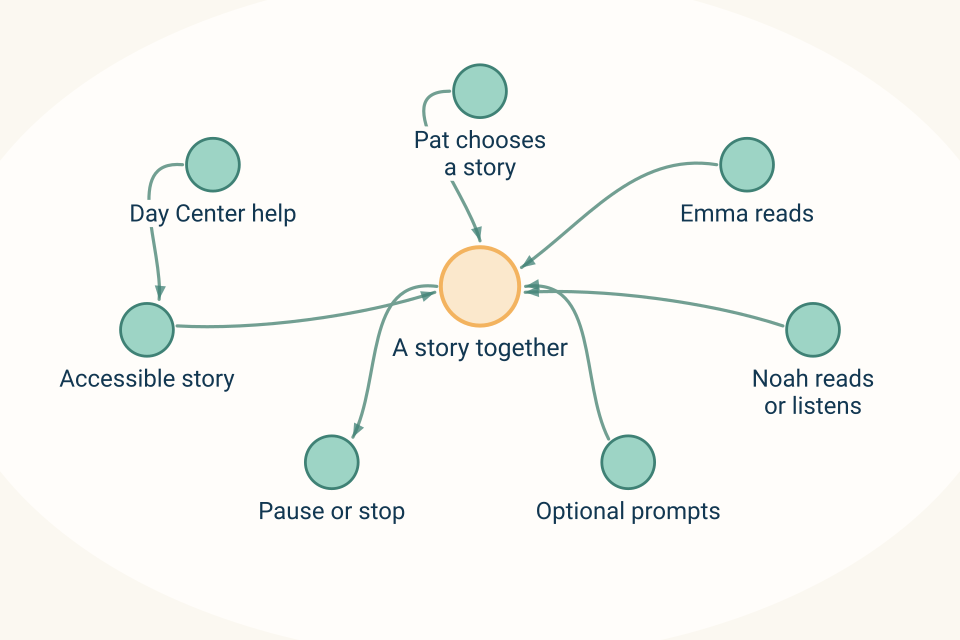
In the fictional family scene, Pat chooses the story they will share. Emma reads with Pat as part of their shared family time. Noah can choose to read or listen rather than being assigned a task. Optional prompts are available if useful; they do not have to direct the evening. The shared story leaves room to pause, comment or stop. An accessible story and recognizable controls help the family use the activity. The adults can contact a person at the Day Center about adapting the resource. The purpose is enjoyment together, not testing Pat’s memory or asking the grandchildren to assess him. This is a concept map of the fictional scene, not a claim of deployed product capability or clinical benefit.
In context
In Context — A story, not an assignment
The continuing family scenes and shared-screen arrangement are fictional illustrations, not documented cases or claims of deployed product capabilities.
Daniel had helped prepare the television before the reading began. Only the story was on the shared screen. The family’s care information remained elsewhere.
Emma sat beside Pat. Noah was still deciding whether he wanted to read or listen. Ellen had the short guide Lena’s team had offered with the activity.
“Are we supposed to ask these questions after every page?” Ellen asked.
Pat looked at the sheet.
“I was hoping for a story, not an examination.”
“They’re ideas,” Daniel said. “It says we can leave them out.”
“An excellent idea already.”
There were two stories to choose from. Pat picked the one set in a railway station.
Emma began reading. A picture showed a traveler sitting beside a large bag.
“Wait,” Pat said as she reached for the next page. “Look how much room he’s taking.”
Noah leaned forward.
“That bag needs its own ticket.”
Pat laughed.
“Write to the railway.”
They stayed with the picture for a moment before continuing.
Nobody asked Pat to remember a station he had visited. Nobody asked Noah to assess how Grandpa was doing. They were talking about a picture in a story they had chosen.
The guide remained beside Ellen.
It was available if it helped.
It did not need to direct the evening.
An engagement is an experience, not a piece of content
In CarePhysics, an engagement can be a conversation, a visit, a lesson, a message, or a shared activity. The format is only part of the experience.
Do not ask for someone’s attention unless you have something worthwhile to give back.
That value may be a clearer explanation, a practiced skill, a useful answer, an opportunity to contribute, or a few enjoyable minutes with another person.
It need not always be an action.
A well-designed medication lesson and a family reading activity have different responsibilities. The lesson may require a qualified professional to check understanding and practical technique. The reading activity may succeed because people enjoyed part of a story and decided to stop.
The mistake is to use the same definition of success for both.
Before choosing the medium, complete this sentence:
This encounter is intended to help these people ______.
“Spend more time in the app” is not enough.
“Prepare one question for the next appointment” gives the designer a useful direction.
“Enjoy a story together without pressure to remember or perform” gives a different direction.
In both cases, the design begins with what the person receives—not what the organization can distribute.
Carry the first five principles into the room
The reading evening brings the human foundations together.
Holistic Care contributes the knowledge that Pat enjoys books and wants to remain Grandpa, not become the subject of every conversation.
Awareness makes the invitation understandable. The family knows what the activity is and what it is not.
Behavioral Influence preserves a manageable, chosen beginning. Pat can choose the story. Noah can listen. Nobody has to complete the activity.
Communications shapes the exchange. People can pause, comment, ask for help, or say they have had enough.
Community supplies a useful resource and a person at the Day Center whom the adults can contact about adapting it.
Those principles do not appear as five separate features. They influence the same experience.
Here the earlier principles become visible in the design of content and encounters.
Love is visible in someone waiting before changing the page. Purpose is visible in Pat choosing to read with his grandchildren. Trust is visible when “you can stop” means exactly that.
The designer’s work is to make room for those actions—not prescribe the emotions people should have.
Start with purpose, then work backward
Instructional design offers useful tools for organizing this work.
Backward design, associated with Grant Wiggins and Jay McTighe, begins with the intended learning, considers what would demonstrate it, and only then selects instruction and activities. It helps avoid beginning with an appealing video or worksheet and trying to invent its purpose afterward.47
For a staff lesson, that might mean deciding that the learner should be able to explain a service limit respectfully, then designing a realistic practice conversation.
For recreation, we borrow the planning discipline without turning leisure into a curriculum. The purpose might be shared enjoyment; the review concerns whether the experience felt comfortable and worthwhile, not whether someone can pass a quiz.
ADDIE—Analyze, Design, Develop, Implement, and Evaluate—provides another organizing process. Robert Maribe Branch’s instructional-design text presents these stages as a framework for planning educational work.48
In our proposed application, the team first learns about the audience and circumstances, designs a small experience, prepares the material, tries it with appropriate support, and revises it. Evaluation is not something saved until hundreds of copies have been distributed.
These tools should make the work more thoughtful, not more bureaucratic.
Sometimes the result of the analysis should be: do not create another video. The person needs a telephone call, a working transport arrangement, or time to rest.
Keep the controls familiar
Think again about the remote control in someone else’s home.
The activity is familiar. The controls are not. You may know exactly what you want to watch while still needing someone to explain how to get there.
That is a design problem, not evidence that you have lost an ability.
Care content can create the same unnecessary work. “Help” becomes “Support” on the next screen. A familiar button moves. One video includes a question route; another sends people searching through a separate menu.
W3C’s guidance on consistent navigation explains the value of keeping repeated navigation in a predictable order, including for people using magnification, screen readers, or other ways of navigating.49
For our engagement, the family should be able to find the next page, return to the previous one, pause, and leave. Those functions should not change because a different story is selected.
The same applies beyond controls. Use recognizable headings and stable meanings across articles, videos, invitations, and messages. The communication approach used here emphasizes that consistency does not require identical wording; each medium should perform its own useful job.
Keep the way through familiar. Adapt what people find there.
Give each encounter a recognizable shape
CarePhysics proposes six functions for content and communication: explain why it matters, make the main idea clear, demonstrate where useful, offer a chosen next step, provide a route to questions or connection, and explain what follows. These are design functions, not a compulsory script.
For shared reading, they might appear like this:
Design function | What it looks like in the experience |
|---|---|
Why it matters | “Here is something you might enjoy reading together.” |
Main idea | The purpose is time together, not finishing or remembering the story. |
Demonstration | Show someone pausing over a picture, making a comment, and letting another person continue. |
Chosen next step | Choose a story, look at one picture, listen, or leave it for another day. |
Questions and connection | Adults know whom to ask about the material or setup. Sharing beyond the household remains permissioned. |
What follows | Stop comfortably. Return another time only if useful. Feedback is optional. |
For a skill lesson, the demonstration and practice would receive more attention. For a service decision, the options, conditions, and question route would be central. For a survey, people need to know what their answers will inform and who will act on them.
Urgency overrides the pattern. An urgent instruction starts with the necessary action.
And enjoyment can be the ending. We do not need to attach a task to every pleasant moment.
A complete example: A Story Together
The following is a proposed engagement, not a dementia treatment or a validated intervention. Its purpose is to make an ordinary family activity easier to begin and adapt.
The invitation
A Story Together
Choose a short story or picture you would enjoy sharing. You can read, take turns, listen, or talk about what catches your attention.
There is no need to finish. The time together is the point.
The preparation
An adult checks the display or printed copy before beginning. Ask whether the words and pictures are comfortable to see from the chosen seats. Make page changes simple. Keep a paper alternative available rather than making technology essential.
Choose material the organization may appropriately use and share. Keep it adult and respectful while considering the children’s interests too. Do not replace accessible writing with childish language.
The shared screen contains the activity—not private messages, care notes, or clinical information.
The material
Here is a short, original fictional passage that could support a small demonstration. It is not presented as anyone’s personal memory.
A Seat by the Window
At the railway station, a man in a blue coat placed his bag on the only empty chair.
“Is that seat taken?” a woman asked.
“Only by my bag.”
“Has it bought a ticket?”
He moved the bag to the floor.
She sat down and unwrapped a sandwich. The man looked toward the tracks. Then he looked at the sandwich.
“Long journey?” she asked.
“Long wait.”
She divided the sandwich and offered him half.
When the train finally arrived, they stayed seated long enough to finish.
“You nearly missed it,” the conductor said.
“Not at all,” the woman replied. “We were having lunch.”
A simple illustration could show the two travelers, the bag, and the window. It should support the scene rather than compete with the text.
The reader’s guidance
Begin with a choice: “Would you like to read, or shall I?”
Read at a comfortable pace. Pause when someone wants to comment. A question such as “Which seat would you choose?” offers a preference rather than requiring a correct answer. It is equally acceptable to make a comment or keep reading.
The prompts are optional. Do not work through them as a checklist.
If the experience becomes tiring, uncomfortable, or uninteresting, stop or try something else. The activity does not need a completed page count to justify the time.
The close
“Shall we leave it there?”
A comfortable ending gives people control over the experience. It also prevents a short activity from growing into something they did not agree to do.
The support
In an organization offering this resource, a named staff member maintains the material and answers adult questions about using it. The instructions include the real contact route and response expectations. Questions about changes in health follow the appropriate clinical route rather than being interpreted through reading performance.
The children remain grandchildren. They are not asked to supervise, record symptoms, or take responsibility for the activity’s success.
One purpose, several kinds of content
The engagement may be supported by more than the story itself. Each additional item should solve a different problem.
The video shows the experience. A short demonstration could show adults offering a choice, a child reading, and someone pausing to enjoy an illustration. Include an ordinary exception: the reader loses interest, asks another person to take over, or decides to stop. Use consented footage or clearly identified demonstration scenes.
The article supports preparation. It can explain the activity’s purpose, offer a few examples of invitations, and show alternatives to the screen. Put optional detail below the main guidance rather than requiring everyone to read it first. AHRQ recommends selecting and testing material for understandability and actionability rather than assuming that short words or a low reading-grade score make it usable.26
The message makes a relevant invitation. It should not imply that completing an activity is expected:
“Here is the reading idea you asked about. There is a short guide and a print option. Try it when it suits you, or keep it for another day.”
The conversation provides personal assistance. Someone can ask whether the material fits, request a different language or format, or say that reading is not what the household wants. A conversation should be allowed to change the offer.
The feedback question helps the organization learn. Instead of asking, “How much did your family enjoy this wonderful activity?” use a neutral introduction:
“We are reviewing this resource to make it easier to use. The activity lead will review responses. You can skip these questions or tell us by phone or in person.”
Then ask whether they tried it, what was useful or difficult, and whether they want a response. Include “not tried” without treating it as failure.
These are illustrative improvement questions, not a validated instrument. An organization using a validated questionnaire must preserve its required wording and scoring.
Most families will not need every item. The purpose of creating alternatives is to offer suitable routes, not send the entire collection to everyone.
Let the experience change the plan
In context
In Context — The page can wait
Noah took the next turn reading.
When he finished the passage, Emma asked Pat which seat he would choose on a train.
“By the window.”
“So you can see where you’re going?”
“So nobody asks me to move every five minutes.”
Ellen laughed.
“I would sit across from you.”
“That has worked reasonably well.”
They talked for a while. The page stayed where it was.
Later, Pat asked Emma to read another passage. After that, Noah went to find a game.
“Are we stopping?” Daniel asked.
“I think we are,” Pat said.
They had not used every prompt or read everything available. They had done what they came to do.
The design had left room for the people, not just the pages. It should also leave room for a different response: “This did not suit us.”
That answer is useful information, not a reason to send a more insistent invitation.
Different ways to open a meaningful moment
Care communication can be accurate and still have imagination. A demonstration can make a task visible; a metaphor can make an unfamiliar idea easier to discuss; a photograph, poem, or welcome moment of humor can open a conversation. Choose the form for this person and this encounter.
Purpose and possible form | An original way to begin—and what to protect |
|---|---|
Make a task understandable: demonstration | “Let me show you, then we can try it together.” Demonstrate one relevant action and invite a question or supported practice. Keep required clinical steps intact. |
Explain an unfamiliar idea: metaphor | “Think of finding your way with an unfamiliar remote.” Choose a recognizable comparison, then explain its limits. The remote concerns controls, not symptoms. |
Open a conversation: question | “Which part would you like us to explain first?” Listen to the answer and adapt the explanation. Offer privacy, time, and a preferred language or format. |
Enjoy something together: photograph or story | “What catches your attention here?” Let a photograph or story invite preference, imagination, or quiet enjoyment rather than a test of recall. |
Share warmth: welcomed humor | Enjoy humor the person welcomes, as Pat and Ellen do in the train conversation. Laugh with, not at, someone; leave worry and disagreement room to be heard. |
Invite reflection or rest: poetry, music, quiet | “Would you enjoy a poem, some music, or a quiet moment?” Match the material, sound, and pace to the person; use appropriately licensed material and make stopping easy. |
Creativity makes room for expression, understanding, and enjoyment. It is an invitation, not an obligation or a treatment promise. Keep necessary instructions clear, ask how the experience felt, and be ready to choose differently.
Personalization begins with asking
Pat’s interest in reading does not establish what another participant will enjoy. It does not even establish what Pat will enjoy every evening.
Ask about current interests, language, beliefs, routines, preferred company, and practical access. AHRQ’s cultural guidance recommends learning from individuals rather than assuming preferences from group membership.13
One household may welcome a story connected with a religious tradition. Another may prefer secular material. Someone may want familiar places and themes; someone else may enjoy discovering something new.
Do not assume nostalgia is always comfortable or that every family wants an activity involving children. A person without nearby relatives may prefer a friend, volunteer, peer, or an activity alone.
Adapt the amount of text, pacing, format, and assistance. Preserve the person’s adult identity. Offer quiet participation without treating it as an inferior version of engagement.
Music may help establish a setting when people want it, but silence is also a design choice. Avoid adding background sound simply to make a video feel more polished. Check whether it competes with speech, and use only material the organization is authorized to use.
AHRQ’s communication guidance supports limiting key points, demonstrating actions, inviting questions, and checking understanding. These practices are relevant to educational encounters; they do not require turning recreation into a comprehension exercise.6
Use reviewed knowledge before asking AI to draft
Lena’s team does not need an assistant to invent what Pat likes. They have information he has chosen to share and an experience he has described.
They may need help turning that knowledge into a useful resource.
The proposed starting collection contains several distinct things: the CarePhysics design pattern, relevant professional guidance, the selected story and its reuse permissions, the center’s actual support arrangements, and any personal preferences authorized for this task.
Those sources do different jobs. The story supplies content. Research helps the team understand possibilities and limits. Local guidance establishes who answers questions. Personal context may shape the invitation. None should silently become another.
Keep sources, owners, review dates, permitted uses, and corrections with reusable material; keep private personal information separately controlled. The detailed knowledge-stewardship approach appears in Chapter 13.
An AI assignment could be:
Using these approved sources, prepare a short shared-reading guide and a demonstration outline. The purpose is enjoyable time together, not memory testing or content completion. Preserve choice, provide a print alternative, identify the adult support route, and show which sources informed the draft. Mark missing information rather than inventing it.
The assistant could prepare alternatives for staff review. It might help shorten instructions, identify inconsistent labels, or propose an accessible layout.
But the reviewer must look beyond fluent wording.
“Ask Pat to remember the station he used as a boy” introduces an unsupported personal history and makes recall part of the task.
“Which seat would you choose?” does neither.
The team also checks that a story is not presented as a family memory, that historical details are verified where relevant, and that an adaptation does not exceed the permissions attached to the material.
AI can make this preparation less repetitive. It can help preserve a staff member’s useful explanation, draft variations, and organize feedback for revision. Those are valuable possibilities when they leave people more time and attention for the encounter.
The review work still counts. A quickly generated draft that requires extensive correction may not save time.
Uploading a book does not train a model or prove it will follow the material. A source collection, a configured assistant, and a tested service are different things.
Keep the assistance available without putting it in charge
An approved assistant could help an adult revisit the guide at any hour, prepare a question, or find an available alternative. It should work within its defined sources and scope.
It should not infer cognitive decline from how long Pat reads, decide that the family needs more reminders, or turn a missed activity into a concern requiring intervention.
The person can also ask for human help without first completing a conversation with the assistant. State when staff are available and which route is appropriate for a concern that cannot wait.
The shared-reading experience here is a proposed design. Verify the actual sharing, access, media, and question routes before using it. Related dated product examples—and features described as planned—are kept in Appendix J.
For the proposed reading engagement, the simplest successful arrangement may require no live AI at all. The assistant helps prepare the material, an adult helps with setup, and the family spends the evening with one another.
A reusable Engagement Design Brief
Before commissioning content, complete a brief that another team member could understand and use.
Design question | Shared-reading example |
|---|---|
Whose situation are we addressing? | Pat and family members who want an enjoyable activity together; preferences and access are confirmed with them. |
What is the purpose? | Offer shared reading, listening, and conversation without pressure to perform. |
What informs the design? | Approved guidance, the person’s stated preferences, permitted story material, and reviewed local experience. Keep research, fiction, and personal information distinct. |
What will happen? | An invitation, a choice of material, simple setup, optional prompts, and an easy stopping point. |
Who supports and reviews it? | A named activity lead reviews the resource; an adult handles family setup; the organization provides its actual question route. |
What may be adapted? | Story choice, language, text size, format, pace, company, and assistance. The person’s privacy and right to decline remain unchanged. |
How will we learn? | Optional feedback on usefulness, comfort, access, and preparation effort; a named owner makes and tests revisions. |
This brief is a proposed design tool, not an assessment of the family.
The same questions can guide a rehabilitation demonstration, a home-care orientation, a staff learning session, or a community survey. The answers—and the evidence needed—will differ.
Give staff the means to deliver the design
Content production is only part of the cost.
Someone must select and review material, check permissions, prepare accessible versions, help with first use, answer questions, and maintain the resource. Budget for that work rather than expecting staff to fit it around everything else.
Distinguish preparing training, making it available, practicing, and demonstrating the required skill. These are separate responsibilities. Offering family education does not establish that learning occurred.
Practice should support the team. Ask staff to try the material, identify confusing steps, and suggest alternatives. Do not use their suggestions as evidence that they were previously performing poorly.
Health systems and community partners can share reviewed resources without imposing one voice or format everywhere. Retain the source and essential meaning; adapt examples, language, delivery, and support to local needs.
A shared library is valuable only when someone maintains it. Outdated contacts, unavailable services, or inaccessible formats can undermine an otherwise thoughtful resource.
The detailed production specifications belong in a Design Guide. The main book’s responsibility is to make the decisions understandable and demonstrate how they affect the experience.
How would we know it helped?
Begin with the purpose, not the available analytics.
For a skill lesson, examine whether the person can perform the relevant task with appropriate support. For a decision aid, examine understanding and whether the choice reflects the person’s priorities. For a survey, examine whose views were heard and what changed because of the answers.
For shared reading, ask whether the experience was wanted, accessible, comfortable, and worth offering again.
Do not make the family document every evening. A voluntary check-in with a small, clearly described group may be enough for an initial design review.
An organization might compare the existing resource with a revised version over a defined four-week improvement period. Record how many households were offered each version, how many provided feedback, and which access routes they used. Include people who did not try it and those who needed help.
Ask about preparation time, difficult controls, unsuitable material, pressure to continue, and unanswered questions. Count staff drafting and review time, including AI corrections.
Keep participant reports, family reports, and staff observations distinct. A smile is an observation, not a complete account of someone’s experience.
The behavioral review behind CarePhysics separates reach, understanding, first action, adoption, useful participation, outcomes, burden, and safety. A content opening or completed activity cannot stand in for all of them.
A recommendation to another family is another question again. Willingness to recommend is not an actual referral; a referral is not proof that the next family received useful support.
Give a named person authority to revise or withdraw the resource. Share unsuccessful findings as well as encouraging ones.
We are evaluating the design—not measuring how well the family loves one another.
Models and Evidence Behind This Chapter
The chapter combines planning frameworks, professional guidance, and research findings. Their roles should remain visible. None establishes that the proposed shared-reading engagement or a particular technology produces a clinical benefit.
Backward design and ADDIE
Choose the purpose before choosing the product
Foundation and use. Wiggins and McTighe’s backward-design approach places intended learning and evidence before instructional activities. Branch’s ADDIE text organizes instructional development through analysis, design, development, implementation, and evaluation. Both approaches are named in the original CarePhysics Engagements section.47
Here, they inform the decision to identify the purpose, prepare a small experience, try it, and revise it.
Evidence boundary. These are planning frameworks, not treatment packages. Applying their logic to recreation is a CarePhysics design adaptation; it does not make family enjoyment an educational test.
Local question: Did the intended human purpose determine the content and evaluation, or did the available technology determine them?
ARCS
Make participation relevant and manageable
Foundation and use. John Keller’s ARCS model organizes motivational design around attention, relevance, confidence, and satisfaction. In this chapter’s proposed application, an interesting scene invites attention, the activity connects with chosen interests, assistance makes participation manageable, and the experience has value beyond completion. They help us ask what the intended audience will receive from the experience.
Foundational research. Keller’s 1987 paper describes developing the model and field-testing it in two in-service teacher-education programs. The paper reported useful design assistance while calling for more controlled studies.50
Evidence boundary. Those field tests were not studies of dementia care or shared family reading. ARCS helps formulate design questions; it does not guarantee motivation or benefit.
Local question: Was the encounter worth beginning, manageable to use, and worthwhile from the participant’s perspective?
Self-Determination Theory
Preserve choice inside the experience
Foundation and use. Autonomy, competence, and relatedness inform the invitation, the available assistance, and the freedom to participate differently. Choosing to listen or stop should not make someone a less valued participant.3
Supporting review. Ntoumanis and colleagues’ meta-analysis included 73 health-domain intervention studies. It found generally small-to-medium changes in motivational measures and health behaviors, with modest, variable health effects. The interventions and settings differed substantially.17
Evidence boundary. The research review informing this book grades this intervention evidence Moderate. It supports examining the quality of participation, not claiming that optional prompts or a choice of stories produce the same effects.
Local question: Did support make participation easier while leaving the decision with the person?
Personally tailored activities
Relevant interests are a starting point, not an outcome promise
Supporting review. A 2020 Cochrane review by Ralph Möhler and colleagues included five randomized studies, with 262 people with dementia completing the studies. Participants lived at home, generally had mild-to-moderate dementia, and were followed for two weeks to four months.
The review found low-certainty evidence that personally tailored activities might reduce some behavioral difficulties and slightly improve quality of life. It found no clear benefit for several other outcomes, including caregiver burden; evidence for engagement itself suggested little or no effect. Adverse effects were not assessed.51
Where we used it. The chapter takes personal interests seriously while asking about effort, fit, and experience.
Evidence boundary. The studies did not test this story, shared television reading, or Genus. They do not justify a claim that personalized activities slow dementia or reliably reduce family strain.
Local question: Did this particular activity suit these people, in these circumstances?
Clear and accessible communication
Test what people can use
Practice foundation. AHRQ recommends understandable, actionable materials and feedback from intended users. Its communication guidance includes demonstrations and checks of understanding. W3C explains how predictable navigation supports people finding repeated functions.26
Where we used it. The reading resource separates instructions from the story, keeps controls recognizable, provides alternatives, and identifies help.
Evidence boundary. Guidance supplies design expectations, not proof that a finished resource is accessible to every person. It must still be tried in the setting where it will be used.
Local question: Can people reach and use the intended value without unnecessary assistance or effort?
Creativity and shared meaning
Let a question open possibilities
Basting’s professional work offers a relevant perspective on imagination and questions that do not depend on producing one correct remembered answer. Her published interview with the University of Wisconsin–Madison’s Dementia Matters discusses creativity as a route into expression and connection.52
The chapter’s optional picture conversations draw on that perspective. They are not presented as a formal TimeSlips intervention or a tested clinical technique.
Local question: Did the prompt invite the person’s contribution—or make them feel that something was being demanded?
One thing to try
Choose one recurring interaction your organization already offers.
Write down what the person is supposed to receive from it. Then walk through the experience using the same device, materials, language, and support available to the intended audience.
Find one point where the design asks for effort without providing clear value. Remove it, explain it, or provide help.
Try the revision with the people it is meant to serve.
Your team’s question is:
What does this interaction give back for the attention, effort, and trust it asks of someone?
One good evening is not a whole pathway
In context
In Context — Something worth returning to
At a later check-in, Lena asked Pat and Ellen about the reading idea.
“The story was good,” Pat said. “We spent quite a while discussing the bag.”
Ellen explained that the questions had initially looked like instructions.
“We thought we were supposed to use them all.”
“That should be clearer,” Lena said.
She noted a change for the next version: place the optional guidance separately and make its purpose explicit.
“Would you like another story?” she asked Pat.
“Yes. But not homework.”
“No homework.”
“And something Noah can read too.”
The family had found something worth trying again. Their feedback had also identified a design problem.
That is how an individual engagement can improve.
The next challenge is how useful encounters fit together: who offers the next resource, when to ask about changing needs, how agreed support continues, and what happens when a plan no longer works.
A worthwhile interaction is a beginning.
A dependable pathway connects it to what follows.
Notes
Center for Self-Determination Theory. The Theory. Official account of the work of Edward L. Deci and Richard M. Ryan on autonomy, competence, and relatedness. Source (opens a new tab)
Agency for Healthcare Research and Quality (2024). Communicate Clearly: Tool 4. Health Literacy Universal Precautions Toolkit, 3rd edition. Source (opens a new tab)
Agency for Healthcare Research and Quality (2024). Consider Culture, Customs, and Beliefs: Tool 10. Health Literacy Universal Precautions Toolkit, 3rd edition. Source (opens a new tab)
Ntoumanis N, Ng JYY, Prestwich A, et al. (2021). A meta-analysis of self-determination theory-informed intervention studies in the health domain: effects on motivation, health behavior, physical, and psychological health. Health Psychology Review. 15(2):214–244. DOI: 10.1080/17437199.2020.1718529. Source (opens a new tab)
Agency for Healthcare Research and Quality (2024). Assess, Select, and Create Easy-to-Understand Materials: Tool 11. Health Literacy Universal Precautions Toolkit, 3rd edition. Source (opens a new tab)
Basting A (2020). How to Meaningfully Reconnect With Those Who Have Dementia. TEDMED talk. TED. Source (opens a new tab)
McTighe J (2019). The Fundamentals of Backward Planning. Educational Leadership. 77(1). ASCD. September 1. Source (opens a new tab)
Branch RM (2009). Instructional Design: The ADDIE Approach. Springer. DOI: 10.1007/978-0-387-09506-6. Source (opens a new tab)
World Wide Web Consortium. Understanding Success Criterion 3.2.3: Consistent Navigation. Understanding WCAG 2.2. Source (opens a new tab)
Keller JM (1987). Development and use of the ARCS model of instructional design. Journal of Instructional Development. 10:2–10. DOI: 10.1007/BF02905780. Source (opens a new tab)
Möhler R, et al. (2020). Personally tailored activities for improving psychosocial outcomes for people with dementia in community settings. Cochrane Database of Systematic Reviews. CD010515. DOI: 10.1002/14651858.CD010515.pub2. Source (opens a new tab)
Basting A (2021). Creative Care: The Power of Imagination in Dementia Caregiving. Dementia Matters interview. University of Wisconsin–Madison. August 17. Source (opens a new tab)