R6
R6 — The Wisdom We Carry Forward
Voices That Remind Us Why We Care
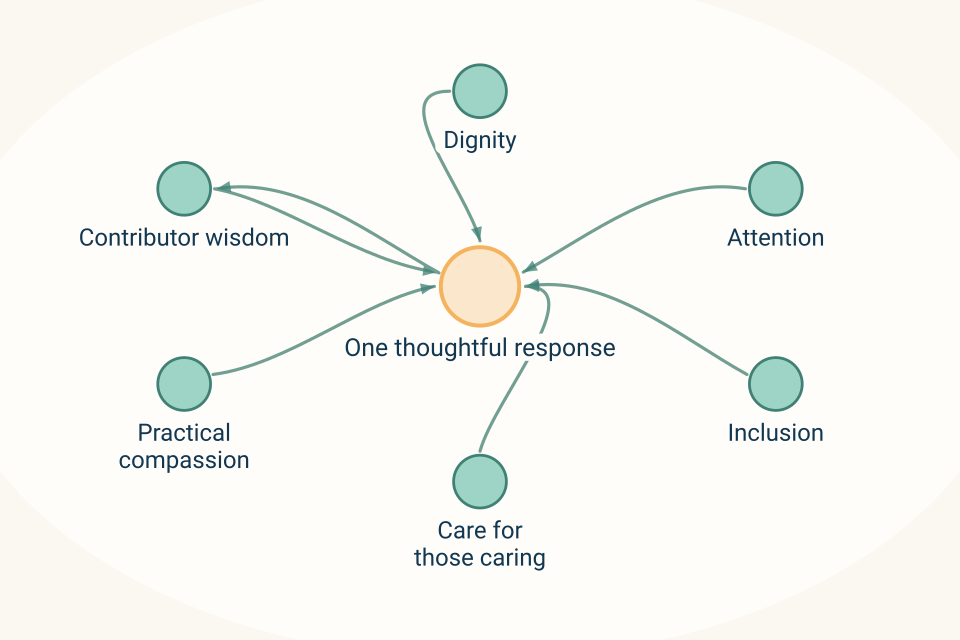
Dignity asks that the response recognize a person’s value before what they can contribute. Attention makes room to hear rather than prepare an answer too soon. Inclusion asks who is affected but missing from the conversation. Care for those caring asks what they could set down if support changed. Practical compassion asks what help is actually received after kind words. Contributor wisdom can change how the next response is prepared. Return to contributors with what their wisdom helped change and preserve their credit. These are selected invitations from the chapter’s wider circle of voices, not a compassion score or a requirement to feel inspired.
At a Glance
The central idea: We honor useful wisdom by letting it change how we see a person—and what we do next.
What you’ll explore: Eight voices whose work invites us to consider dignity, attention, love, inclusion, rest, practical compassion, hope, and community. Their perspectives differ. Each offers something worth bringing into the work of care.
Bring it into your setting: Find a thought for a family conversation, a first visit, a team discussion, or an organizational decision. The aim is encouragement, not another list of obligations.
Carry it forward: Make room for the wisdom of patients, participants, caregivers, volunteers, and frontline teams. Preserve their words, respect their privacy, and show what their contributions helped change.
A Wider Circle of Wisdom
Throughout this book, we have selected quotations from people whose work offers insight into care, communication, learning, and the human condition. Their words have helped introduce questions that deserve more than a passing answer. Yet a few lines cannot hold the contribution of a life, and no book can make room for every voice worth hearing. This chapter widens the circle. It brings additional voices into the conversation, considers the work behind their words, and asks what they might inspire in how we care for one another. Alongside them, we honor the patients, participants, caregivers, volunteers, and frontline teams whose wisdom is often shared without ever appearing in a book.
You may recognize some of these names. Others may introduce a perspective you have not considered before. Read them as invitations, not instructions to feel a particular way.
Their work comes from different places: hospice care, education, feminist thought, disability rights, spiritual practice, medicine, and community organizing. We should not erase those differences to make everyone appear to have said the same thing.
What follows is our reflection on how their contributions can complement CarePhysics. Their words are attributed; the care examples are ours. None of these quotations is an endorsement of the framework or evidence that a service works.
You do not need to finish the chapter with eight new commitments. One thought may be enough. It may help you approach a person differently. It may remind you that you deserve support too.
R6.1 — You Matter Before Anything Else
“You matter because you are you.”
— Cicely Saunders, as remembered by St Christopher’s Hospice.144
Saunders’s hospice work joined attention to physical symptoms with psychological, social, and spiritual suffering. St Christopher’s account describes her concept of total pain and her commitment to professionals bringing their different skills together around the individual.145
The short sentence above carries no entrance requirement. It does not say that a person matters because they are recovering, independent, agreeable, or able to contribute.
That is a place from which to begin Holistic Care.
Before the plan, there is someone whose life the plan is entering. Ask how they want to be addressed. Speak to them rather than only to the person beside them. Learn what they look forward to, what they want explained, and what would make this encounter more comfortable.
A person can need considerable assistance and still have preferences worth hearing. They can change their mind about an activity. They can want company without wanting to perform for the group.
For an organization, the invitation is practical. Design the welcome, the room, the schedule, and the response route so that this attention is possible. Give the team the preparation and support needed to act on what they learn.
For a family caregiver, there is another way to receive the sentence: it includes you. Your health, friendships, privacy, and ordinary enjoyment do not become unimportant because someone else needs help.
Our earlier chapters asked what matters to the person. Saunders’s words remind us why the answer deserves a place in the care.
What would show this person that they matter before they have done anything for us?
R6.2 — Attention Is Something We Can Give
“Listening is where love begins: listening to ourselves and then to our neighbors.”
— Fred Rogers, The World According to Mister Rogers, quoted by the Fred Rogers Institute.146
Rogers worked in children’s television, where his deliberate pauses and attentive exchanges made room for another person. The Institute’s archival reflection connects his outward attention with his own practice of stillness and reflection. His observation about listening includes ourselves as well as others.146
The application to adult care is not to borrow a children’s presentation style. It is to consider what we make possible when we stop filling every space with an explanation.
In context
In Context — The question underneath
This and the later scenes are fictional teaching examples, separate from the book’s continuing family.
A visitor to a Day Center asks whether she has to stay for the entire introduction.
The staff member begins explaining the schedule, then stops.
“Is there something about staying that concerns you?”
“I don’t want to be rude if I decide it isn’t for me.”
“You can tell us that. Looking around is not an agreement to attend.”
Now the schedule can be discussed in the light of the actual question.
Listening did not require a more impressive answer. It required noticing that the prepared answer might be addressing the wrong concern.
This is where Awareness, Communications, and Engagements meet. A useful explanation responds to what the person needs to understand, not only what the organization is ready to say.
A team also needs permission to pause. A script can support someone without requiring them to complete it regardless of the answer. A leader can make time for a question instead of treating every departure from the agenda as a delay.
And listening to ourselves can include recognizing that we are tired, uncertain, or in need of help before continuing.
What might we hear if we were not already preparing our answer?
R6.3 — Love Becomes Visible in What We Do
“There can be no love without justice.”
— bell hooks, from “To Love Again: The Heart of Feminism” in Feminism Is for Everybody, as quoted in the publisher’s description.147
Writing about feminist politics, hooks connected love with freedom from domination, equality, and mutual respect. The sentence belongs within that argument, not merely in a collection of comforting remarks about kindness.147
For care, it invites a demanding but hopeful question: does our concern show up in the way decisions are made?
We may describe a service as welcoming. Who can actually use it? We may encourage someone to express a preference. What happens when the preference is inconvenient? We may praise a caregiver’s devotion. Have we made any of the work easier to share?
Love becomes visible in the answer.
Consider a family planning conversation. Instead of letting the person with the most time on the call become responsible for everything, the adults discuss what each can realistically accept. The person receiving care remains part of the decision. Private concerns have an appropriate route.
Or consider an organization that learns its invitation assumes every household has a nearby relative and a smartphone. It revises the invitation and provides another way to reach the service. The words change because the offer changes.
These are proposed applications of the challenge hooks presents. They connect love with autonomy, access, and responsibility rather than affection alone.
We can begin without pretending that every difficult arrangement will be settled. Ask whose voice is missing, whose work has become invisible, and which decision we have the authority to change.
The purpose is not to judge whether a tired family has loved well enough. It is to make caring less dependent on someone continually surrendering their own needs. That distinction runs through the book’s writing guidance and support chapters.
Where should our stated concern become a different decision?
R6.4 — Belonging Requires a Real Place at the Table
“Disability only becomes a tragedy when society fails to provide the things we need to lead our lives…”
— Judy Heumann, in a 1987 interview recalled by journalist Joseph Shapiro in 2023.148
Heumann challenged exclusion from education, work, and public life. In the interview passage, she named employment opportunities and accessible buildings as examples of what society should provide. Her disability-rights work asked people to examine the barriers around a person, not regard that person’s life as a tragedy.148
The invitation to care organizations is more substantial than making room for someone after the plan is complete. It is to involve the people affected while the plan can still change.
In context
In Context — The invitation is not enough
A home-support organization invites service users to review its new first-visit process. The invitation offers only an online meeting and asks people to complete a written questionnaire beforehand.
One participant phones.
“I can talk with you. I can’t use that form.”
The coordinator offers a telephone conversation without the questionnaire. The participant explains that the most difficult part of the existing process is not the visit itself. It is discovering who will respond when the arrangements change.
The team now has a different design question—and someone who wants to help examine the answer.
Belonging includes an effective way to contribute. It also includes the freedom not to join a committee in order to receive a usable service.
For CarePhysics, this connects Community with accessible Technology and meaningful choice. Ask about language, format, timing, and preferred involvement. Do not infer those preferences from an identity or diagnosis.
Provide a named response to the contribution. Explain what changed, what could not change, and why. If an access problem requires staffing, equipment, or money, bring it to someone able to address that resource need.
A person’s presence at the table should be capable of changing what happens there.
Who is affected by this decision but missing from the conversation?
R6.5 — The People Who Care Deserve Care Too
“Rest is my natural state. It is my birthright.”
— Tricia Hersey, in a Here & Now interview, April 21, 2022.149
Hersey’s work through The Nap Ministry and Rest Is Resistance connects rest with dignity and challenges systems that treat people as instruments of production. Its foundations include Black liberation and womanist thought—a tradition centering Black women’s lives and perspectives. The work is not simply a recommendation to sleep so that we can produce more afterward.150
That distinction matters in a book about care.
Someone should not have to justify rest by promising to become a more efficient caregiver. A worker’s need for a break should not depend on being sufficiently exhausted to earn sympathy.
In our application, the question becomes what support would allow the person to set something down.
For a caregiver, that may mean appropriate assistance being provided while they choose how to use the time. No report of how productively the break was spent is required.
For staff, it may mean removing duplicate entry, providing coverage, or arranging protected time for preparation. For a volunteer, it may mean a bounded role and a straightforward way to say they are unavailable.
Encouragement without those arrangements can become another expectation. An organization should not put a message about rest on the wall while depending on people to finish essential work at home.
Chapter 11 asks who supports the people on whom the care plan depends. Hersey’s contribution helps us resist a narrower answer in which support is valuable only because it extracts more work later.
You can care deeply and need a limit. You can be committed and need someone else to take over an agreed task. Neither requires an apology for being human.
What could someone set down because we changed the support around them?
R6.6 — Compassion Needs Something Practical Behind It
“The idea that some lives matter less is the root of all that is wrong with the world.”
— Paul Farmer, as quoted by Partners In Health.151
Partners In Health, which Farmer co-founded, places equal worth alongside solidarity, accompaniment, and partnership in describing its work. Accompaniment means continuing alongside people as they pursue care, rather than regarding the initial recommendation as the end of the responsibility.151
For CarePhysics, that turns compassion toward the practical arrangements that make help reachable.
A person may understand a recommendation and still be unable to act. Before offering more encouragement, ask whether the obstacle is cost, transport, language, timing, an unanswered request, or something else. Different barriers call for different responses.
A hospital and a community service can agree who will receive a request, who will contact the person, and what happens if the service cannot accept it. A home-care organization can explain how a change is handled without making a family call every possible replacement themselves.
Where the support is unavailable, say so and keep the need visible. A reassuring message cannot provide a missing worker or vehicle. The next responsible action may be to investigate another option, revise the arrangement, or bring the gap to a funding or service-planning discussion.
Compassion therefore belongs in budgets, response capacity, training, and partnership agreements as well as conversations.
It also belongs in honesty. Do not ask a family to depend on a promise nobody has accepted. Do not describe a sent referral as received care.
The contribution Farmer’s words invite us to consider is not only whether we feel concern for someone. It is whether our choices reflect equal concern when their needs are costly, complicated, or easy to overlook.
What help is actually received after our compassionate words are spoken?
R6.7 — Hope Does Not Require an Easy Life
“It’s possible to live a good life, even though it isn’t an easy life.”
— Rachel Naomi Remen, in conversation with Krista Tippett.152
Remen spoke about her own experience of illness and her work as a physician when she made this observation. In the same conversation, she distinguished curing from the wider human work of helping people live with illness, loss, and uncertainty. The reflection did not dismiss medical treatment; she acknowledged its importance in her own life.152
There is room in that perspective for hope without a prediction.
Care can support something worthwhile today even when the future is uncertain. The worthwhile thing belongs to the person: a conversation, a practical decision, quiet company, an activity, or simply time without another demand.
In context
In Context — A different kind of visit
A family member arrives with a familiar game. The person they have come to see looks at it, then toward the window.
“Would you rather sit here?”
“For a while.”
They put the game away. There is no need to rescue the visit by completing the activity they brought. They remain together, and the conversation starts when it starts.
The scene is small. It does not resolve the illness or establish a clinical outcome. It shows a choice that the people involved can recognize as their own.
We should not ask someone to find a lesson in suffering before offering support. Grief does not owe us an optimistic conclusion. A difficult day need not be described as a missed opportunity for growth.
Instead, ask what could make the present more manageable, comfortable, or connected. Listen to the answer without requiring it to be inspiring.
Meaningful participation includes enjoyment and rest. Sometimes hope lies in knowing that there is still something to choose—and someone willing to help make that choice possible.
What would make today more worthwhile without pretending that everything is all right?
R6.8 — Begin Where You Can Make a Difference
“In order to change society, we have to transform ourselves.”
— Grace Lee Boggs, in Roadtrip Nation’s interview profile.153
Boggs’s community work in Detroit connected personal change with collective action. In her writing on community-building education, she described people working to reshape their neighborhoods and schools while also changing through that work. The emphasis was not on individuals improving themselves in isolation from the conditions around them.154
For a care organization, we can take that invitation into our own practices before asking everyone else to change.
When people cannot reach us, examine the route. When staff raise the same difficulty repeatedly, examine what our response has been. When a partnership produces more referrals but no additional capacity, examine the plan rather than celebrating its activity.
Start with a question shared by the people affected. Give them an appropriate way to contribute, including those who cannot attend a formal meeting or comfortably use the chosen technology.
Then choose a change that someone has the authority and resources to make. A small beginning is not a reason to ignore a larger injustice; it is a place to begin learning and accepting responsibility.
This is the connection to shared learning and the first meaningful pathway. We can improve one introduction, one response process, or one recurring encounter while retaining an honest account of what remains unresolved.
A community or state group can help carry those findings into decisions that one local organization cannot make alone. Local experience deserves to inform the larger discussion, not disappear beneath an average.
The encouraging possibility is that we need not arrive with every answer. We can begin with a real question, listen across roles, and let what we learn change our own work.
What should we change about our own way of working before asking others to change?
R6.9 — The Wisdom That Never Appears on a Book Cover
The people quoted here have public records of their work. Much of the wisdom care depends on arrives another way.
A participant explains why an activity would be easier to choose at a different time. A patient corrects an assumption in the instructions. A caregiver identifies the arrangement that repeatedly creates extra work. A volunteer discovers a clearer way to show someone where to go.
These are kinds of contribution to invite—not testimonials we can invent or assume every organization has already collected.
CarePhysics has acknowledged families, patients, caregivers, researchers, and care professionals as contributors since its earlier manuscript. That gratitude should remain part of how the work is done, not only its opening pages.
Ask who noticed the useful idea. Make it possible for them to explain it. Record what was considered, what was tried, and what changed. Return to the contributor with the result, including when the proposal could not be implemented or did not help.
A local success deserves recognition without being made into a universal claim. An unfavorable finding deserves attention without making its contributor seem unhelpful.
Permission matters. Someone may welcome use of the lesson while keeping their name or personal story private. Another may want appropriate credit. Ask rather than assume.
The dated Day Center materials describe ways for staff and families to contribute observations and feedback. The larger invitation is to make such contributions part of a reviewed learning process, not simply a collection of favorable comments.
You do not need a published quotation to offer something worth hearing. A careful observation, a candid question, or a better way to explain a task can give the next person a better starting point.
What has someone receiving or providing care taught you that deserves to be carried forward?
R6.10 — Carry One Thought into the Next Encounter
There is no requirement to turn this chapter into a program.
Choose a thought that stays with you. You may keep it privately, discuss it with someone, or use it to examine an ordinary part of care. It need not become a public pledge.
For a team, one reflection could begin a voluntary discussion during protected work time. For a content creator, it might inform an original article or a short demonstration of a respectful conversation. An optional question could invite people to identify a part of the service they would change.
Keep the source and original context with any quotation. Distinguish the speaker’s words from your interpretation. A poem, interview, or philosophical argument should not be relabeled as clinical evidence.
If the material invites a question or request for help, name the responder and explain what follows. Provide appropriate language and access alternatives. Familiar structure can make the invitation easier to use without requiring everyone to respond in the same way.
Assistance that protects the human purpose
An approved AI assistant could work with reviewed passages and an organization’s own guidance to prepare discussion questions or draft an original care example. A person checks the quotation, its context, and the proposed application before use. Do not ask the assistant to impersonate the speaker, invent an endorsement, or alter words inside quotation marks.
Keep sources, owners, review dates, permitted uses, and corrections. Separate research, reflective writing, local service facts, fiction, and private information. The proposed workflow remains retrieval, local context, drafting, human review, testing, and revision; uploading a book is not model training.
Used with appropriate knowledge, guidelines, and rules, assistance can reduce repeated preparation and help a team give more attention to people. That is an opportunity to test, not a reason to expand its role without review. Genus supplies technology; partners retain their care, staffing, programs, and voice.
Let the thought change something real
For one service change, compare the experience with the current process over an agreed period. Name who reviews it. Ask whether people understood the offer, could use it, and received the support. Count all requests due for response, not only those successfully answered. Include staff effort, family workload, safety, privacy, and access.
Reading, sharing, or praising a quotation is not a measure of compassion. Willingness to recommend, an actual referral, and a received service are different results. No family or staff member should be ranked by enthusiasm for this chapter.
Inspiration should leave people with room to act, ask for help, or rest—not another standard they fear they cannot meet.
A leader may respond by making time. A professional may ask a better question. A family may agree on one bounded responsibility. A participant may help redesign an invitation. A person who has carried too much may recognize that their own need for support belongs in the conversation.
None needs to be grand to be worth doing.
We honor these voices not only by remembering their words, but by making more room for their wisdom in how we care for one another.
Notes
St Christopher’s Hospice. About St Christopher’s. Institutional account of Cicely Saunders and the hospice’s founding purpose. Source (opens a new tab)
St Christopher’s Hospice. Voices and reflections on the work of Cicely Saunders. Institutional historical resource. Source (opens a new tab)
Fred Rogers Institute. Reflections on Fred Rogers: Healing Power of Presence. Archival reflection; includes a quotation from The World According to Mister Rogers. Source (opens a new tab)
hooks b (2000). Feminism Is for Everybody: Passionate Politics. South End Press. Bibliographic listing of the work; later audio edition linked. Source (opens a new tab)
Shapiro J (2023). Activist Judy Heumann led a reimagining of what it means to be disabled. GBH/NPR. March 4; recalls the author’s 1987 interview with Heumann. Source (opens a new tab)
Hersey T (2022). Interview on The Nap Ministry, rest, and sleep. Here & Now, WBUR. April 21. Source (opens a new tab)
Hersey T (2022). Rest Is Resistance: A Manifesto. Little, Brown Spark. Publisher’s description. Source (opens a new tab)
Partners In Health (n.d.). Injustice has a cure: What Drives Us. Institutional statement quoting Paul Farmer on equality, solidarity, and accompaniment. Source (opens a new tab)
Remen RN. How We Live With Loss. Interview with Krista Tippett. The On Being Project. Source (opens a new tab)
Roadtrip Nation. Grace Lee Boggs. Interview profile. Source (opens a new tab)
The James and Grace Lee Boggs Center. Community-Building Education: Its Time Has Come. Grace Lee Boggs’s essay. Source (opens a new tab)