R5
R5 — Connected Outcomes: Social Physics Applied to Healthcare
Honoring the Social Physics Foundation—and Bringing Complementary Knowledge into Care
At a Glance
The central idea: Social Physics helps us see the relationships through which ideas become action. Complementary health knowledge helps us design the support around that action—and examine what it makes possible.
What you’ll explore: An appreciation of Alex Pentland and his collaborators, the social direction their work illuminates, and how that perspective can work alongside behavioral models, communication methods, professional experience, and tested care programs.
Design and AI: Follow useful knowledge into a conversation, a chosen next step, a shared responsibility, and a learning process. Explore assistance that makes human wisdom easier to use while keeping judgment, permission, and accountability with people.
Put it to work: Examine one existing connection: what it is meant to support, which complementary help belongs around it, and how the people involved will know whether it helped.
“Social physics is about idea flow, the way human social networks spread ideas and transform those ideas into behaviors.”
— MIT’s description of Alex Pentland’s Social Physics.5
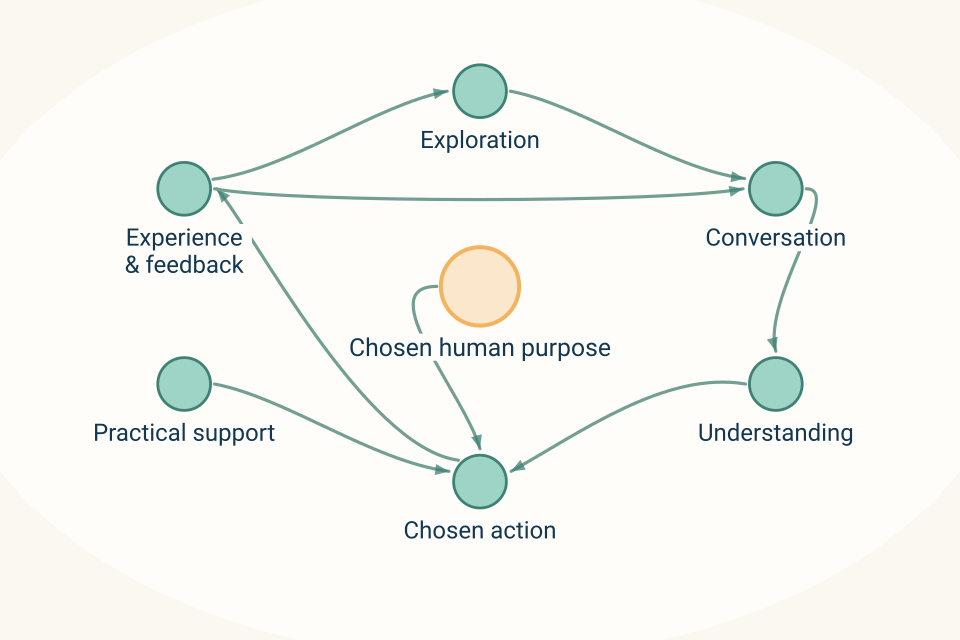
Exploration brings discoveries from other people and sources into conversation. Conversation helps people interpret what the discovery means for them. The person’s own human purpose guides their choice of action. Understanding informs the choice without requiring agreement or action. Practical support addresses the conditions needed for the chosen action to be workable. Examine people’s experience and feedback after an action is tried. Return that learning to the conversation with the people involved. Carry useful experience forward so others can explore it with its context attached. This is the book’s proposed application of Social Physics alongside complementary care knowledge. The combination’s outcomes require evaluation; relationships may also matter simply for belonging and enjoyment.
R5.1 — A Path Worth Following
Some contributions do more than offer a method. They give others a different place from which to begin.
CarePhysics approaches Social Physics in that spirit.
Alex Pentland and his collaborators directed attention to how patterns of interaction shape the movement of ideas and their translation into behavior. Their research used observations of social activity and experiments to examine relationships among communication, group organization, and action. The contribution was not simply another recommendation to connect. It was a way to investigate what happens through those connections.
That is groundwork worth honoring.
For healthcare, it opens a valuable line of inquiry. Alongside asking what a person knows, we can ask how knowledge reaches them, whom they want to discuss it with, whose experience could help, and how the people involved can act together.
Consider a care-planning conversation. A clinician brings professional knowledge. A social worker understands available support. A caregiver explains the difficult part of the evening. A participant offers a preference that changes the proposed activity. A frontline colleague identifies what the team can realistically provide.
Our opportunity is to make room for those contributions and connect them with a decision someone can use.
The social perspective does not diminish individual expertise. It invites us to examine how expertise becomes available beyond the person who holds it. For this book, that is an important reason to place Social Physics beside the independently developed work of Bandura, Rogers, Centola, health-behavior researchers, and communication and care professionals. Each tradition contributes questions of its own.
The original CarePhysics manuscript acknowledged researchers, clinicians, caregivers, families, patients, chaplains, and others whose knowledge shaped its purpose. Its intention was to help organizations bring their expertise and resources into meaningful encounters. This reflection continues that acknowledgment.
We are not completing an unfinished theory. We are bringing complementary bodies of knowledge into the same practical setting.
Social Physics helps us see the social pathways of action. CarePhysics asks how we can design care that makes good use of those pathways.
The appreciation is therefore both intellectual and practical: understand the contribution, preserve its meaning, and carry it into work that can be examined with the people it is intended to help.
R5.2 — The Social Direction: Discover, Interpret, Learn Together
Exploration opens the circle
In Pentland’s account, exploration concerns reaching beyond familiar sources to encounter different people, ideas, and possibilities. Engagement concerns the interaction through which ideas can be interpreted, reinforced, coordinated, and acted upon. These are related functions, not synonyms for opening content or accumulating contacts.
For a care organization, exploration might begin when a nurse learns about a community service previously missing from the discharge conversation. It might come from a caregiver who knows a useful local resource, a volunteer with a practical idea, or another team willing to share something it tried.
The design question is how to make those discoveries available to the people who could use them.
A contact list can be part of the answer. So can a professional introduction, a short demonstration, a reviewed story, or time to speak with someone who understands the setting.
Engagement gives discovery somewhere to go
Now imagine a person learning that a Day Center exists.
The next useful conversation might concern the activities, the assistance provided, the cost, or what an introductory visit involves. Another person may already understand the service and want help arranging transport. Someone else may prefer to consider another option.
The information has reached them. The conversation helps establish what it means for them.
This is the proposed care application of exploration and engagement: not sending more material until someone complies, but connecting discovery with an opportunity to understand, question, choose, and obtain appropriate help.
The social direction is also visible inside a team. A colleague can bring a promising approach from elsewhere; the people doing the work can examine whether it fits, identify what must change, and decide how to try it. The useful knowledge moves outward and returns with experience attached.
The research review informing this book identifies this combination—discovering ideas and having relationships through which to work with them—as Social Physics’s particularly valuable contribution to the care discussion.
Social learning includes the return journey
In our application, the person receiving support does not stand at the end of an information pipeline.
A participant can improve the invitation. A patient can explain why an instruction will not work at home. A caregiver can reveal a burden the organization has overlooked. A volunteer can make a demonstration clearer.
That gives the organization a design responsibility: provide a route for the contribution, consider it, and return with what happened.
A conversation can also be worthwhile simply because people enjoy it. Belonging, friendship, and shared pleasure do not have to produce another care task. Connected outcomes includes those experiences while asking separate questions when an organization promises navigation, respite, or improved health.
We are looking for connections that serve a human purpose—not a requirement to make every relationship more productive.
R5.3 — Complementary Knowledge, a More Complete Response
The social perspective gives us a wider view. Other foundations help us make decisions within it.
Their relationship is not a competition for the best explanation of everything. It is a practical division of attention.
Understand what makes action possible
COM-B, developed by Susan Michie, Maartje van Stralen, and Robert West, examines capability, opportunity, and motivation. The Behaviour Change Wheel connects that analysis with choices about intervention design.2
This adds a useful question to a promising introduction: what needs to be in place for the person to act?
If the explanation is unfamiliar, offer clarification. If a skill is required, provide appropriate instruction and practice. If transport or an available place is missing, investigate that resource. The social connection may help reveal the need and reach someone able to address it.
The same inquiry belongs inside the organization. A worker may understand the referral process but lack time or coverage to complete it. The response then concerns the conditions of the work, not another reminder about caring.
Let purpose remain the person’s own
Self-Determination Theory, associated with Richard Ryan and Edward Deci, examines autonomy, competence, and relatedness. It distinguishes self-endorsed participation from action driven mainly by external control, while recognizing both enjoyment and personally valued reasons for doing something.3
In care, those questions help us use relationships respectfully.
Pat might choose a reading group because the conversation interests him. Ellen might welcome a service because it gives her time for something of her own. Neither needs to adopt the organization’s preferred description of success.
An invitation to contribute can reveal purpose. It can also become pressure if someone feels they must be useful to deserve a place. Our design should leave the person free to lead, listen, rest, or decline.
Motivational interviewing contributes a collaborative way to explore mixed feelings and personal reasons. It helps a professional ask what matters rather than argue someone toward a predetermined decision. Its role is different from solving an unavailable-service problem.
Make the next step understandable and manageable
Social Cognitive Theory directs attention to interactions among personal factors, behavior, and environment. Demonstration and supported practice offer concrete ways to work with learning needs; they are techniques, not the whole theory.
A prospective participant might want to see what a visit involves. A caregiver learning a consequential care skill needs appropriate professional preparation and an opportunity to demonstrate readiness. A person using an unfamiliar screen may simply need someone to show the relevant control.
Fogg’s Behavior Model adds attention to motivation, ability, and a prompt at the moment of action. In our proposed application, it helps turn an overwhelming invitation to organize care into one chosen, useful beginning—such as requesting a conversation.
The receiving service must still make the conversation happen.
Give the encounter a familiar design
Communication and learning-design methods help the team decide what an article should explain, what a video should demonstrate, what a question is for, and how someone can respond.
The CarePhysics pattern gives these formats a common structure: why it matters → main idea → demonstration → chosen next step → questions or connection → what follows. Urgent instructions come first; validated questionnaires retain their wording and scoring; an enjoyable activity need not end with a task.
Keep the way through familiar while adapting the assistance. Our remote-control analogy concerns unfamiliar design, not Pat’s symptoms: knowing the purpose does not make a different set of controls obvious.
These foundations developed in their own right. Together, they help us examine the relationship, the person’s reasons, the practical conditions, and the experience being offered. Their contribution is visible in a better-designed response—not in how many model names appear in the plan.
R5.4 — Seeing the Contributions Together
In context
In Context — The family’s pathway, viewed again
This reflection looks back at the established fictional family. It adds no new clinical event, responsibility, or measured outcome.
Pat’s fall brought him to the hospital. The questions that followed belonged to more than one conversation.
Clinicians remained responsible for assessment. Casey helped the family understand the transition and appropriate contacts. Sam made room for Pat’s preferences and Ellen’s concerns. Lena and the Day Center team explored fit and learned from the day Pat actually experienced.
Maya and Daniel contributed within responsibilities they accepted. Their love did not make their availability unlimited. Emma and Noah remained grandchildren, with adult support for enjoyable time together.
The recurring social-worker meeting made those different contributions discussable: what mattered, what had been observed, what remained uncertain, and who could act. That is the narrative function of the meeting—not a claim that a single coordinator knows or owns everything.
Seen through Social Physics, the story invites attention to the movement of knowledge between these people. Seen through the complementary models, it also invites questions about choice, understanding, resources, and the practical next step.
The ten CarePhysics principles organize those questions in their established order.
Holistic Care begins with the person and the household’s circumstances. Awareness makes relevant information and uncertainty understandable. Behavioral Influence examines a feasible, self-endorsed next step. Communications makes room for listening, disagreement, and clear commitments. Community connects the household with people and resources beyond it.
Engagements shapes each worthwhile encounter. Pathways joins those encounters over time. Technology makes the relevant part accessible. Care AI assists with preparation and the use of reviewed knowledge. Scoring asks what helped, what created difficulty, and what should change.
The principles do not need to be displayed to the family every time they are used.
A tile may hold a short welcome video, an article, and an optional question. A verified contact can be saved in a phone book or printed on a card. A telephone call, virtual meeting, or planned visit supplies the personal conversation. The pathway explains who responds and how the next arrangement is confirmed.
The video should show the actual offer, not an idealized service. The article can preserve necessary detail. The question needs a responder and appropriate privacy. Optional content should not become an obstacle to speaking with a person.
The source communication guide emphasizes this consistency of meaning across channels rather than identical wording.
The later failed ride belongs in the reflection because it exposes a practical condition. Pat wanted to attend and the family was ready. More information would not have moved the vehicle. The partners needed to clarify what happened, communicate with the family, and review their responsibilities.
One subsequent completed day was worth recognizing. It did not resolve every future journey or the separate additional-Tuesday request.
The social perspective remains useful in both moments: when a connection helps, and when the people around it must repair an arrangement.
Love is visible in that work—in direct attention, an accepted responsibility, a limit honestly stated, or room for someone else to rest. The writing guide places those actions at the heart of the book, without making self-sacrifice the proof of love.
R5.5 — When the People We Support Shape the Support
Pat’s request to hear the afternoon choices earlier is a small but important example of knowledge moving in the other direction.
He did not ask for a new program. He identified something about the timing of the existing choice.
Lena could take that suggestion to the team. Staff could explain what was feasible and where the conversation would fit. Pat could then say whether the arrangement helped.
The contribution began with him. The work of implementing it belonged to the people who accepted it. The result needed to be examined with those involved.
That is a useful pattern for health systems, home-care organizations, volunteers, and community services to adopt: make it possible for someone receiving support to improve the way it is offered.
An AI assistant could help record an idea or locate relevant guidance. It should preserve whose idea it was and distinguish a suggestion from an accepted action. A reviewed lesson might later inform a staff huddle, demonstration, article, or pathway.
The dated Day Center materials describe staff wins and observations alongside family feedback and editable notes. They provide examples of contribution routes, not evidence that every contribution produces improvement.
The learning becomes more substantial when the organization records what it considered, who decided, what actually changed, and what happened on review. Its result might be to continue, adjust, stop, or leave the current practice unchanged with a stated reason.
Celebrate a useful change at the level the evidence supports. A person reporting a better experience is something to acknowledge; it is not automatically a generalizable clinical finding.
Keep difficult and unchanged results too. Ask permission before sharing a story, and preserve the lesson without carrying unnecessary private details into another setting.
This gives appreciation a practical form. Researchers are credited for their ideas. Staff are credited for their expertise. Participants, patients, caregivers, and volunteers are credited for what they contribute.
Knowledge travels with its sources, and the people who helped create it can see that they were heard.
R5.6 — AI Can Help Human Wisdom Travel
At Genus, the research and working materials behind CarePhysics are used to help prepare features, articles, videos, questions, and support experiences. This is an internal working practice described in the project’s source material, not a claim that using the collection proves effectiveness.
The same approach can serve another organization’s voice and expertise.
A health system might combine selected research with approved clinical instructions. A Day Center might add current program facts and reviewed activity guidance. A home-care organization might contribute a useful staff explanation and the procedure it must preserve.
The assistant’s task is to make the appropriate knowledge easier to work with.
Before a meeting, it could organize authorized questions, retrieve guidance, and prepare a draft that keeps differing accounts visible. Sam reviews support-planning material within his role; clinicians review clinical matters; Lena confirms Day Center facts.
The process is retrieval → local context → draft or options → human review → testing → revision. Research, design guidance, local facts, fictional examples, and permissioned personal information remain distinguishable. Sources, owners, review dates, permitted uses, and corrections stay attached. Uploading a book is not model training or proof of reliable retrieval.
Help while a question can still be answered
In context
In Context — A prompt for the facilitator
This is an optional, hypothetical live-assistance workflow, not another event in the family’s story or a verified deployment claim.
During an agreed meeting, the assistant offers a quiet suggestion:
A question about who will contact the family if the arrangement changes remains unresolved. Would it be useful to clarify that before closing?
The facilitator checks with the people present. The appropriate person accepts a defined action—or explains what remains to be arranged. The draft summary reflects that answer.
The assistant has helped focus attention. It has not decided what someone feels or declared that the meeting succeeded.
In a 2023 nonclinical randomized study, Sharma and colleagues tested HAILEY’s just-in-time writing suggestions with 300 peer supporters on TalkLife. Assisted replies improved on the study’s measure of conversational empathy. The result supports investigating bounded conversational assistance; it does not establish reliable emotion detection, impartial mediation, or improved clinical outcomes in spoken care meetings.78
Immediate post-encounter feedback can extend the learning. Patients, participants, caregivers, staff, clinicians, and volunteers can be offered separate ways to describe what helped and what remained unanswered. Explain recipients and privacy limits, permit later or nondigital responses, and allow people to decline.
AI can help organize the accounts without deciding which person is right. WHO’s guidance emphasizes defined tasks, stakeholder involvement, and human responsibility while identifying risks from inaccurate or biased outputs and overreliance.1
Protect private notes before they enter a shared workflow. Do not infer emotions or beliefs from tone, appearance, or silence. Keep live prompts limited, optional, and easy to dismiss so the people remain the focus.
Properly applied—with relevant knowledge, guidelines, rules, and review—AI can be a gift. It can help reduce repeated searching and drafting, preserve a useful explanation, and provide more individually relevant support.
A tested assistant can also offer approved routine information when questions arise outside office hours and help someone prepare for a human conversation. State actual human response times and the separate urgent route. Around-the-clock information is not continuous professional care.
Measure the whole task, including checking and corrections. The value of assistance is what it enables people to do with greater attention and less unnecessary work—not how much text it produces.
R5.7 — The Same Foundation, Different Communities
The application should become more specific as it reaches a person or organization.
A health system may use the social perspective to improve a clinical-to-community introduction: what information travels, who accepts the next responsibility, and how the family knows what happened.
A home-care or rehabilitation team may focus on a professionally reviewed demonstration, supported practice, and an appropriate contact between visits. The household’s knowledge about routines can help shape the arrangement without replacing professional guidance.
A Day Center may connect chosen participation with caregiver support. An independent-living community may begin with a clear introduction to assistance people can request without committing to a larger service.
A community or state partnership may learn that repeated access problems require changes in transport, staffing, language assistance, or funding. Shared learning should help identify those decisions, not disguise a resource gap with more persuasive content.
These are proposed directions, not one prescribed network for every household.
Ask about beliefs, culture, language, privacy, preferred supporters, access, and what the person wants care to protect. Do not infer those answers from a name, age, neighborhood, or diagnosis. The reference guidance in R3 develops that person-led approach.
A person may choose family involvement, a private professional conversation, or support from a trusted community group. Someone with few personal connections should receive an appropriate institutional route to help rather than first being asked to build a network.
The people providing that support need preparation and resources too. Budget for staffing, training, interpretation, accessibility, review time, coordination, and technical help. Give volunteers clear roles and a responder. Establish coverage so the pathway does not depend on one constantly available navigator.
The Social Physics review identifies both network exclusion and overload of a person connecting multiple services as risks to address. It recommends attention to reciprocity, alternative routes, and the burden carried by each person.
Genus supplies technology; partners retain care, staffing, programs, relationships, professional decisions, and voice. A sent referral is not a completed handoff. Make permissions and accepted responsibilities visible, along with what happens when a request remains unanswered.
The goal is a better-supported network, not a larger set of obligations imposed on the people already doing the caring.
R5.8 — Learning What the Combination Achieves
The appreciation for this groundwork should lead us to thoughtful tests, not automatic claims.
Different studies illuminate different parts
Social arrangements can change a behavioral response. In their 2013 paper, Ankur Mani, Iyad Rahwan, and Alex Pentland analyzed a physical-activity experiment from MIT’s Friends and Family study. Participants experienced direct rewards, peer-activity visibility, or rewards to peers based on their activity. The peer-reward condition showed the largest short-term increase in the phone-recorded activity measure. The study examined a defined social-incentive arrangement, not clinical care or the acceptability of applying pressure to families.142
Network structure can affect adoption. Damon Centola’s randomized online-network experiment placed more than 1,500 participants in constructed health communities. Adoption of the introduced online tool was greater in clustered networks than in the comparison networks. This related work provides evidence about behavioral diffusion in that setting, not a clinical outcome or a result belonging to Pentland’s study.27
Adding structured care support can improve a specified outcome. Gitlin and colleagues’ ADS Plus cluster-randomized trial involved 203 caregivers across 34 adult day-service sites. Trained staff added education, validation, referrals, problem-solving, and self-care support. Adjusted depression scores were lower in the added-support group at twelve months. The sample was predominantly female and college educated; 22.7 percent were lost to follow-up. The attendance comparison did not meet the conventional statistical-significance threshold.44
ADS Plus is useful for this reflection because it tested additional, structured support around an existing service. It did not test the complete CarePhysics synthesis, AI, or an isolated social-connection feature.
Programs can help on some measures without improving others. The 2025 D-CARE trial enrolled 2,176 person–caregiver pairs and compared health-system dementia care, community-based dementia care, and usual care over eighteen months. It found no significant group differences in its primary outcomes of participant behavioral symptoms and caregiver strain; caregiver self-efficacy was higher in the intervention groups.60
A separate analysis of the same trial found higher caregiver satisfaction with the interventions while several other participant and caregiver outcomes did not differ significantly. These were different programs and comparisons from ADS Plus. The findings help refine the question of what support achieves, rather than settle the value of all coordinated care.143
The grades in the author-held research review also remain distinct: Moderate for SDT intervention evidence, Emerging for the named Fogg approach, and Emerging-to-moderate for the broader Social Physics perspective. These are the review’s judgments, not a new grade for their combination.
Make “amplify” a question we can answer
In this reflection, amplification describes the possibility that complementary support makes an approach more useful by addressing conditions another component leaves untouched.
To establish a combined benefit, specify compared with what, for whom, over what period, using which resources, and on which outcome. Demonstrating an effect greater than the separate components requires a design that can estimate those components and their interaction on a stated scale. Percentages from unrelated studies cannot be added together to establish it.
The principles address different potential breaks in a care experience; their effects are not assumed to multiply.
For a local pathway, record the baseline, population, versions used, data source, denominator, review period, and responsible owner. Network research may require analysis of shared conditions and effects spreading among connected people, rather than treating every observation as independent.
Separate reach, understanding, a first chosen action, adoption, useful participation, services received, outcomes, and attributable impact. Willingness to recommend, actual referrals, and a referred person receiving help also remain different events. Include family and staff effort, safety, privacy, equity, and available service capacity.
Use suitable validated instruments when the claim requires them and preserve their wording and scoring. Report unanswered requests, missing information, withdrawals, and adverse or burdensome experiences—not only completed successes. Never rank how much a family cares or infer staff compassion from participation records.
The dated Day Center export makes some practical boundaries explicit: bookings are not attendance, educational delivery is not evidenced completion, and documentation time requires local measurement. An assistant must work within those facts.
A useful finding gives someone authority to continue, revise, pause, or expand the work. Evaluation should help the service become more dependable, not merely make the report more impressive.
R5.9 — Carrying the Groundwork Forward
The best tribute to a body of work is to understand what it contributes and use it carefully enough that others can build on the result.
Social Physics gives this book an important social direction: look at how knowledge moves, how people interpret it together, and how relationships shape what becomes possible. Complementary health research, professional judgment, and lived experience add different strengths to the same care situation.
CarePhysics brings those contributions into questions an organization can act on: what matters, what should be explained, what must be demonstrated, who can help, what responsibility is accepted, and how we will learn whether the support was useful.
One thing to try
Choose one existing connection—a referral, a welcome, a family conversation, or a staff learning exchange.
Ask a person receiving the support and a person providing it what the connection is intended to make possible. Identify one complementary change: clearer information, a different conversation, appropriate practice, a practical resource, or an accepted responsibility.
Name an owner, provide the support required, and return to examine what happened. Preserve contributor credit and an honest account of the result.
The question is:
What becomes possible when useful knowledge reaches the people who can understand it, choose how to use it, and help one another follow through?
In the family’s story, the screen holds the page. Pat, Ellen, Emma, and Noah supply the relationship. The care around them is intended to protect more opportunities for ordinary time together—not turn that time into another task.
That is the direction worth carrying forward.
A connection opens an opportunity. Thoughtful, practical support helps people use it. A meaningful outcome is what they are better able to understand, choose, receive, contribute, or enjoy.
We honor the groundwork by bringing it into the care people can actually experience—and by leaving the work open to what they teach us next.
Notes
World Health Organization (2024). WHO releases AI ethics and governance guidance for large multi-modal models. January 18. Source (opens a new tab)
Michie S, van Stralen MM, West R (2011). The behaviour change wheel: A new method for characterising and designing behaviour change interventions. Implementation Science. 6:42. DOI: 10.1186/1748-5908-6-42. Source (opens a new tab)
Center for Self-Determination Theory. The Theory. Official account of the work of Edward L. Deci and Richard M. Ryan on autonomy, competence, and relatedness. Source (opens a new tab)
Massachusetts Institute of Technology, Industrial Liaison Program. Social Physics: How Ideas Turn into Action. Book description of Alex Pentland’s work on idea flow, exploration, and engagement. Source (opens a new tab)
University of Pennsylvania, Network Dynamics Group. Spreading Behavior Online. Research summary of Damon Centola’s 2010 online-network experiment. Source (opens a new tab)
Gitlin LN, Roth DL, Marx KA, et al. (2024). Embedding Caregiver Support Within Adult Day Services: Outcomes of a Multisite Trial. The Gerontologist. 64(4):gnad107. DOI: 10.1093/geront/gnad107. Source (opens a new tab)
Reuben DB, Gill TM, Stevens A, et al. (2025). Health System, Community-Based, or Usual Dementia Care for Persons With Dementia and Caregivers: The D-CARE Randomized Clinical Trial. JAMA. 333(11):950–961. DOI: 10.1001/jama.2024.25056. Source (opens a new tab)
Sharma A, Rushton K, Lin IW, et al. (2023). Human–AI collaboration enables more empathic conversations in text-based peer-to-peer mental health support. Nature Machine Intelligence. 5:46–57. DOI: 10.1038/s42256-022-00593-2. Source (opens a new tab)
Mani A, Rahwan I, Pentland A (2013). Inducing Peer Pressure to Promote Cooperation. Scientific Reports. 3:1735. DOI: 10.1038/srep01735. Source (opens a new tab)
Reuben DB, Stevens AB, Gill TM, et al. (2025). Patient and Caregiver Outcomes of Health System, Community-Based, and Usual Dementia Care: A Prespecified Analysis of the Dementia Care Study (D-CARE) Randomized Clinical Trial. JAMA Internal Medicine. Source (opens a new tab)