R7
R7 — Words from the Front Line
Small Sentences That Give Us Room for Grace
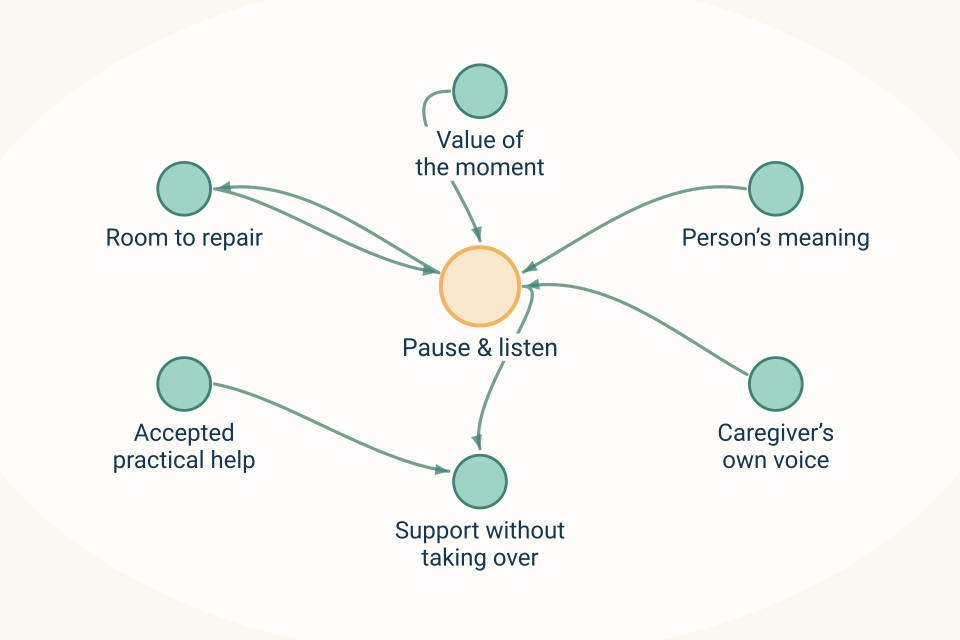
Notice what this moment does and does not need to accomplish before responding. Ask what the person means rather than assume the same words mean the same thing to everyone. Hear the caregiver’s account of their own life. Listening helps identify support that leaves a chosen part with the person. Accepted practical help can make that support usable. A pause can make room to return to a sentence that needs repair. Repairing the conversation means listening again rather than defending the original response. The chapter includes two autobiographical family recollections and ten fictional reflections. These are invitations to reflect, not outcome evidence or a demand for a perfect conversation.
At a Glance
The central idea: An ordinary sentence can give us a reason to pause, a different way to understand, and room to respond with greater care.
What you’ll explore: Two recollections from my own family and ten fictional reflections from the lives of people receiving and providing care. Together, they invite us to consider the value of a moment, the need to be heard, the support behind a promise, and the grace to begin again.
Carry it with you: Choose a thought that speaks to your situation. You do not need to apply every reflection, produce a perfect conversation, or turn a difficult day into an uplifting story.
Something We Needed to Hear
We have all heard words that made us pause. A child says something we had not thought to explain. A caregiver puts a difficult feeling into a few plain words. A nurse offers a sentence that makes room for us to be family rather than organize the next task.
We carry some of those words long after the conversation. They return when we need them, helping us hear a situation differently or be a little gentler with ourselves.
In the previous chapter, we considered people whose words have reached wide audiences. Here, we turn toward the kitchen table, the home visit, the Day Center, the hospital room, and the conversation between colleagues. The person receiving care belongs among these voices—not only as the subject of what other people say.
The words do not have to be famous to change what we hear.
The first two passages are my own recollections. The ten that follow are original fictional dialogue created for this chapter, with imagined contexts. They are not collected quotations, anonymous testimonials, or accounts of actual professionals. They offer situations in which you may recognize a question or remember a moment of your own.
We are not looking for hidden meanings we can confidently assign to strangers. We are making room to ask, to listen, and sometimes to revise the answer we were about to give.
Grace, here, means room to be human: to care deeply without always knowing what to say; to acknowledge a mistake; to accept help; and to recognize that an encounter can matter without resolving everything.
R7.1 — The Value of the Moment
The memories and the moment
“The memories are for me, the moments for my grandmother.”
In context
In Context — Joe’s recollection
I remember my son saying those words. He understood that his grandmother could enjoy their time together even though she would not remember the encounter afterward. He could carry the memory. She could have the moment.
Two people could receive different things from the same time together, and both could matter.
His words give me a way to think about what we ask of a visit. Must it lead to a story that can be retold? Must the conversation stay on course? Must the person remember who came or what they did before we regard the time as worthwhile?
My son’s observation invites a different starting point: what is this time like for the people sharing it?
For another family, that might mean reading a little, listening to music, looking at a picture, or simply being nearby. The activity is an invitation. It can change or stop. A person need not demonstrate what they remember to earn the company.
This also offers grace to the visitor. You do not have to create an extraordinary experience every time. You can arrive as a son, daughter, grandchild, friend, or neighbor—not as someone responsible for producing an improvement.
Children in particular should remain family members, with adults providing the support they need. Their presence is not a treatment assignment.
My son’s words do not tell us what every person experiences. They remind me not to make future recall the condition under which I value present enjoyment.
What are we asking this moment to accomplish that it does not need to accomplish?
The same words, different lives
“I just wanna go home.”
In context
In Context — Joe’s recollection
My daughter said this when she was young and struggling. Later, I heard the same request from my father.
Their situations were different. What connected the words for me was a longing I came to hear beneath them: a wish to return to when everything felt okay.
In those conversations, talking about happy experiences—fishing, camping, a walk—helped ease some of the immediate stress and shift the conversation. We could speak about something familiar and good without first finding an answer to everything that was difficult.
That is how I understood those experiences. I would not turn that understanding into a rule about what everyone means by home.
Someone else may mean an actual place. There may be a practical concern, discomfort, or a question we have not answered. The request deserves attention before we decide that a different subject would be more helpful.
What I carry forward is not a technique for making someone stop asking. It is a reason to listen more closely.
The words may invite us to ask what feels unfamiliar, what is missed, or what the person wants us to understand. They may also remind us to offer company while a concern remains unresolved.
For my daughter and my father, recalling happy moments gave those conversations another direction. It did not make their situations the same. It helped me recognize that answering the words and responding to the person were not always the same task.
You do not need to find a hidden explanation every time. Sometimes the thoughtful response is to admit that you do not yet understand and stay curious. Sometimes it is to bring in someone who can help with the actual need.
What might help us understand what this person means by “home” today?
R7.2 — Hear Before Answering
When the explanation is not the whole answer
“I know you explained it. I’m still scared.”
In context
In Context — Fictional illustration: a patient and a nurse
The nurse has explained the next steps. The patient can describe them. As the conversation appears to be ending, the patient says these words.
The nurse could repeat the explanation. Instead, she asks, “What feels most frightening right now?”
The patient is worried about being at home when another question arises. Together, they review the appropriate contact and what to do when help cannot wait. The nurse checks whether something else remains unanswered.
The conversation does not have to end with a declaration that the fear is gone. It can end with the concern better understood and the relevant support made clearer.
In this scene, the patient was not asking the nurse to prove that she had already done her job. The patient was giving her another piece of information.
For those of us trying to help, there is grace in that distinction. Another question is not necessarily evidence that we explained badly. It may reveal the part we have not discussed yet.
For organizations, this means leaving room beyond delivery of the information. A video or article can prepare a conversation; it should not be treated as evidence that there is nothing left to ask.
Have we answered the question—or only finished the explanation?
When the caregiver is the person being asked
“When you asked how I was, I thought you meant him.”
In context
In Context — Fictional illustration: a family caregiver and a social worker
A caregiver has described appointments, meals, and the difficult parts of the week. The social worker asks how she is doing.
She begins another account of her husband’s day.
“I do want to hear about him,” the social worker says. “I’m also asking about you.”
The caregiver pauses, then offers the sentence above.
The social worker gives her time and explains the available private route for concerns she does not want placed in a shared family update.
This is not an invitation to provide another report. It is an invitation to have an experience of her own.
The answer might concern sleep, friendship, work, worry, or an arrangement that has become too much to carry. It might be that she does not want to discuss it today. Either way, the question belongs to her.
A family can make the same distinction. A call can include the person doing the caring without turning them into a source of updates about someone else.
And when a caregiver does name a need, the next response matters. Help may require an agreed task, a professional conversation, or a service the organization must investigate. Being noticed is a beginning, not a substitute for what has been requested.
When did we last ask this person about their own life—and leave room for the answer?
R7.3 — Help Without Taking Over
Staying nearby
“I can do this part. Could you stay nearby?”
In context
In Context — Fictional illustration: a Day Center participant and a volunteer
A participant is arranging place cards for a small group. A volunteer reaches to finish the stack so everything will be ready.
The participant asks her to wait.
“I can do this part. Could you stay nearby?”
The volunteer leaves the cards within reach and asks which part he would like help with. They continue together, with him doing the portion he chose.
There is no need to stage a success or make the task a test. The useful change is that the offer of help now fits the request.
Support and control can look similar when we are moving quickly. Finishing for someone may feel efficient while taking away the part they wanted to do. The question to ask is not simply whether assistance is needed, but what kind is welcome and appropriate.
This example concerns an ordinary activity. Care tasks with safety requirements need the relevant professional guidance. Preserving choice does not mean leaving someone without necessary assistance.
For a volunteer or staff member, the invitation is modest: ask before assuming the whole task is yours. For the person receiving help, there can be room to request both independence in one part and company in another.
Needing someone nearby does not cancel the contribution being made.
Which part does this person want to do, and what support would let that remain theirs?
Being the one who learns
“She showed me how to do it. For a while, I was the one learning.”
In context
In Context — Fictional illustration: a home-care worker reflecting with a colleague
During an agreed household activity, a woman and her home-care worker arrange a few flowers in a jar. The worker begins placing them together.
The woman suggests a different arrangement and shows how she wants the stems positioned. The worker follows her lead.
Later, describing the exchange to a colleague without sharing private details, the worker says these words.
The woman was receiving assistance. She also had something to offer. Neither fact displaced the other.
CarePhysics asks us to make room for contribution without requiring it. A person might choose to share a skill, recommend a story, explain a familiar routine, or suggest a better way to do something. They may also want to enjoy the company without teaching anyone.
In this example, the worker did not need to invent a special role or offer exaggerated praise. She needed to notice whose knowledge was relevant and be willing to use it.
The same invitation belongs in a health-system planning meeting or a community program. A patient or participant may know something about the practical experience that the team has not yet considered.
Let the knowledge change the work. Ask before recording or reusing a personal story, and give credit in the way its contributor prefers.
What might this person show us if we stopped assuming all the useful knowledge was ours?
R7.4 — Leave Room to Be Family
A visit without an agenda
“Could you come over without a list, just this once?”
In context
In Context — Fictional illustration: a parent and an adult child
The daughter’s list holds important things: a call to make, a form to review, an arrangement to confirm. She brings it because she wants to help and does not want to forget anything.
Her father’s request is not a declaration that the work is unnecessary. He is asking whether there can also be time that belongs to their relationship.
They look at what genuinely needs attention. A call can be made before the visit. Another task can be handled by someone who agrees to it. They decide which work will remain for a later conversation.
Then they make room for a visit that is not organized entirely around getting through the list.
There is no failure of love on either side. The daughter is trying to carry responsibility. Her father is asking for ordinary company. Both deserve support.
The answer should not be another demand that the daughter somehow find more time. It may require the family or service to share the work differently.
This is one place an organization can help preserve relationships: make necessary arrangements clearer and remove avoidable coordination. The distinction remains important—love does not require one person to carry everything.
A relationship can include care without becoming only a set of care tasks.
What would need to be handled differently so this visit could contain more than arrangements?
Someone else has accepted this part
“You can just sit with her. We’ve got this part.”
In context
In Context — Fictional illustration: a hospice nurse and a relative
The nurse has explained the care the team is providing during this visit and who is responsible. The relative keeps asking what else needs doing.
The nurse offers the sentence above, then leaves room for a question.
The relative can sit beside the person she loves. She can talk, listen, or be quiet. She does not have to invent a task to justify being there.
The reassurance rests on the words this part. The team has accepted a specific responsibility. It has not promised unlimited coverage or suggested that no further question will arise.
That is why the statement can mean more than encouragement. Someone has made the room it offers possible.
The relative may choose to remain involved in a task. She may need a break herself. There is no required bedside performance, no perfect thing to say, and no obligation to turn the visit into a memory worthy of retelling.
For the organization, the question is what it can truthfully take responsibility for. For the family, it is whether that accepted help can be received without being treated as a failure of devotion.
Presence does not have to be constant to be sincere. And professional support should not make a relative feel that every moment away is a moment of care withheld.
What responsibility can we genuinely hold so someone else has room to be family?
R7.5 — Make Support Usable
Time away is not always time released
“I can take the afternoon off. I can’t seem to stop being on call.”
In context
In Context — Fictional illustration: a caregiver reviewing a support arrangement
The afternoon is booked. Yet the caregiver keeps the phone close and continues checking what may need changing.
Instead of telling him to relax, the coordinator asks which responsibilities still reach him and what he expects to happen if the arrangement changes.
Some questions concern actual gaps: who answers the provider, who can approve an agreed alternative, and what happens if the usual person is absent. Another concern is that the caregiver has not yet seen how the plan works without his involvement.
They separate what can be clarified now from what needs another person to accept responsibility. They agree when to review the arrangement again.
The caregiver is not asked to switch off his concern on command. Nor is the service booked on the calendar automatically counted as relief he has experienced.
A useful review asks about the preparation, interruptions, and decisions surrounding the time away. It also asks what the caregiver would like the support to make possible.
For leaders, this is a reminder to examine the whole arrangement rather than only the hours supplied. For families, it makes room for a statement that might otherwise feel ungrateful: the help matters, and part of the work is still with me.
Both things can be true.
What is still being carried during the time we call a break?
The obstacle was not the explanation
“I knew where to go. I didn’t have a way to get there.”
In context
In Context — Fictional illustration: a patient and a community navigator
The appointment did not happen. The patient received the directions and understood why the visit had been recommended.
When the navigator calls, the patient explains that there was no workable journey.
The navigator does not begin by repeating the address. They ask what assistance is needed and check the actual transport options, including cost and availability. They explain what still needs confirmation and when the patient will hear again.
The conversation has identified the problem. It has not yet supplied the ride.
That distinction matters to the person who must plan around the answer. A possible resource is not a confirmed arrangement, and a telephone number is not necessarily a journey they can make.
This reflects the barrier-first approach used throughout CarePhysics: different difficulties need different responses. Someone who lacks a practical opportunity does not need to be treated as though they lack motivation.
A community or state partnership may need to address a gap that no individual navigator can resolve. Keeping the unmet need visible is more useful than recording the person as uninterested.
The grace in this sentence is also for the person seeking help. Understanding what needs doing and being able to do it are not the same thing. A practical obstacle is worth naming without apology.
Are we explaining the next step, or helping make it possible?
R7.6 — Give Ourselves Room to Learn
A conversation can be repaired
“Can I say that again? It came out wrong.”
In context
In Context — Fictional illustration: a nurse revisiting her wording
The nurse has said, “You should have called sooner.” As the conversation continues, she recognizes that it sounded like blame.
She stops.
“Can I say that again? It came out wrong. I’m sorry. Can you tell me what made it difficult to reach us?”
The patient can explain, remain upset, or say they do not want to discuss it further at that moment. The apology does not require forgiveness in return.
But the nurse has taken responsibility for her words and made another kind of conversation possible.
This is not a way to make a serious error disappear with a gentler sentence. If information was wrong, correct it. If care or a response was delayed, address what happened through the appropriate process. Repair includes action where action is needed.
For the everyday moment, though, we can leave room to try again. A parent, professional, caregiver, or volunteer need not defend an unhelpful phrase simply because it was the one that came out first.
A team should also be able to reflect on such an encounter without turning it into a public test of character. Ask what support, practice, or working condition would help next time.
Grace does not mean that our words have no consequences. It means we can acknowledge those consequences without deciding that improvement is no longer possible.
Is there a sentence we could return to—not to defend it, but to make room for a better response?
Let the useful part travel
“Tell me what worked. I want the next person to know.”
In context
In Context — Fictional illustration: a team lead and a volunteer
A volunteer describes a first visit. Rather than explain every activity at the door, she asked what the visitor most wanted to see. The visitor chose a quieter place to begin and asked questions there.
The team lead wants to understand the exchange, not simply add a positive story to the report.
What did the visitor ask for? What did the volunteer offer? Which part would require a different arrangement on a busy day? Would the visitor be willing to say whether the approach was useful?
The team can prepare a general practice example without sharing the visitor’s private information. The volunteer receives appropriate credit, and the next person trying the approach knows the circumstances in which it was used.
One encouraging encounter does not establish a universal method. It gives the team something worth considering and, where appropriate, trying again.
Include the difficult part too. A useful handoff can say that the person preferred another approach or that something could not be provided. Learning is not improved by keeping only the flattering accounts.
This is the knowledge-sharing purpose of CarePhysics at an ordinary scale: preserve what someone noticed, review the lesson, adapt it to the next situation, and return with what happened.
A small piece of wisdom should not have to be rediscovered by every person who joins the team.
What did someone learn today that could give the next person a better starting point?
When a Sentence Becomes Support
The twelve reflections point toward different responses. One asks for company. Another asks for a practical resource. Another asks us to notice a person we have overlooked. None is a phrase to apply automatically whenever a situation seems familiar.
Start with the person, their language, beliefs, preferences, and circumstances. Ask rather than assume. Preserve their right to want a different kind of help—or not to discuss something today.
For an organization, a sentence can become a design question. Is the invitation understandable? Can someone ask privately? Does a chosen next step have a responder? Are staff given the time, training, coverage, and resources needed to follow through?
A short article could explore one reflection. A clearly labeled demonstration video could show an imperfect conversation and its repair. An optional question in a tile could prepare a call or virtual meeting, provided the organization names who receives it and what happens next. Offer appropriate telephone, print, language, and access alternatives. Familiar structure should make help easier to find, not require another task before it can be requested.
An inspirational message cannot substitute for staffing, transport, respite, or professional care. If a reflection exposes one of those gaps, let the finding reach someone who can address it.
Let Assistance Preserve the Meaning
A team preparing a voluntary discussion could ask an approved AI assistant to work from one of these reflections and its own reviewed guidance. The assistant might draft questions or an explicitly fictional practice scene. A responsible person checks the result before use.
Keep the labels attached. My family recollections should not acquire invented details. The fictional lines should not become anonymous testimonials. A summary should not turn “I would prefer a private conversation” into a claim about someone’s family relationships or cultural beliefs.
The knowledge-bank approach keeps sources, owners, review dates, permitted uses, and corrections visible. Relevant material is retrieved, placed alongside verified local information, developed into options, reviewed, tried, and revised. Uploading a chapter is not model training or proof that an assistant will use it correctly.
This kind of preparation can be a gift when it removes repetitive work and leaves more attention for people. Its usefulness still needs to be checked, including review effort. Genus supplies technology; the partner retains its care, staffing, program, voice, and professional responsibilities.
No one needs to disclose a private encounter to contribute to the discussion. Obtain appropriate permission for real words shared later, retain disagreements, and let contributors choose how they are credited.
Carry One Thought into Tomorrow
There is no need to complete twelve exercises. Choose one sentence that made you pause.
Perhaps it changes a question you ask. Perhaps it leads a team to examine an arrangement or helps you describe a limit. Perhaps, for now, it simply lets you recognize that you are not required to know every answer.
If a team tries a service change, name an owner, look at what happens now, and agree when to review it. Include everyone offered the changed process rather than only those who responded favorably. Ask whether help was understood and received, what effort it required, and whether it created a privacy, safety, or access problem. A reflection read or shared is not a measure of compassion or a clinical outcome.
Keep the larger distinction in view: a first action, ongoing useful participation, received support, outcomes, and attributable impact are different things. So are willingness to recommend a service, an actual referral, and another person receiving help. Do not turn these passages into a ranking of families or staff.
For the reader, the invitation is more personal.
Recall something someone said that helped you hear differently. You may know the exact words, or only remember what the conversation opened up. Keep that distinction honest. The thought can remain private; it does not need to become content to matter.
There will be moments when the careful words do not bring the response you hoped for. Another person may remain afraid or upset. You may be tired, or discover that the needed help is not yet available. That is not an instruction to try harder indefinitely or to turn disappointment into gratitude.
It is a reason to look again, seek appropriate support, and give the next response a chance to be different.
My son’s words return us to the beginning: the memory he could carry, the moment his grandmother could enjoy. They did not need the same thing from the encounter for it to matter to both of them.
We can bring that generosity into the next conversation. Listen for what is being asked. Offer what we can truthfully provide. Ask for help with what we cannot carry alone.
Sometimes the words we carry forward are simply the ones that help us meet the next moment with a little more understanding—and give ourselves a little grace.