Chapter 3
Behavioral Influence — Support the Next Chosen Step
At a Glance
The central idea: Before asking someone to change, understand what is getting in the way.
What you’ll explore: Why understanding an option does not automatically make it desirable or possible. Learn to distinguish mixed feelings from practical barriers, connect support with a person’s own purpose, and encourage action without using guilt or pressure. Pat and Ellen consider a Day Center while preserving their right to ask questions, explore alternatives, and decide.
Design and AI: Match the response to the need: a conversation, demonstration, clearer explanation, practical assistance, or smaller first step. Explore how an approved AI assistant could prepare relevant options, reduce repetitive work, and help people reach human support without secretly trying to secure agreement.
Put it to work: Create a Barrier-and-Next-Step Guide that connects a chosen goal with the support, responsibility, and follow-through needed to pursue it.
Evidence and evaluation: Examine COM-B, motivational interviewing, Self-Determination Theory, the Fogg Behavior Model, and social-learning research. Evaluate informed choice, barriers addressed, useful action, pressure, access, and workload—not enrollment alone.
“Put simply, this involves coming alongside the person and helping them to say why and how they might change for themselves.”
— Stephen Rollnick, co-developer of motivational interviewing, “About Motivational Interviewing.”28
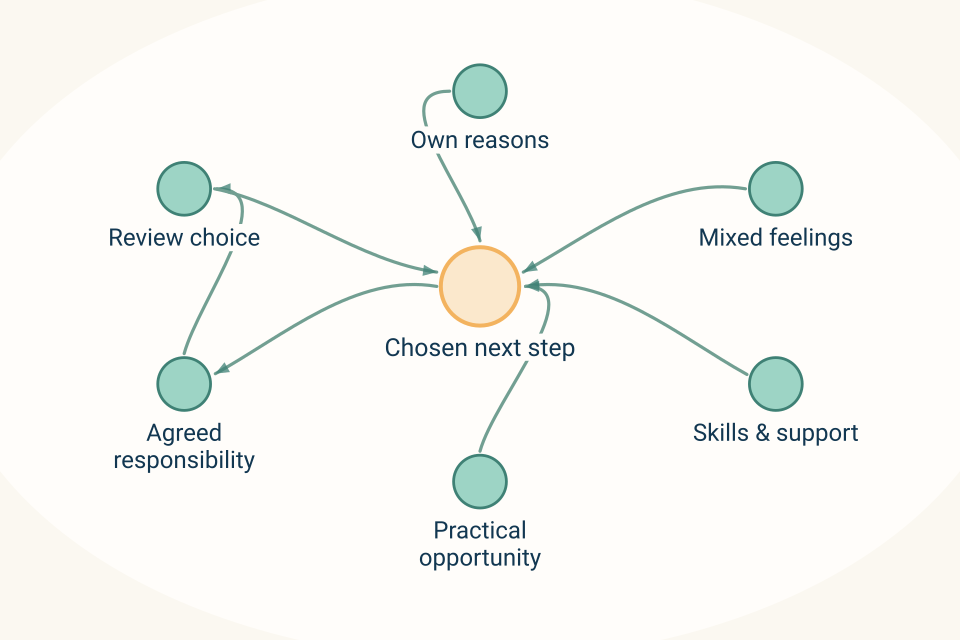
A person’s own reasons guide the next step they choose. Discuss mixed feelings before treating a next step as agreed. Identify the skills and support the chosen step requires. Practical opportunity determines whether the chosen step is feasible. The chosen step connects to an agreed responsibility for support. The responsible person follows through and reviews the experience. Review preserves the person’s ability to reconsider or choose another step. The purpose is informed choice and workable support, not securing enrollment or compliance.
The person keeps a say. |
1. Understand: Know what the offer involves. 2. Opportunity: Check timing, cost, transport, and service fit. 3. Personal reason: Connect the option with what matters to the person. 4. Chosen step: Consider an informational call, another route, or more time. Asking a question is not enrolling. Pausing or declining remains a choice. |
In context
In Context — Pat and Ellen consider an option
Sam placed a short description of a Day Center on the table.
“We’ve talked about finding some support during the week,” he said. “Would you like to hear about one possibility?”
Ellen looked at Pat before answering.
“What would he do there?”
“I’d like to know that too,” Pat said. “And whether I get to choose.”
Sam explained the services described in the center’s current information. Then he stopped.
“What are you picturing when you hear ‘Day Center’?”
“A room where someone tells me what to do until Ellen comes back.”
“And what would you want instead?”
“People I can talk to. Something interesting. Not a whole day organized because nobody knows what else to do with me.”
Ellen turned toward him.
“That isn’t what I want.”
“I know,” Pat said. “I’m asking what they want.”
Sam left the description on the table.
“We should ask them.”
Ellen had a different concern.
“I would like some time when I’m not keeping track of everything. But I don’t want him having a miserable day so I can have a better one.”
“Then we need to look at both experiences,” Sam said. “What the day might offer Pat, and whether the arrangements would actually give you usable time.”
Pat picked up the page.
“Is reading on here?”
“There are activity examples. We would need to ask what they offer now.”
“I’m not joining a committee.”
Ellen smiled. “You usually end up running it.”
“Exactly. I’m trying to avoid that.”
They had not decided to visit. Clinical follow-up was still underway, and the center would need to establish whether its services and eligibility requirements fit Pat’s situation.
But something useful had happened.
Instead of arguing about whether Pat should attend, they had begun identifying what each of them needed to understand—and what would make an introduction worth considering.
Understanding does not remove every barrier
In the previous chapter, the family began separating what they knew from what remained uncertain. They could identify the appropriate people for medical questions and practical support.
That was progress. It was not a decision to use a service.
Before asking someone to change, understand what is getting in the way.
Behavioral Influence brings that question into the design of care. Our approach includes questions, purpose, social influence, humor, and other approaches to supporting change. This edition places those approaches within a clear boundary: they should help people pursue worthwhile goals they can understand and endorse, not make agreement the price of being treated well.
We can explain why an option may help. We can recommend appropriate support within our professional roles. We can encourage someone, offer assistance, and return to a question they have asked us to revisit.
But we should remain open to learning that the option is wrong, the timing is wrong, or the organization has not made participation practical.
The question is not simply, “How do we get a yes?”
It is, “What would help this person make and carry out a sound decision?”
What is making the next step difficult?
COM-B provides a useful starting point. It asks us to consider capability, opportunity, and motivation: what someone can do, what their surroundings make possible, and what directs their action. Capability includes physical abilities and relevant knowledge or skills; opportunity includes resources and social circumstances. Here, capability is a behavioral-model term, not a judgment about someone’s legal decision-making capacity.2
Translated into everyday practice, it gives us three questions.
Does the person understand the action and have the support or skills to take it?
A request to “contact the center” assumes that the person knows which center, whom to ask for, what to say, and how to use the contact route. A clearer invitation or supported first call may address that difficulty.
Is there a practical opportunity?
The person may understand everything and still face an unaffordable fee, an unsuitable schedule, an inaccessible entrance, unavailable transportation, or a service that cannot meet their needs.
Those are not problems to solve with enthusiasm.
Does the action connect with something the person values—and what concerns compete with it?
Someone may want companionship but dislike organized groups. A caregiver may want relief and worry about leaving a loved one with unfamiliar people. Another person may have tried a similar service and had a poor experience.
The research review informing this book makes this distinction central: hesitation about care can arise from knowledge, trust, cost, access, fatigue, family circumstances, or several barriers together. Those situations should not receive the same intervention.
Do not turn these questions into another form people must complete before receiving help. Use them to guide the conversation and the organization’s response.
A reminder may help when a willing person has forgotten a manageable task. It will not create a seat in a full program. A video may clarify what happens during a visit. It will not resolve a fee the household cannot afford.
Sometimes the behavior that needs to change is the organization’s.
A barrier in the action, a constraint in the pathway
A practical barrier can also reveal a recurring limit in the service around the person. Eliyahu M. Goldratt’s Theory of Constraints (TOC) offers a management approach for focusing improvement on what is currently limiting an agreed system goal. Begin by defining that goal, not by labeling a person as the bottleneck.29
COM-B already includes the resources and circumstances that make action possible. TOC adds a process-wide prioritization question: which condition should we address first to make the intended support work? An unanswered request is a clue, not its own explanation. The cause may be missing information, unclear ownership, insufficient capacity, an unsuitable offer, or a decision not to proceed.
Investigate with the people involved. Preserve choice, necessary care, and other important improvements even while focusing the project. See Chapter 7’s worked example. See R2.5’s explanation of the method.
Make room for mixed feelings
Motivational interviewing offers a way to work with ambivalence: wanting something to change while also having reasons to keep things as they are. It uses a collaborative, purposeful conversation to explore the person’s own reasons and possibilities, rather than relying on argument or unsolicited persuasion. It is a learned practice, not a collection of sentences that automatically changes behavior.30
In this chapter, we borrow its stance for an illustrative conversation. We are not presenting a few lines of dialogue as a complete motivational-interviewing intervention.
In context
In Context — Asking what the hesitation means
“What might make a day away from home worthwhile?” Sam asked Pat.
“Having a reason to go.”
“What sort of reason?”
“A good conversation. Hearing something I haven’t heard already.”
“And what might make you decide against it?”
“Being treated like I’ve agreed to everything because I agreed to walk through the door.”
Sam wrote that down.
“So an introduction would need to remain an introduction.”
“Yes.”
He turned to Ellen.
“What would you need to know?”
“That someone would tell me honestly if it wasn’t going well. And that I wouldn’t spend the whole time wondering.”
“Would speaking with the person responsible help you decide what to ask next?”
“It might.”
Sam had not answered their concerns with reassurance he could not substantiate. He had helped make the concerns specific enough to investigate.
Back in practice, that is an important distinction. “You have nothing to worry about” closes a subject. “Who would contact you, and under what circumstances?” creates an answer the organization must be able to provide.
Respecting hesitation does not mean leaving people alone with it.
Purpose is a reason, not a pressure point
Self-Determination Theory asks whether participation feels chosen, manageable, and supported through relationships. Its three central needs—autonomy, competence, and relatedness—give us a way to examine the quality of motivation, not merely whether someone acts.3
For this book, purpose begins with what the person values.
Pat may be interested in a discussion because he enjoys history. That is different from telling him the center needs a retired teacher and implying that declining would disappoint everyone.
An invitation to contribute should be genuine, appropriate, and optional. Pat can offer a story, ask a question, listen, or decide he would rather do something else. His history opens possibilities; it does not assign him a job.
The Day Center materials informing CarePhysics make that distinction concrete: they describe optional hosting and activity roles alongside choices to observe, leave an activity, decline, or change one’s mind. These are documented design examples, not evidence that contribution produces a particular health outcome.
Love needs the same protection.
We should not tell Pat that attending is how he proves he loves Ellen. We should not tell Ellen that a loving wife ought to manage without help. Both deserve support, and neither should have to make the other feel guilty to obtain it.
Culture, beliefs, and family expectations belong in this conversation, but not as assumptions. Ask whom the person wants involved, which routines or practices matter, and whether the proposed arrangement fits. One person may want a family discussion; another may want to consider the option privately. A trusted community or faith connection may be welcome—or irrelevant.
The organization’s task is to discover the difference, not select a script from someone’s background.
Make the beginning smaller—not the decision less honest
Once a person has a reason to explore an option, consider how much the first step asks of them.
BJ Fogg’s Behavior Model examines motivation, ability, and a prompt coming together at the moment of action. In design, it directs attention to whether the requested behavior is manageable when the invitation arrives. It supplements the broader examination of resources and autonomy; it does not replace it.4
“Choose a care program” is a substantial decision.
“Would speaking with the team help you decide what to ask?” is a smaller possibility.
The smaller step must still be truthful. A call described as informational should not trigger enrollment, recurring messages, or wider family sharing without agreement. A visit must not conceal an obligation to attend again.
Make consent easier to understand, not easier to bypass.
A prompt should also follow the person’s preference. Someone may welcome an agreed reminder. Another may want to initiate contact themselves. A decision to pause should not generate increasingly urgent messages.
Small actions are useful when they help people move toward something that matters. They are not valuable simply because a system can count them.
Design content that helps people decide
The content brief now becomes more specific.
Instead of asking a team to create a promotional video, ask it to help people assess whether an introductory conversation or visit would be useful.
The video should show an actual, representative part of the service: the entrance, the welcome, an activity, a quieter option, and the person who answers questions. Filming requires appropriate consent; a staged scene should be identified as a demonstration.
Include a question or exception. Show someone asking whether they can watch before joining. Let the staff response demonstrate the center’s real practice.
The companion article can provide information better considered at a person’s own pace: services, costs, eligibility, transportation arrangements, assistance offered, and what must be confirmed before attendance.
A proposed invitation might read:
Could this Day Center fit your week?
A conversation with the team can help you explore what the program offers and whether it fits your needs and interests.
You can ask about the day, the people providing support, choices during activities, costs, and arrangements for getting there.
For example: “I would like to see an activity before deciding whether to attend. Is that possible?”
You may request a conversation, ask a question in writing, or take more time. Asking for information is not an agreement to enroll.
The center will explain its next steps, including any assessment required before participation.
Before publication, the organization must add its verified contact, responder, response expectation, and actual introductory options. Do not promise a tour, free trial, transportation, or immediate place because those would make the invitation more attractive.
The familiar CarePhysics pattern remains visible: why it matters, the main idea, a demonstration, a chosen next step, questions, and what follows. Different formats can perform different jobs while preserving the same facts and expectations.
A survey can support the same purpose. Ask what information or assistance would help, explain who receives the answer, and include room to say that the service does not seem right. A response should lead somewhere—not simply improve an audience profile.
Put the barrier beside the responsibility
The practical tool for this chapter is a Barrier-and-Next-Step Guide.
It is a conversation aid, not a validated assessment or a score of readiness. Its purpose is to prevent a concern from becoming another task handed back to the family.
In context
In Context — Making the chosen step workable
Pat and Ellen agree that they would like to speak with Lena, who leads the Day Center team.
Sam first confirms that an informational conversation is available while Pat’s clinical assessment continues. That does not establish eligibility for enrollment or participation.
With their permission, he shares the questions they have chosen. Lena accepts responsibility for the call, and they confirm an arrangement that works for Pat and Ellen.
Their guide records:
Question or concern | What needs to happen | Who owns the next step |
|---|---|---|
Pat wants to know whether the activities interest him and whether he has choices. | Explain current activities and actual options to join, observe, rest, or decline. | Lena, with Pat deciding what interests him. |
Ellen wants to understand communication when something is difficult. | Explain the center’s contact practices and limits; answer her questions. | Lena. |
Costs, eligibility, transportation, and required support remain unresolved. | Confirm the requirements and available arrangements before discussing attendance. | Lena provides program facts; Sam helps explore gaps and alternatives. |
Pat and Ellen have chosen a conversation, not enrollment. | Keep the call informational; obtain separate agreement for any later step. | Sam and Lena respect the agreed scope. |
They may decide not to proceed. | Offer further discussion or alternatives when requested, without treating the decision as failure. | Sam, within his role. |
In context
The completed step is a human introduction: Lena has spoken with Sam and accepted the agreed contact.
It is not yet a visit, a delivered service, or respite for Ellen.
That distinction preserves both trust and an accurate account of what has happened.
AI can make the preparation easier
Preparing this kind of conversation involves useful work and repetitive work.
The useful work is understanding what matters, checking what the service can provide, and helping people consider their choices. The repetitive work may include assembling approved descriptions, organizing questions, adapting a handout, and checking whether an agreed contact has been confirmed.
An organization-approved AI assistant could help with that preparation.
It might retrieve current program information and relevant CarePhysics guidance, then draft a comparison of available options. It could distinguish questions already answered from those requiring a person. It could prepare a plain-language article and a video outline from the same approved facts.
A helpful drafting instruction would be:
Prepare options that address the concerns the person has actually expressed. Show what is known, what remains unconfirmed, and who can answer. Do not infer beliefs, diagnose reluctance, invent service availability, or treat enrollment as the required outcome.
Sam would review support-planning material within his role. Lena would confirm program information. Clinical questions would remain with the clinical team. Personal notes would enter the process only with appropriate permission, and a shared draft would exclude private concerns that were not authorized for sharing.
The proposed knowledge-bank workflow keeps research, design guidance, local facts, and personal context distinguishable. It also preserves the source, owner, review date, approved use, and corrections. Giving an assistant the book is a starting resource, not proof that it will apply the ideas correctly.
Properly applied, this assistance can offer a real gift: less time rebuilding routine materials and more attention available for the person.
Families could also ask routine, in-scope questions outside office hours, revisit an explanation, or prepare for a human conversation. The assistant should identify uncertainty and make human help easy to request. Its availability must not be mistaken for continuous professional coverage; actual response times and urgent routes remain explicit.
The assistant should not search for the phrase most likely to overcome a person’s reluctance. It should help identify whether a concern needs information, practical assistance, a different option, or a person who can listen.
That is purposeful personalization: adapting support, not exploiting vulnerability.
The organization has a behavior to change too
Suppose a team rarely makes community referrals.
An annual training presentation may be useful when staff lack information. It is not enough when the referral requires duplicate entry, nobody knows whether the service has capacity, or staff never learn what happened afterward.
The same barrier-first questions apply to professionals. The research review informing this book explicitly identifies time, workflow, knowledge, and uncertainty about follow-through as different possible reasons a referral process is not used.
Ask the team what makes the task difficult. Observe the process with permission. Remove redundant steps. Confirm partner contacts. Allow time for introductions and exceptions. Invite staff to contribute better explanations and practical improvements, then show what changed because they spoke.
Training in motivational interviewing requires practice and feedback, not a script pasted beside the telephone. MINT describes it as a skilled approach requiring self-awareness, discipline, and continuing development.30
The organizational commitments also include capacity, staffing, costs, language access, accessible formats, and alternatives to digital participation. A simple invitation creates work somewhere: someone must answer, interpret, arrange, or follow up.
This applies beyond Day Centers. In an illustrative rehabilitation setting, a person may want to practice but need a demonstration or different arrangement. In home care, hesitation may concern privacy and who enters the home. A working caregiver may need support at a time the program does not currently offer.
Community and state groups can help investigate repeated barriers across organizations. Where transportation, hours, or language support repeatedly prevent access, the response may require resources or service redesign—not a more persuasive campaign.
How would we know it helped?
The central question is whether people can make and carry out a meaningful choice with appropriate support.
Begin with a baseline for one defined service introduction. Then test the revised approach over a stated period, with a named person responsible for reviewing the results.
Keep the stages separate: people reached, options understood, questions answered, next steps chosen, contacts completed, services begun, and participation that remains useful. Willingness to recommend, an actual referral, and a referred person receiving help are also different outcomes. The CarePhysics measurement approach makes these distinctions explicit.
Record both the barrier and what happened to it. “Transportation discussed” is different from “a workable ride confirmed.” “Fee information provided” is different from “an affordable arrangement available.”
Ask about the decision itself. Did the person feel heard? Could they disagree? Did they understand that an introductory call did not commit them to enrollment? Did the process add pressure or relieve uncertainty?
A decision not to use a service may be a sound decision outcome. An unmet need caused by unaffordable or unavailable care is different; calling it “choice” would hide the access problem. The supporting review treats informed non-use as potentially successful while separately examining access, burden, and safety.
Report denominators and missing information. How many people were offered support? How many responded? Who could not be reached through the chosen route? Include people using paper, telephone, interpretation, or personal assistance.
Count staff and family effort, including travel, intake, preparation, AI review, corrections, and follow-up. Reduced administrative work must be demonstrated after those costs are included.
Do not rank families by participation or staff by how often they obtain agreement. Use the findings to improve the offer, resolve barriers, change the process, or stop an unhelpful approach.
Models and Evidence Behind This Chapter
These foundations serve different purposes. A model organizes questions. A study tests a particular intervention or relationship. A CarePhysics example proposes an application.
The evidence labels below follow the research review informing this book. They are not a single clinical grade for the whole chapter, and evidence for a mechanism does not establish the effectiveness of a Genus feature or this fictional pathway.
COM-B and the Behaviour Change Wheel
Match the response to the barrier
Foundation and use. COM-B guides the distinction among needing understanding or skills, having a practical opportunity, and wanting to pursue the action. We use it before choosing a reminder, explanation, conversation, or service change.
Foundational research. Susan Michie, Maartje van Stralen, and Robert West’s 2011 paper reviewed 19 behavioral frameworks to develop the Behaviour Change Wheel. It examined the reliability of applying the framework to existing interventions and called for further research on whether it improves intervention design and effectiveness. It was not a trial of Day Center introductions.2
Evidence boundary. The research review informing this book labels this Strong conceptual support. It does not justify saying that COM-B increases participation by a predictable amount.
Local question: Did identifying the barrier change what the organization actually provided?
Motivational interviewing
Explore the person’s own reasons for change
Foundation and use. Motivational interviewing supports collaborative exploration of mixed feelings, values, confidence, and possible action. In the chapter, Sam asks what would make the option worthwhile and what might make Pat or Ellen decide against it. He does not argue them into agreement.30
Supporting review. Sevda Uzun and Nermin Gürhan’s 2024 meta-analysis included 38 studies and 25,425 participants with chronic illnesses. It found a small average improvement in quality of life, but no statistically significant pooled improvement in self-efficacy. Results varied greatly between studies; some studies were small or used before-and-after designs. The underlying search ended in May 2021.31
Evidence boundary. The CarePhysics review grades this evidence Moderate. The findings concern the studied interventions, not a few conversational phrases or an AI imitation of motivational interviewing.
Local question: Did the conversation clarify a concern or chosen goal while preserving the person’s ability to disagree?
Self-Determination Theory
Examine whether participation feels chosen
Foundation and use. Autonomy, competence, and relatedness inform the chapter’s emphasis on choice, manageable steps, and supportive relationships. They also help us examine whether purpose is being offered as an opportunity or used as pressure.3
Supporting review. Nikos Ntoumanis and colleagues’ meta-analysis, published in the 2021 volume of Health Psychology Review, included 73 health-domain intervention studies: 58 randomized trials and 15 quasi-experimental studies. It found generally small-to-medium changes in motivational measures and health behaviors, with smaller positive changes in physical and psychological health. Effects varied across studies and over time.17
Evidence boundary. Our commissioned review grades the intervention evidence Moderate. It does not establish that offering a choice of activities will improve health, or that every supportive invitation will result in attendance.
Local question: Did people experience meaningful choice and appropriate help, rather than a polite form of control?
The Fogg Behavior Model
Make the chosen beginning manageable
Foundation and use. Fogg’s model focuses on motivation, ability, and a prompt at the moment of action. Here, it informs the move from a large decision about care to a manageable informational conversation—after the family’s concerns and practical circumstances have been considered.4
Supporting review. A 2025 scoping review by Giuliano Duarte-Anselmi and colleagues identified six studies applying the model in health-related interventions. The studies addressed different populations, behaviors, and delivery methods. The review reported promising findings but also limited long-term follow-up and a need for stronger comparative research. A scoping review maps a field; it does not provide a dependable pooled estimate of effectiveness.32
Evidence boundary. Our commissioned review grades the named model’s health-application evidence Emerging. A smaller first action is not automatically a lasting habit or a beneficial care outcome.
Local question: Did reducing unnecessary effort help someone take a useful step they had chosen—and did that step lead anywhere helpful?
Social Physics and related network research
Give new information a route into human support
Foundation and use. Alex Pentland’s Social Physics emphasizes idea flow, exploration, and engagement: discovering ideas beyond one’s immediate circle and working with them through interaction. In this chapter, Sam introduces an outside resource and helps the family reach someone who can answer for it. That is a proposed care application of the network perspective.5
Related experiment. Damon Centola’s 2010 online-network experiment involved more than 1,500 participants assigned to differently structured networks. Adoption of an online health tool averaged approximately 54 percent in clustered networks versus 38 percent in randomly structured networks. This demonstrated that network structure and reinforcing contacts could affect that behavior in the experimental setting.27
Evidence boundary. This was not a trial of family care or Day Center attendance, nor a validation of Pentland’s entire framework. Our commissioned review grades the broader Social Physics perspective Emerging-to-moderate and cautions that social learning can carry mistakes as well as useful information.
Local question: Did an introduction help someone obtain reliable answers or practical support—with permission—rather than simply expose them to more messages?
One thing to try
Choose one situation your organization currently describes as “people not engaging.”
Replace that label with a specific, observable event: people request information but do not arrange a conversation, for example.
Ask someone who experienced the process what happened. Do not begin with your explanation.
Identify whether the next useful response is information, a demonstration, a conversation, practical assistance, a different option, or permission to pause. Assign responsibility for providing it, then check whether it helped.
Your team’s question is:
Are we asking the person to become more motivated when we should be making the support more workable?
A chosen step still needs people behind it
In context
In Context — From considering help to sharing responsibility
When the call with Lena was arranged, Pat placed the note beside his book.
“Just questions,” he said.
“Just questions,” Ellen agreed.
She had written down what she wanted to ask about the day and how the center would keep in touch. Pat had added his own question at the bottom.
“Can I watch first?”
Later, Daniel called.
“Let me know what you decide. I’m happy to help.”
Ellen appreciated the offer. She also knew that deciding what help to ask for, finding a time, and checking the arrangements could become another job.
Pat and Ellen had chosen a next step. They had not yet agreed how the adults around them would share the work that might follow.
That would require more than willingness.
It would require people to say what they needed, listen to one another, and make commitments others could rely on.
That is the next principle:
Communications — Help People Feel Heard.
Notes
Michie S, van Stralen MM, West R (2011). The behaviour change wheel: A new method for characterising and designing behaviour change interventions. Implementation Science. 6:42. DOI: 10.1186/1748-5908-6-42. Source (opens a new tab)
Center for Self-Determination Theory. The Theory. Official account of the work of Edward L. Deci and Richard M. Ryan on autonomy, competence, and relatedness. Source (opens a new tab)
Fogg BJ. Fogg Behavior Model. Stanford Behavior Design Lab. The model describes motivation, ability, and a prompt converging for behavior. Source (opens a new tab)
Massachusetts Institute of Technology, Industrial Liaison Program. Social Physics: How Ideas Turn into Action. Book description of Alex Pentland’s work on idea flow, exploration, and engagement. Source (opens a new tab)
Ntoumanis N, Ng JYY, Prestwich A, et al. (2021). A meta-analysis of self-determination theory-informed intervention studies in the health domain: effects on motivation, health behavior, physical, and psychological health. Health Psychology Review. 15(2):214–244. DOI: 10.1080/17437199.2020.1718529. Source (opens a new tab)
University of Pennsylvania, Network Dynamics Group. Spreading Behavior Online. Research summary of Damon Centola’s 2010 online-network experiment. Source (opens a new tab)
Rollnick S. About Motivational Interviewing. Author’s description of the approach. Source (opens a new tab)
Theory of Constraints International Certification Organization (TOCICO) (n.d.). Masterclass Series: Introduction to Theory of Constraints. Public presentation description and learning summary; Alan Barnard. Public source [R1: TOC2; checked October 1, 2026]. Source (opens a new tab)
Motivational Interviewing Network of Trainers. Understanding Motivational Interviewing. Source (opens a new tab)
Uzun S, Gürhan N (2024). The effect of motivational interviewing on quality of life and self-efficacy behaviors of individuals with chronic illness: A meta-analysis study. Public Health Nursing. 41(5):901–922. DOI: 10.1111/phn.13339. Source (opens a new tab)
Duarte-Anselmi G, Crane SM, Armayones Ruiz M, Villalobos Dintrans P (2025). Behavioral science meets public health: a scoping review of the Fogg Behavior Model in behavior change interventions. BMC Public Health. 25:3468. DOI: 10.1186/s12889-025-24525-y. Source (opens a new tab)