Appendices and Practical Tools
Put the Knowledge to Work
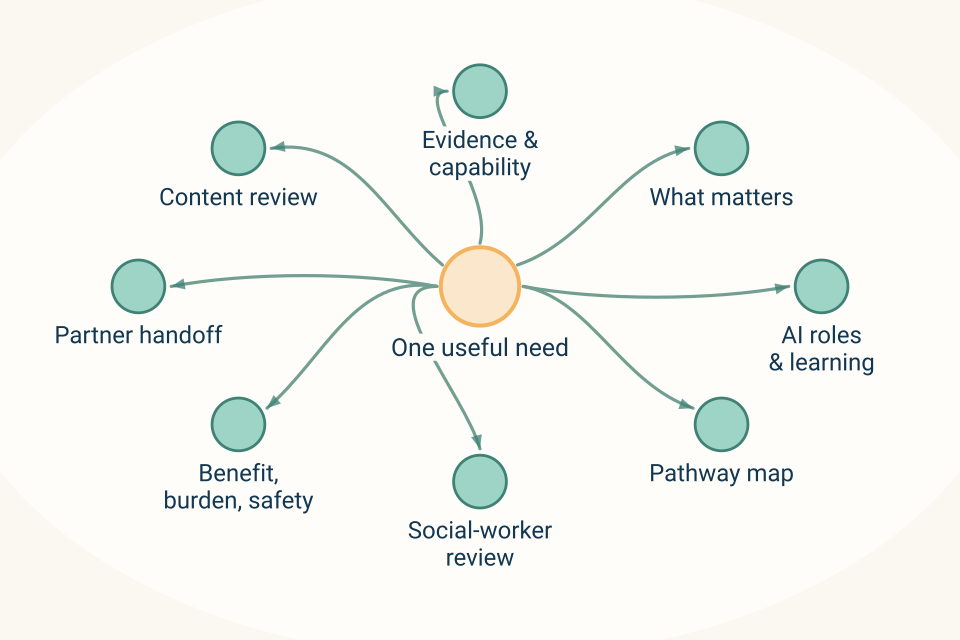
Use Appendix A to examine evidence and Appendix J to distinguish an idea, capability, deployment and demonstrated benefit. Use Appendix B to understand what the person and chosen supporters want known. Use Appendix C to define an assistant’s role and Appendix I to review errors and learning. Use Appendix D to connect a chosen next step with people, resources, confirmation and alternatives. Use Appendix E to prepare a social-worker review conversation and record actual agreement. Use Appendix F to examine benefit, burden, safety, access and what should change. Use Appendix G to establish accepted partner responsibilities and confirm follow-through. Use Appendix H to review understandable content and maintain its knowledge sources. This is the single shared overview for Appendices A–J. The tools are adaptable planning aids, not validated clinical questionnaires, legal agreements or proof of program effectiveness.
Begin with the need—not the form
A useful tool should help someone ask a better question, make a clearer decision, or carry an agreed responsibility. It should not become another obstacle between a person and help.
The chapters have shown what that work can look like. These appendices turn the planning tools into records you can adapt for your setting. They are intended for health systems, home-care organizations, Day Centers, community partners, families, and the people who support them. You do not need to reproduce Pat and Ellen’s pathway or adopt a particular technology to begin.
Choose one situation: an introduction that leaves people uncertain, a caregiver who needs practical support, a resource that needs review, or a handoff nobody can confirm. Start with the relevant tool, involve the people affected, and decide who can act on what you learn.
These are adaptable planning aids, not validated clinical questionnaires, legal agreements, or evidence that a program works. The fields below develop the book’s proposed tools. Required professional procedures and records remain in place; refer to them rather than creating competing instructions.
A family can use selected questions in conversation without completing every field. A staff member can help record the agreed part. Leave room for “not known,” “not discussed,” and “prefer not to answer.” Do not turn an empty box into a guessed fact.
The aim is not a completed collection of forms. It is support that someone can understand, choose, and receive.
Choose the tool that fits
Appendix | Tool | Use it when you need to… |
|---|---|---|
A | Evidence Register | Understand what supports a claim and where its limits belong. |
B | Person + Family “What Matters” Profile | Learn what the person and their chosen supporters want understood. |
C | Assistant Role Card | Define an AI assistant’s task, sources, permissions, review, and limits. |
D | Pathway Map | Connect a chosen next step with people, resources, confirmations, and alternatives. |
E | Social-Worker Review Meeting Pack | Prepare a useful conversation and record what people actually agree. |
F | Benefit–Burden–Safety Measurement Plan | Examine usefulness, effort, safety, access, and what should change. |
G | Partner Handoff Agreement | Establish what each organization accepts and how follow-through is confirmed. |
H | Content, Tile, and Pathway Review | Prepare understandable material and maintain the knowledge behind it. |
I | AI Safety and Learning Log | Respond to errors, preserve useful ideas, and verify the resulting changes. |
J | Genus Capability and Evidence Matrix | Distinguish an idea, a documented capability, a local deployment, and demonstrated benefit. |
The A–J identifiers follow the appendix plan. Related planning cards bring the later chapter outputs into this collection: the project charter and backup plan sit in D, staff support in E, shared learning in F, and organizational knowledge stewardship in H. These are proposed working versions of the chapter tools, not additional principles.
Give each working copy a clear home
For whichever tool you use, record its purpose, version, date, named owner, relevant reviewer, next review point, approved storage location, and intended recipients. Add backup coverage where the work depends on a response.
Reuse verified information from the appropriate record instead of asking people to repeat it unnecessarily. Keep private accounts in the appropriate restricted location; a “private” heading inside a document shared with everyone is not a separate channel.
The questions can stay familiar while the language, format, timing, and assistance change. Ask what works for this person. Do not infer beliefs, preferences, or family roles from a demographic label. Protect time for enjoyment and rest as well as action.