Closing Reflection — The Future We Choose
More capable technology. More room for one another.
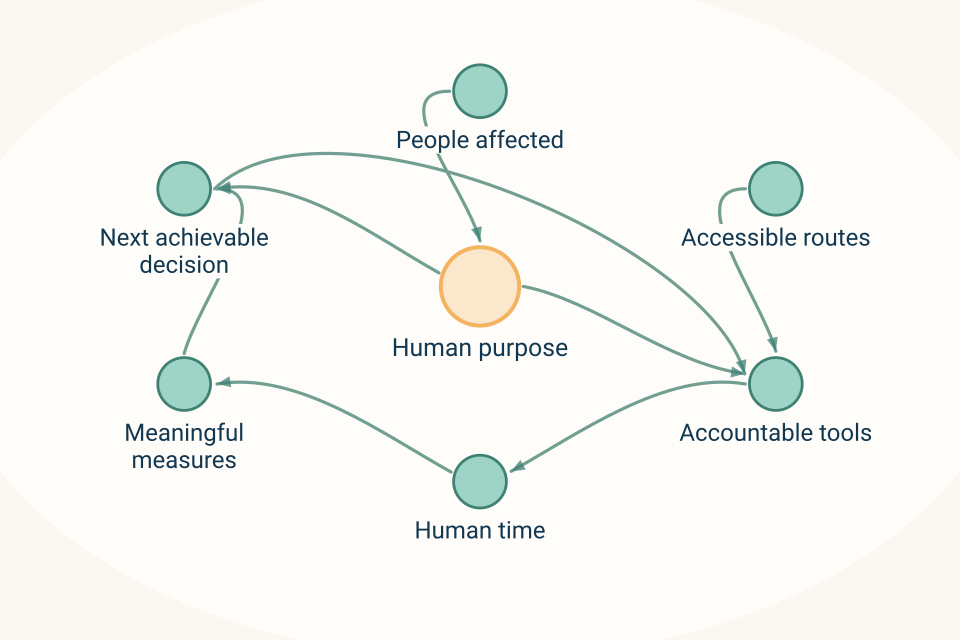
People affected by a proposed tool help define its human purpose. That purpose directs the design of accountable tools. Accessible routes help determine whether people can actually use the tools. The proposed tools should aim to protect human time rather than consume it. Examine whether human time and other meaningful experiences actually changed. Meaningful measures inform the next achievable decision. Human purpose continues to guide that decision. The decision changes which tools and arrangements are tried next. The chapter’s future examples are possibilities, not deployment promises, forecasts or established benefits.
The Next Five Years — A Window of Possibility
The next five years could bring into everyday care possibilities that once seemed decades away. Looking from 2026 toward 2031, we can imagine more capable robots supporting teams, transportation becoming easier to use, and medical devices fitting more naturally into the places we live.
The opportunity is not simply to welcome more capable machines. It is to be clear about the kind of care we want them to help us create.
Perhaps a nurse will spend less of a shift retrieving supplies and more time hearing a concern. Perhaps a person who needs travel assistance will be able to choose an afternoon with friends without turning the journey into a family project. Perhaps a caregiver will finish the day without reconstructing the same information for several different people.
These are futures worth working toward.
There are visible beginnings. In May 2025, ChristianaCare described its use of collaborative robots and a research fellowship that gave bedside nurses a role in studying robotics in hospital work.175
The FDA’s Home as a Health Care Hub initiative and Idea Lab examine how medical devices could fit people’s homes, routines, and other technologies rather than operate as isolated pieces of equipment.176
Neither example supplies a timetable for every household or organization. They give us something concrete to learn from while we shape the next version.
The question is not only what the technology will become capable of doing.
What should become easier, more dependable, or more human because it is there?
The Star Trek Invitation — Imagine the People as Well as the Devices
Star Trek offers a useful image for this closing. Its official account of the franchise emphasizes an optimistic future associated with diversity, inclusion, acceptance, and hope.177
The remarkable devices are part of the appeal. But there is another part worth bringing into our conversation: different people using their knowledge to face a shared challenge.
That is the invitation we can take from the fiction. Imagine the people as carefully as the equipment.
Who belongs in the room? Who is heard when the plan is being developed? What does the person with the most powerful tool do when someone else knows something they have missed?
In care, we can bring those questions into design before a product is finished. Invite the person who will use it, the caregiver who knows the evening routine, the worker who understands the difficult handoff, and the community partner responsible for what follows.
Imagination becomes practical when a conversation changes a design brief, a budget, a service agreement, or a test. A hopeful description can give people something to examine together. Their questions can then make the proposal better.
We do not have to predict every invention to take part in that work. We can name what we want preserved: choice, dignity, useful help, and relationships with room for disagreement and affection.
We can imagine a future with extraordinary tools and still make the most important part of the picture the people working together.
Quiet Technology, Visible Care
A useful ambition is technology that asks less of our attention while making appropriate help easier to reach.
Imagine fewer repeated forms, familiar controls, and relevant information available to an authorized professional before the conversation begins. The person should not need to understand every system behind the service to use the part that matters today.
But quiet does not mean concealed. People should understand what is being collected, what is shared, and who is responsible. The communication discipline developed throughout this book asks us to simplify the experience without hiding the human role or the handoff.
A robot can earn its place by doing a defined task well. An assistant can help prepare a question without pretending to be a clinician or family member. Neither needs to imitate love to support the people who bring it.
Let the technology be quiet in its operation and clear about its responsibilities.
For leaders, this raises a decision that belongs near the beginning of a project: when a tool genuinely returns time, what will we protect that time for?
Listening, direct care, preparation, learning, and rest should be possible answers. We can also use greater capacity to reach people waiting for help. What matters is making that choice deliberately, rather than assuming every saved minute must become another demand.
Glimpses of a Future Worth Building
In context
In Context — Six imagined futures
The following scenes are original future illustrations, not reports of deployed services or predictions that every capability will be available by 2031. They do not extend Pat and Ellen’s clinical story. Each begins with something a person wants to do.
In context
A nurse stays with the person
A patient has another question. The nurse sits down to hear it.
The supplies needed for the next part of the visit have already been requested. A logistics robot carries them to the agreed delivery point through a workflow the team has tested. Staff confirm that the correct items arrived; the robot does not choose the treatment.
The nurse is still there when the patient explains what has been worrying him.
In this imagined hospital, the useful innovation is not only movement down a corridor. It is the opportunity to reduce an avoidable interruption. The nursing team helps decide which tasks belong in the workflow and whether it actually gives them more room for care.
In context
An ordinary task remains someone’s own
In an assisted-living community, a resident is preparing to show a small group how she arranges flowers.
An assistive robot brings the agreed materials to a position she can reach. A staff member has checked the setup and remains available for the help she requests.
The resident chooses the flowers. She changes the arrangement. When someone asks why she places one stem apart from the others, she explains.
The machine has helped move materials. The knowledge and the pleasure of sharing it belong to her.
A similar design might support a community-center workshop or an ordinary activity at home. The aim is not to complete every task for someone. It is to preserve the parts they want to do and provide suitable assistance around them.
In context
The journey makes the day possible
A man wants to meet a friend at a Day Center’s open community event. He uses a wheelchair and needs a travel arrangement he can trust.
An accessible automated service, authorized for the route and suitable for his needs, provides a clear way to confirm the journey. He can book through an accessible interface or a staffed telephone service. He knows how to identify the vehicle, obtain the boarding assistance he needs, and reach a person during the trip.
His mobility device is secured appropriately. The destination and arrival assistance are confirmed. Someone has accepted responsibility for the return arrangements and for helping if the plan changes.
He arrives to see his friend.
The achievement is not simply that a vehicle drove itself. It is that the whole journey became usable.
The U.S. Department of Transportation’s 2022 Inclusive Design Challenge explored prototypes addressing vehicle location, boarding, securement, interaction, and exit. Those design questions offer a starting point, not proof that accessible automated travel is now available everywhere.178
In context
The home remains a home
A woman completes an agreed measurement using a medical device selected with her care team. It fits comfortably within her routine and sends the relevant reading through the authorized system.
She does not copy the number into another form. She can see whether it was received and understands when the team reviews readings, what is not continuously monitored, and whom to contact with a concern.
The device does not decide how she feels. During the next conversation, she explains something that the measurement does not capture. The clinician considers both.
Elsewhere in the home, an accessible control adjusts the lighting she chooses. There are ordinary switches and a workable plan for equipment or connection failure. Clinical equipment has an appropriate place; it does not dictate the appearance and rhythm of every room.
Home is still where she lives, welcomes people, and closes the door when she wants privacy.
In context
A question gets a useful beginning at any hour
Late in the evening, a caregiver remembers a nonurgent question about an upcoming support visit.
An approved assistant retrieves the organization’s current guide, explains what the visit includes, and helps her prepare the question she wants a person to answer. It identifies the source rather than improvising a service promise.
She chooses to send the question. The assistant states when a human response is expected and keeps a submitted request distinct from an accepted appointment. The separate urgent-help route is easy to find.
At the next conversation, the professional has the question in advance. The caregiver can explain what matters rather than begin by reconstructing the inquiry.
The assistant was available when the thought occurred. A person remains responsible for the care and the answer requiring judgment.
In context
Connection is easier to choose
At a community center, a participant wants to share a story with a relative who lives away. A familiar display supports the call and puts the chosen material where both can see it.
A volunteer helps with the setup, then steps back. The participant chooses whether to read, talk about a picture, or move on to something else. No private care information appears on the shared screen.
Later, the same kind of accessible tool might help someone join a group discussion or arrange a conversation with a friend. Introductions are offered with permission, not generated as obligations.
When the conversation ends, the screen can go quiet. There is no streak to preserve and no demand for a report.
The technology helped make the encounter possible. The people decided what to make of it.
Better Feedback, Better Conversations
These scenes bring two kinds of information together.
Technical feedback might tell the team that a reading arrived, a delivery was completed, or a journey was interrupted. Human feedback explains whether the arrangement was understandable, comfortable, wanted, and useful.
Our design should give each its proper place. A reassuring dashboard should not dismiss a person’s concern. A pleasant conversation should not be reported as proof that a clinical measure improved.
Connect the information with a response: appropriate review, a conversation where needed, an accepted next action, and follow-through.
The ten principles remain useful here. Holistic Care starts with the person. Awareness and Communications support understanding. Behavioral Influence asks about a chosen, feasible action; Community brings relevant relationships and services into reach. Engagements and Pathways organize the experience. Technology and Care AI assist the work. Scoring helps us examine it. This is complementary design, not a formula that guarantees multiplied effects.
The knowledge should also travel back from the encounter. A participant might suggest a better invitation; a caregiver might identify duplicated work; a volunteer might improve the demonstration. Staff can explain what the proposed change would require.
An approved assistant could organize those ideas and prepare options from reviewed research and local guidance. A responsible person checks the sources, feasibility, and permission to reuse the material. The team tries an appropriate change, credits its contributors, and returns with what happened—including when the result was unhelpful.
Keep research, local facts, fictional examples, and private context distinct. Retain owners, review dates, approved uses, and corrections. Retrieval, drafting, human review, testing, and revision are separate steps; uploading this book does not train a model or establish that it will apply the knowledge reliably.
WHO’s AI guidance likewise calls for defined tasks and stakeholder involvement and warns about inaccurate outputs and inappropriate delegation. These responsibilities belong inside the design, not outside the hopeful picture.1
With relevant knowledge, clear guidelines, practical rules, and accountable people, AI can be a gift: less repetitive preparation and more useful support around the next human conversation.
The Words We Use Help Set the Direction
Every reader can contribute to this future through the questions and expectations they bring into a conversation.
When we describe a technology, begin with what someone is trying to do. Explain the actual assistance. Show who remains responsible and what happens next.
Compare two possible design ambitions. One begins, “Replace the caregiver.” Another asks, “Which repetitive tasks could we take off the team while preserving skilled care and time with people?” The second gives us a more specific job to investigate.
Similarly, rather than making continuous observation the goal, ask which agreed information would help the right person respond. Rather than asking how to get everyone onto the platform, ask how people can understand and try useful support, including through appropriate alternatives.
These are not softer words for an unchanged product. The service must earn the description. Our communication guide makes that distinction explicit: an attractive explanation cannot supply an absent capability or completed handoff.
Use the same discipline in a video, article, survey, message, or demonstration. Explain why the offer matters, make the main idea clear, show the relevant action, offer a chosen next step, identify the responder, and explain what follows. Preserve essential clinical wording and urgency.
Invite questions before asking for adoption. A caregiver worried about privacy, a resident who dislikes the controls, or a nurse who identifies additional work is contributing to the design—not standing outside progress.
Hopeful language should widen that conversation. It should help people picture something worth trying without making enthusiasm a test of courage, kindness, or professional commitment.
We can be enthusiastic about the possibility and exact about the promise.
Build a Future People Can Actually Enter
The future we describe should include people living alone, people renting their homes, and households with limited income, connectivity, or service choices.
Ask about language, beliefs, culture, access needs, preferred supporters, and the kind of assistance a person welcomes. The answer belongs to that person, not a demographic label.
Design with those circumstances from the beginning. The FDA’s Idea Lab offers one example of that direction: its development included conversations with patients and care partners, professionals, and technology developers, as well as visits to housing settings. The resulting resource is a design initiative, not evidence that the access problem has been solved.179
For each service we hope to build, include the ordinary conditions of dependability: installation, cleaning where relevant, maintenance, repair, staff training, accessible controls, and a safe response when equipment, power, or connectivity fails.
Ask who pays, who answers, and who covers an absence. Give reviewers time to review. Include appropriate permissions and an understandable way to change them. Preserve a route to necessary support when someone declines optional technology.
A family should not discover that the promised assistance has made them the unpaid technical support team. A professional should not be held responsible for an automated process they cannot inspect or interrupt.
Community and state groups can help by funding the service around the tool, supporting shared learning, and addressing gaps that one organization cannot close. A capable connection cannot substitute for unavailable care.
Genus supplies technology. Partners retain their care, staffing, programs, relationships, professional decisions, and voice. The future described here is a shared invitation, not a product roadmap.
Let Progress Mean Something People Recognize
When an innovation is introduced, ask questions people can answer from experience.
Was the service easier to reach? Could the person influence the arrangement? Did unnecessary work decrease after setup, checking, and maintenance? Was there more room for direct care, contribution, enjoyment, or usable time away? Who remained excluded or carried additional work?
Technical reliability and clinical safety need their own evaluation. So do communication and relationships. The same project may improve one part and reveal a problem in another.
For an actual test, establish a baseline, a defined population and denominator, a review period, and an owner able to change the process. Use a comparison suited to the claim. Preserve validated instruments where used, and include missing responses, adverse experiences, and burdensome results.
Keep reach, understanding, first action, adoption, useful participation, service receipt, outcomes, and attributable impact distinct. Willingness to recommend, an actual referral, and another person receiving support are different events too.
More trips, readings, or conversations may be useful process information. Their value still depends on what they made possible.
Evidence is how we discover which parts of the hoped-for future deserve to grow.
Help Give the Future Its Purpose
This book began with people: the questions care brings into a family, the professionals and communities willing to help, and the knowledge we can learn to use together.
Its closing invitation belongs to all of them.
A person receiving care can name what they want protected. A caregiver can reveal work that the plan has overlooked. A volunteer can offer an idea. A professional can improve an encounter. A designer can make help easier to reach. A leader can provide the resources and protect the human time the new tool is meant to create.
You do not need to predict the next breakthrough to contribute.
Take one question into the next conversation:
In five years, what would I like to be easier for the people we serve—and what human connection should that make more room for?
Let the answer influence one achievable decision. Bring the people affected into it. Learn enough to decide what should follow.
We welcome what you discover, including the ideas, corrections, and unanswered questions this book has not yet made room for. Our generation’s opportunity is not only to create more capable tools. It is to carry human wisdom forward with them.
Return to the futures we imagined: a nurse stays to hear a question; someone reaches a friend; a resident has something to teach; a caregiver has a clear answer and a person to turn to. A family spends an evening together without making every conversation about care. This is the future I hope we choose—more room to listen, contribute, and belong.
More Room to Be a Family.
Notes
World Health Organization (2024). WHO releases AI ethics and governance guidance for large multi-modal models. January 18. Source (opens a new tab)
ChristianaCare, “ChristianaCare Charts New Course With Nurse Robotics Research Fellowship,” May 12, 2025. Provider account of collaborative-robot use and nurse involvement in a research fellowship; not evidence of quantified savings or clinical benefit. Source check recorded in the original draft: September 27, 2026. Source (opens a new tab)
FDA, “Home as a Health Care Hub.” Official initiative and Idea Lab description; design direction, not demonstrated clinical effects. Source check recorded in the original draft: September 27, 2026. Source (opens a new tab)
StarTrek.com Staff, “Take the Chair, Make an Impact” This Star Trek Day on September 8, September 3, 2024. Cultural analogy only; not an endorsement or causal innovation claim. Source (opens a new tab)
U.S. Department of Transportation, “On Anniversary of ADA, USDOT Announces Winners of its First-Ever Inclusive Design Challenge,” July 26, 2022. Historical prototype competition, not current nationwide service availability. Source (opens a new tab)
FDA, “Frequently Asked Questions for the Home as a Health Care Hub.” Development input is not evidence of improved access or health outcomes. Source (opens a new tab)