Introduction
What If We Could Bring Out the Best in Care?
Meaningful change can begin with a good question.
What if we could bring love, compassion, and purpose more fully into everyday care—while giving the people who provide it more time, better support, and less unnecessary work?
What if a family could feel more connected and better prepared without someone having to spend every evening coordinating the next day? What if a nurse, social worker, or care team member could spend less time reconstructing information and more time understanding the person in front of them?
What if technology and artificial intelligence could help us carry the best of one encounter into the next: a thoughtful explanation, a useful question, a practical solution, or something a family taught us that another family should not have to discover alone?
And what if we could pursue those possibilities through principles people can understand—drawing on established research, care practices, and human experience rather than starting over with every new tool?
These are the questions at the heart of CarePhysics.
The ambition is to connect things that belong together: the humanity of care, the knowledge of the people providing and receiving it, and practical ways to make that knowledge useful.
Love gives us a reason to pay attention. Compassion asks us to understand what someone is carrying. Purpose helps us recognize what care should protect or make possible. Research helps us examine our assumptions. Thoughtful design gives those intentions a place in the everyday work.
Technology should serve that work. The future worth building is one in which a more capable system makes more room for a human being.
Where These Questions Became Personal
I lost both of my parents to dementia.
The idea for Genus began taking shape during that journey, while our family was still learning what care would ask of us. My children were nine, eleven, and thirteen when it began. They came with me to visit their grandparents in hospitals, Day Centers, rehabilitation centers, assisted-living communities, and dementia-care settings. I was there as a son and a father, trying to support one generation while raising the next.
There were medical questions, but there were also questions about ordinary life. How could we make a visit meaningful? How could we share responsibilities? What help was available? What should we ask next?
I saw worry follow families into their work and relationships. I saw care teams responding to difficult situations while needing more time, preparation, and support themselves. I also encountered remarkable knowledge and generosity. People had found thoughtful ways to welcome, explain, listen, and help. They were willing to share what experience had taught them.
That combination—real strain alongside real wisdom—became the starting point. The question was how to make more of that wisdom available, and how to give people better conditions in which to use it.
Conversations became interviews, focus groups, and a wider inquiry. Families, patients, participants, volunteers, nurses, social workers, doctors, researchers, and organizational leaders contributed perspectives that changed the work. The questions grew beyond my own family.
The “I” became “we.” And that “we” continues to make room for “us.”
Throughout the book, “we” acknowledges that wider circle of contributors. Their perspectives need not be identical. When we describe company practice, we say “we at Genus,” keeping that responsibility distinct from the broader community.
Dementia brought this work into focus, but it does not define its limits. These questions belong in hospitals, homes, rehabilitation, independent and assisted living, Day Centers, workplaces, and communities. They matter to someone surrounded by relatives and to someone living alone.
Carry the Best Forward
Consider what we might learn from one ordinary encounter. A team member finds a clearer way to explain a confusing instruction. A family member points out that an apparently simple task requires three telephone calls. A participant suggests offering activity choices earlier, before the day becomes tiring. A volunteer notices that a photograph of the entrance would answer a question the welcome booklet leaves unresolved.
Each observation could improve the next experience.
CarePhysics asks us to give that knowledge a dependable route forward. Invite the contribution. Understand the situation in which it arose. Review it alongside relevant evidence and professional guidance. Try an appropriate change. Ask the people involved what happened. Credit the contribution and share what others can responsibly use.
The lesson may become a better conversation, a short demonstration, a revised article, a staff practice exercise, or a change in how a service is arranged. Sometimes the useful result is removing an unnecessary step. Sometimes it is recognizing that more resources are needed. Learning means allowing what people discover to change what we do.
This is the opportunity we see in technology and AI: assistance that helps people find, prepare, connect, and carry forward useful knowledge.
Imagine a care team preparing for a family conversation. An appropriately configured assistant could assemble relevant guidance, organize questions already raised, and prepare a draft for review. During an agreed, supported interaction, it might bring an unanswered question to the facilitator’s attention. Afterward, it could help prepare the follow-up and preserve a useful suggestion for review. These are proposed tasks to configure and evaluate, with people retaining judgment, relationships, and responsibility.1
The goal is less time rebuilding what we already know, and more opportunity to use what we know well.
We should ask what happens to any time returned. Does it create room for a question, a break, preparation, or a more personal interaction? Does it make the day more workable for staff and families? Evaluate the complete experience, including the work of checking and following through.
Efficiency has a human purpose when it changes what people have time and energy to do.
A Strong Foundation for Better Questions
We do not have to invent the foundations of good care. CarePhysics brings together research and practice from healthcare, behavioral science, social learning, communication, education, design, and organizational improvement. Its contribution is to organize that knowledge around choices people can recognize and put to work.
The behavioral foundations ask different questions. COM-B examines capability, opportunity, and motivation. Self-Determination Theory directs attention to autonomy, competence, and relatedness. Fogg’s model considers motivation, ability, and a prompt coming together at the moment of action. They help us investigate what makes a chosen step possible rather than assume that every difficulty calls for another reminder.2,3,4
Alex Pentland’s Social Physics brings attention to how ideas move through relationships and become part of collective action. Health-communication practice adds plain language, attentive listening, demonstrations, and opportunities to check understanding. Together, these perspectives help us ask how useful knowledge reaches a person and becomes something they can work with.5,6
The Age-Friendly 4Ms—What Matters, Medication, Mentation, and Mobility—offer a complementary framework for older-adult care. The initiative led by The John A. Hartford Foundation and the Institute for Healthcare Improvement, with their partners, connects assessment with action across the four elements.7
RUSH University Medical Center’s Caring for Caregivers model makes another need explicit: the person doing the caring needs support in their own right. Its approach to identifying, understanding, and assisting caregivers informs the separate caregiver-support pathway in this book.8
Eliyahu Goldratt’s Theory of Constraints contributes a practical improvement question: what is currently limiting the result we are trying to achieve? A family may understand a service and want it, yet still be waiting because responsibility is unclear or capacity is unavailable. Improving the invitation alone will not resolve that situation. We need to examine the arrangement and direct the next improvement where it can help the whole process.9
These approaches do different jobs. The person’s life gives those jobs a common purpose.
CarePhysics is an evidence-informed framework. Some foundations have a substantial research history; others offer promising methods or emerging applications. We distinguish published findings, professional guidance, our proposed applications, and local experience. Evidence supporting one component does not validate the whole combination or a particular product. R1 presents the research and its limits; R2 explains the models.
Make the Human Purpose Practical
Love and compassion become visible in how care is organized. For a person receiving care, that may mean being addressed directly, understanding a choice, or finding that something important to them has changed the plan. For a caregiver, it may mean a private conversation about their own needs or dependable support that leaves time they can genuinely use. For a team member, it may mean the right information, workable preparation time, and a clear route to help.
Seeing the whole person also means making room for worries about cost, work, transportation, housing, and future decisions. A concern deserves an appropriate response and a connection to people qualified to help. A kind explanation is valuable; a practical question also needs an answer.10
Communication design belongs here too. Think of the television remote in your own home. You know where the controls are. At someone else’s house, the same simple task can become unfamiliar. Care information can create that experience repeatedly: a different format, different terminology, and another way to find the next step.
We can give people more familiar ways through. A video can show what an article explains. A message can make the next action clear. A question can invite a response from someone prepared to answer. Keep the structure recognizable while adapting language, examples, depth, and assistance to the person and setting.
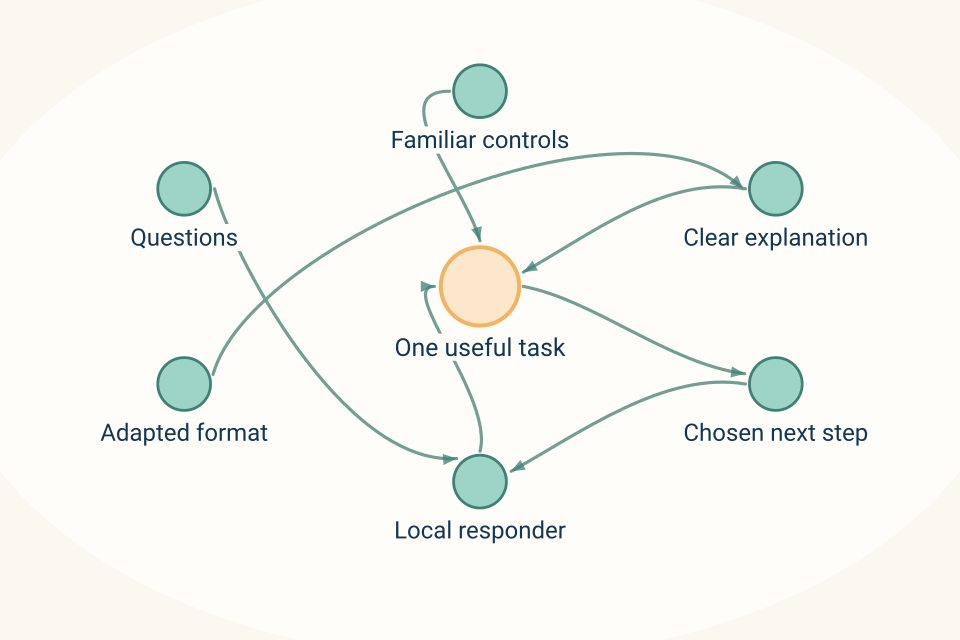
Familiar controls help someone find their way through one useful task. A clear explanation says what the task is and why it matters. The task offers a visible, feasible next step the person can choose. The next step includes a verified local responder and contact route where help is needed. Language, format, depth and assistance adapt the explanation to the person. Questions need a route to someone prepared to answer. The responder provides the human help behind the task. Conceptual design relationships; local services must verify their own contacts and response commitments.
A familiar way to find help What this is: One clear explanation of the resource and why it matters. What happens next: A visible, feasible step the person can choose. Who can help: The verified local responder, contact route, and response expectation. Keep the wayfinding familiar; adapt the help. |
There is room for creativity as well as clarity. A story, a shared photograph, appropriate humor, or a thoughtful analogy may offer another way into a conversation. Sometimes the purpose is learning. Sometimes it is simply enjoying time together. We should design for both.
Ten Principles. Nine Areas of Improvement. One Human Purpose.
The first five principles—Holistic Care, Awareness, Behavioral Influence, Communications, and Community—help us understand people, support their choices, make information usable, and connect them with relationships and resources.
The next five—Engagements, Pathways, Technology, Care AI, and Scoring—turn that understanding into worthwhile interactions, connected support, useful tools, and continuing learning.
TEN PRINCIPLES | NINE AREAS WHERE WE SEEK IMPROVEMENT |
|---|---|
1 Holistic Care 2 Awareness 3 Behavioral Influence 4 Communications 5 Community 6 Engagements 7 Pathways 8 Technology 9 Care AI 10 Scoring | 1 Culture of care 2 Social needs and resources (SDOH) 3 Care equity 4 Community connections 5 Stronger relationships 6 Quality of life 7 Staff well-being and caregiver strain 8 Relevant health and care outcomes 9 Organizational sustainability |
The nine areas are improvements to pursue and examine, not nine guaranteed results or a one-to-one match with principles. Chapter 10 turns them into evaluation questions. Better care should be meaningful to the person receiving it, workable for the people providing it, and sustainable for the organizations supporting it.
Bring out the best in care—and make it easier for people to bring their best to one another.
A Book to Read, Revisit, and Put to Work
We at Genus use CarePhysics as one of our operational guides for content, training, development, and the experiences we help organizations prepare. We are sharing that foundation so others can examine it, adapt it, and contribute to it. Applying the principles does not require adopting Genus technology.
The main book has three parts. Human Foundations develops Principles 1–5. Putting Care into Practice develops Principles 6–10. Better Care, Learning Together applies the ten principles to supporting caregivers and teams, working across organizations, sharing knowledge, and beginning with one meaningful pathway. Its five chapters are applications, not additional principles.
The Reference Companion provides research summaries, model explanations, culture and care, related books, Social Physics, public and frontline voices, and shared terminology. The practical appendices supply working tools. You do not need every page or every tool for every task. Begin with a question and return for the depth your situation needs.
Meet Pat and Ellen
We follow Pat, a 79-year-old retired teacher, and Ellen, his 76-year-old wife. Their daughter, Maya, lives away; their son, Daniel, lives nearby. Emma and Noah are their grandchildren. Casey coordinates discharge, Sam is the social worker, and Lena leads the Day Center team. Jordan joins later when we examine learning across organizations.
Their story is fictional, separate from the family experience that began this introduction. Throughout the book, family scenes and teaching examples illustrate choices; they are not testimonials, reports of deployed services, or evidence of outcomes.
A fall brings Pat to the hospital. Clinical concerns remain with the healthcare team while the family begins to discuss changes it has noticed but does not yet understand. The story follows the choices, support, and relationships around them. Pat has humor, interests, and knowledge to contribute. Ellen has needs and hopes of her own. Their grandchildren remain grandchildren.
Bring your experience alongside theirs. You may recognize a difficult handoff, a confusing explanation, an overworked colleague, or a family trying to find its way. You may also recognize something your team already does beautifully—something worth understanding, protecting, and sharing.
From “What If” to What Happens Next
The opportunity before us is not only to build more capable tools. It is to become more deliberate about what we ask those tools to help us do. We can ask for less repetition and better preparation, clearer communication and dependable support. We can give people’s ideas a fair hearing and show them what changed.
We can make love, compassion, and purpose part of decisions about time, training, content, services, and technology. And we can keep learning.
What if the next person could begin with the best of what we have learned—and help us make it better?
Notes
World Health Organization (2024). WHO releases AI ethics and governance guidance for large multi-modal models. January 18. Source (opens a new tab)
Michie S, van Stralen MM, West R (2011). The behaviour change wheel: A new method for characterising and designing behaviour change interventions. Implementation Science. 6:42. DOI: 10.1186/1748-5908-6-42. Source (opens a new tab)
Center for Self-Determination Theory. The Theory. Official account of the work of Edward L. Deci and Richard M. Ryan on autonomy, competence, and relatedness. Source (opens a new tab)
Fogg BJ. Fogg Behavior Model. Stanford Behavior Design Lab. The model describes motivation, ability, and a prompt converging for behavior. Source (opens a new tab)
Massachusetts Institute of Technology, Industrial Liaison Program. Social Physics: How Ideas Turn into Action. Book description of Alex Pentland’s work on idea flow, exploration, and engagement. Source (opens a new tab)
Agency for Healthcare Research and Quality (2024). Communicate Clearly: Tool 4. Health Literacy Universal Precautions Toolkit, 3rd edition. Source (opens a new tab)
Institute for Healthcare Improvement (2026), Age-Friendly Health Systems: Guide to Using the 4Ms in the Care of Older Adults in Hospitals. Public IHI 2026 hospital guide (PDF) [R1 source CG4]. The John A. Hartford Foundation (2024), Age-Friendly Health Systems Updated Guides: Guide to Using the 4Ms in the Care of Older Adults in Hospitals and Ambulatory Practices and Guide to the Care of Older Adults in Nursing Homes. Public Hartford Foundation guide announcement [R1 source CG14]. Source 1 (opens a new tab) · Source 2 (opens a new tab)
RUSH Center for Excellence in Aging. Caring for Caregivers Across U.S. Public implementation resource for the C4C model. Source (opens a new tab)
Goldratt Research Labs. Introduction to Theory of Constraints (TOC). Description of the Five Focusing Steps. Source (opens a new tab)
Agency for Healthcare Research and Quality (2024). Attend to Social Needs: Tool 18. Health Literacy Universal Precautions Toolkit, 3rd edition. Source (opens a new tab)