Chapter 1
Holistic Care — See the Person
At a Glance
The central idea: Before organizing care around a condition, understand the person whose life the care is entering.
What you’ll explore: How identity, relationships, beliefs, resources, and priorities shape support. Pat and Ellen’s different answers show why a family needs more than one voice. Love becomes practical through attention and shared responsibility.
Design and AI: Carry stated priorities into content, timing, and involvement. Use permissioned information and human review; preserve differences and keep observations distinct from diagnoses.
Put it to work: Create a Person-and-Family Support Profile with priorities, preferences, support, open questions, and follow-up responsibility.
Evidence and evaluation: Examine person-centered care, purpose, Self-Determination Theory, and the Age-Friendly 4Ms. Ask whether the plan reflects people’s priorities and makes support more workable.
“What mattered to him was that he mattered to me.”
— Kedar Mate, MD, reflecting on a patient encounter in “Why Asking ‘What Matters To You?’ Matters,” Institute for Healthcare Improvement, March 15, 2022.12
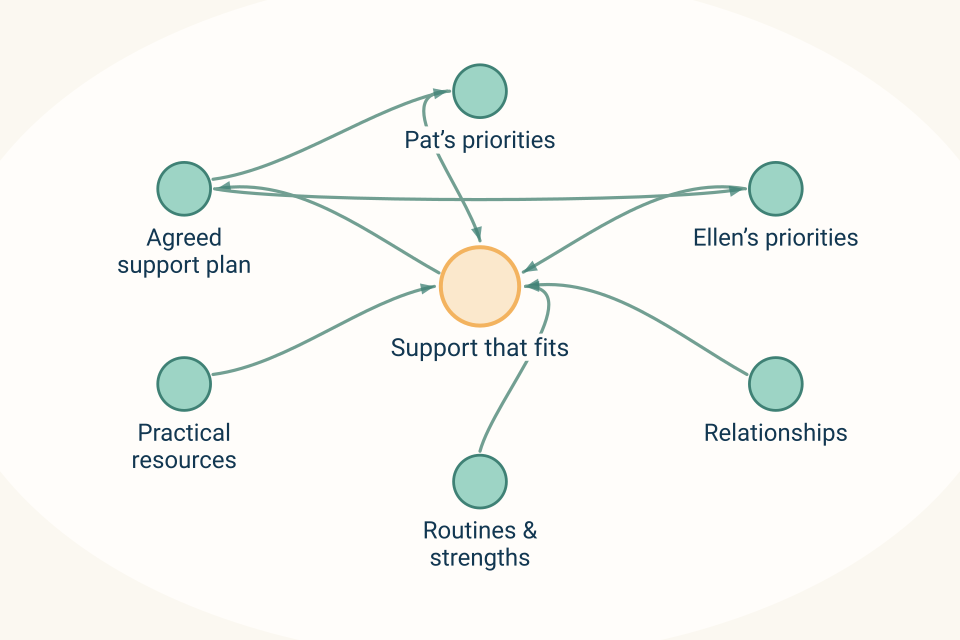
Pat’s own priorities help shape support that fits his life. Ellen’s separate priorities help shape support that fits her life. Relationships inform how support can fit. Routines and strengths inform how support can fit. Practical resources help determine which support is workable. These perspectives and circumstances inform an agreed support plan. Review the plan against Pat’s priorities. Review the plan against Ellen’s priorities without treating the two accounts as one. Pat and Ellen are the book’s fictional characters; this is a design summary, not an outcome report.
Pat “Reading with the grandchildren. Seeing people. Having something to talk about besides appointments.” | Ellen “The appointments. Calls. What we need to ask. Telling the children what happened.” |
Relationships · Routines · Strengths · Priorities · Practical support Ask each person. Keep different perspectives visible. | |
In context
In Context — Pat and Ellen at the hospital
The fall had brought Pat to the hospital. By the time Casey pulled a chair beside his bed to discuss returning home, the family had accumulated another set of questions.
Ellen had mentioned that Pat sometimes repeated himself or became uncertain about an arrangement they had already discussed. Their daughter, Maya, had noticed things during calls. Their son, Daniel, who lived nearby, had noticed other things.
They had not put those observations together before.
Pat, 79, was a retired teacher. He had spent much of his life explaining things to other people. He was finding it uncomfortable to sit in a room where everyone seemed to have an explanation for him.
Casey began with a question.
“What are you most concerned about when you think about going home?”
“Everybody deciding what I can’t do anymore,” Pat said.
Casey waited.
“And talking about me when I’m sitting right here.”
“I’ll speak with you directly,” Casey said. “What would you particularly like us to help you keep doing?”
Pat glanced at the book beside his bed.
“Reading with the grandchildren. Seeing people. Having something to talk about besides appointments.”
Then Casey turned to Ellen.
“What has become difficult for you?”
Ellen, 76, had been keeping track of the papers. She straightened them before answering.
“I’m worried I’ll miss something important.”
“What are you keeping track of now?”
“The appointments. Calls. What we need to ask. Telling the children what happened.” She paused. “It doesn’t sound like much when I say it.”
“It sounds like several different jobs,” Casey replied.
Pat looked toward her.
“I didn’t know you were making all those calls.”
“I didn’t want you worrying.”
For a moment, neither of them spoke.
Casey did not try to settle the question of Pat’s memory. Those concerns belonged with the clinicians assessing him. Nor did she assume that Ellen’s presence meant the family had all the support it needed.
She had learned something important about each of them.
Pat wanted to remain involved in his own life. Ellen wanted help carrying uncertainty without feeling that she had failed him.
The care plan needed to make room for both.
The person is more than the problem
You cannot care well for someone you know only by their condition.
Holistic Care means considering the life in which care must work. In CarePhysics, that includes medical, physical, emotional, social, family, financial, and legal concerns—not as separate boxes to fill, but as connected dimensions of a person’s circumstances.
Medical care addresses assessment and treatment. Physical support concerns what daily activities require and what the environment makes possible. Emotional concerns include uncertainty, frustration, grief, and the wish to feel secure. Relationships can provide companionship and practical help, while also bringing disagreements and competing responsibilities.
Financial questions may determine whether an option is usable. Legal questions may need a qualified professional. Family involvement requires understanding who is willing and able to help, what they have agreed to do, and what support they need themselves.
Culture, beliefs, identity, and personal history run through all of this.
For Pat, reading is not merely an activity that might occupy an afternoon. It connects with being a teacher and a grandfather. For Ellen, a few dependable hours for herself would mean more than time away from a task. It would restore choices that have quietly narrowed.
Neither belongs in a footnote to the medical plan.
At the same time, seeing the whole person does not mean collecting everything about them. We need enough understanding to make the next decisions well, with permission to revisit what changes. A person should not have to disclose their entire life to receive appropriate help.
The question is practical:
What do we need to understand so that the support we offer can fit this person’s life?
Make practical concerns easier to bring into the conversation
Whole-person care also makes room for money, work, housing, and future decisions. Someone may hesitate to raise these concerns because they do not know who can help—or because they prefer not to discuss them in front of relatives. Offer a private beginning and ask which concern they want to address first.
The concern | A question to begin with | Resource and accepted follow-through |
|---|---|---|
“We do not know what the service will cost.” | “Which charges or assistance options would you like someone to explain?” | A named service representative, benefits counselor, or appropriate financial-assistance contact checks actual costs, coverage, and available help. Record what is confirmed, what is unknown, and who will reply. |
“We are unsure who could make a decision later.” | “What would you like to understand about future decisions, and whom do you want involved?” | Help prepare questions for the person’s clinician and a qualified local legal professional. Do not infer authority from a family relationship, screening result, or diagnosis. |
“I cannot keep missing work for these arrangements.” | “Which part of the schedule or paperwork is hardest to manage?” | The service owner reviews appointment timing, response routes, and practical help with the person. Questions about employment rights or benefits go to an appropriately qualified resource; no job protection or payment is promised. |
These are original navigation examples, not legal advice or statements of eligibility. AHRQ’s social-needs guidance recommends asking whether help is wanted, identifying a suitable resource, and checking whether the connection occurred. A cost question deserves an actual answer; an unanswered request remains open.10
In context
In Context — Care that fits a working life
An original fictional illustration, separate from Pat and Ellen’s story.
A working-age person managing a long-term condition has received the appointment instructions. The next visit would mean losing another shift, and the estimated charge is unclear.
“I understand why I’m coming. I’m trying to work out how to get there without losing the hours I need.”
The navigator checks which appointment routes the clinical team considers appropriate and which times the service can actually offer. A separate, agreed contact will explain the charge and possible assistance. The person chooses what to share about work; nobody contacts the employer without permission.
The plan now identifies two practical questions and who will answer them. It does not assume that understanding the instructions removed the obstacles—or promise that an option exists before it has been checked.
Different lives need different starting points
Consider two families learning about the same community service.
In one illustrative household, the immediate question is whether the service can accommodate an important religious practice. In another, it is whether anyone can provide transportation before a working caregiver’s shift begins. A third person may want to visit alone before discussing the idea with relatives.
The service description could be accurate in every case and still fail to answer the question that matters.
Culture includes more than ethnicity or a language preference. Beliefs, family customs, professional experience, community relationships, and other parts of identity can shape how someone interprets care. AHRQ’s guidance on cultural humility emphasizes learning from the individual rather than assuming that membership in a group tells us what that person believes or prefers.13
For our purposes, that means asking specific, respectful questions.
“Who would you like involved in this conversation?”
“Are there beliefs or routines we should understand when we discuss these options?”
“What would make this feel comfortable—or uncomfortable—for you?”
Someone may want decisions discussed with several relatives. Another may want a private conversation first. A person may wish to involve a faith leader, a friend, or someone they consider family who is not a relative. None of these arrangements should be assigned by the organization.
The same discipline applies within a household. Ellen’s preferences do not automatically describe Pat’s. Maya’s comfort with technology does not establish what her parents will find useful. Daniel’s proximity does not tell us when he is available.
We should also separate cultural understanding from practical access. A person who cannot afford a service does not need a more persuasive explanation of its value. A family without reliable transportation does not have a communication-style problem. An unanswered message may require a different contact route rather than another reminder.
The behavioral review informing this book makes that distinction central: similar patterns of nonparticipation can arise from very different barriers, including knowledge, cost, access, exhaustion, trust, and family circumstances.
Language deserves its own questions. AHRQ recommends asking what language people prefer for conversation and for written materials, rather than inferring either from how they sound. It also calls for qualified language support rather than relying on untrained staff or relatives to interpret consequential care conversations.14
This is not an exercise in finding a cultural label and selecting the corresponding script. It is learning how to work with the person in front of us.
What research helps us understand
Pat and Ellen’s conversation raises three questions. Should their priorities influence the plan? Does purpose deserve attention? And how do we support participation without taking over?
Different kinds of evidence help answer them.
Practice guidance: bring home life into the conversation. AHRQ’s IDEAL discharge-planning approach includes patients and families as partners. It asks teams to discuss what life at home will involve, explain relevant information plainly, check understanding, and attend to people’s goals, preferences, observations, and concerns. This is guidance for organizing care, not proof that asking one additional question will prevent a hospital return. It gives Casey a sound reason to look beyond completed paperwork.15
Observational evidence: purpose is worth taking seriously. Eric Kim and colleagues examined data from 12,998 U.S. adults older than 50 in the Health and Retirement Study. Their study, published in a 2022 journal issue, examined purpose in relation to later health and well-being. Higher purpose was associated with several favorable outcomes over four years, including less depression and loneliness, but not with every outcome studied. Because this was observational research, it does not establish that assigning a meaningful activity causes those benefits.16
Our application is narrower: ask what matters, and examine whether the care leaves room for it. Pat’s interest in reading gives us a direction to explore with him. It is not a treatment prescription.
A foundational model: choice, capability, and connection. Self-Determination Theory draws attention to autonomy, competence, and relatedness—whether an action feels self-endorsed, whether someone feels able to participate, and whether they experience supportive connection. Autonomy does not require doing everything alone; a person can choose to seek help or make decisions with others.3
A meta-analysis by Nikos Ntoumanis and colleagues combined 73 experimental studies of Self-Determination Theory–informed interventions in health promotion and disease management. It found generally small-to-medium changes in motivation and health behaviors, with smaller positive changes in health outcomes. Effects were modest and varied across studies. The author-held research review informing this book classifies the intervention evidence as Moderate, rather than treating the model as a guarantee of improvement.17
For Pat, the design question becomes: can he remain an active participant while receiving support? For Ellen, it becomes: can she ask for help without being judged for needing it?
These are useful questions to bring into practice. The particular approach we build around them still needs its own evaluation.
A practical companion: the Age-Friendly 4Ms
The Age-Friendly Health Systems initiative gives whole-person care a recognizable practice framework: What Matters, Medication, Mentation, and Mobility. Launched by The John A. Hartford Foundation and the Institute for Healthcare Improvement (IHI), with the American Hospital Association and the Catholic Health Association of the United States, it brings these elements together rather than treating them as separate projects.7
IHI’s guidance asks teams both to assess and to act on the four elements as a set. What Matters concerns the person’s health goals and care preferences. Medication concerns appropriate use that does not interfere with those goals or with mentation and mobility. Mentation addresses dementia, depression, and delirium. Mobility concerns moving safely and maintaining function so the person can do what matters.18
For our application, the next question is what this understanding changes. A preference in a profile should influence a real choice. Medication-support information should reach the qualified professional responsible for review, rather than become a suggestion for an assistant to change treatment. Observations about mood, thinking, or movement should lead to appropriate assessment and support—not an invented diagnosis.
In a Day Center, the framework can help connect a person’s chosen activities with the assistance, professional guidance, and environment needed to participate. A recorded fall-risk score alone does not provide that assistance. A medication list alone does not establish that an appropriate review has occurred.
We call this proposed mapping 4Ms-informed. It is an original application of published guidance, not a claim that Genus implements the full framework, that every Day Center offers the same clinical services, or that a site has received Age-Friendly recognition. That recognition follows IHI’s separate process.19
Pat’s priorities and Ellen’s needs remain distinct. Chapter 11 adds a complementary caregiver-support pathway; R1 identifies public sources and evidence limits, and Appendix B offers a short planning aid. Together, these approaches help us ask what each person needs and who will act on the answer.
Love and purpose must change the plan
It would be easy to leave Casey’s conversation feeling that something compassionate had happened, then continue with exactly the same arrangements.
CarePhysics asks us to go further.
What should change because Pat wants to remain involved? People should address him directly, explain the choices, and ask whom he wants included. What should change because Ellen is carrying the calls and arrangements? The plan should identify work that others might take on and services that could provide support.
Love should not become an argument for Ellen to carry more.
Nor should purpose become another demand placed on Pat. He does not need to lead a group, tell a story, complete an activity, or demonstrate progress to deserve care. There can be room to contribute and room to rest.
His history offers possibilities, not assignments.
Later, a Day Center team might learn that he enjoys local history and offer him a role in a discussion. They should still ask whether that interests him now. Being a retired teacher does not mean wanting to teach every afternoon.
This distinction is reflected in the Day Center design materials behind the book: staff are encouraged to ask about both past and present interests, while preserving the ability to watch, decline, change one’s mind, or participate differently.
For an organization, this turns broad values into choices about the day. Is there a quiet place? Can an activity be shortened? Can someone contribute without performing for the group? Does the person receiving support have a voice in what is written about them?
Those decisions are where compassion becomes part of the service.
Listen in stages, then use what you learn
In context
Casey cannot resolve every question before Pat leaves the hospital. Immediate safety and discharge requirements come first. Other concerns need time, appropriate expertise, and another conversation.
With Pat and Ellen’s permission, she calls Sam, a community social worker, while they are together.
Casey explains the questions they have agreed to share. Sam introduces his role and confirms that he can meet with them to discuss home routines, family support, and available community options. They agree on how to arrange that meeting. Clinical questions remain with Pat’s healthcare team.
Casey has done more than give them another telephone number. Sam has accepted responsibility for a specific next conversation.
At their first meeting, Sam does not start over with the entire history.
“Casey told me you wanted help making the week more manageable,” he says. “Is that still the right place to begin?”
Ellen nods.
Pat adds, “As long as manageable doesn’t mean somebody plans every minute.”
“What would you like to leave unplanned?”
“My reading. The grandchildren. Some peace and quiet.”
“And what would help you, Ellen?”
“Knowing which things I really need to handle—and which ones I don’t.”
Sam asks what they want discussed together and offers each of them a way to raise a concern privately. He learns enough to prepare the next steps, without treating this meeting as their only opportunity to explain themselves.
This is staged listening: establish what is needed now, carry it forward accurately, and return to it when circumstances or preferences change.
A long intake that no one revisits is not necessarily more useful than a shorter conversation that changes the next encounter. The revised CarePhysics approach favors a maintained person-and-family profile over information collected once and then left behind.
Let the understanding change the content
Sam also asks how they would like information.
Pat wants the conversation addressed to him, with something he can read afterward. Ellen wants a short summary that separates immediate arrangements from questions that can wait. They agree that Maya and Daniel can receive the shared information needed for an upcoming family conversation, without automatically receiving private notes.
Now the design brief is different.
Instead of sending a general packet about caregiving, Sam can prepare a short meeting guide with a clear purpose: help this family arrive ready to discuss what matters and what is becoming difficult.
An illustrative invitation might read:
Making next week more manageable
Our conversation will begin with what you want to keep doing and what has become difficult to organize.
You do not need to prepare a complete history. You can bring one question, make a short note, or simply talk with Sam when you arrive. For example: “I would like help with the appointments, but I still want to make my own decisions.”
Tell Sam’s office who you would like involved and whether you need help with language, access, or the meeting format. Afterward, Sam will confirm the agreed next steps and who is responsible for each one.
The invitation explains why the conversation matters, gives one main idea, demonstrates a way to begin, offers choices, names the response route, and explains what follows. It uses the familiar content pattern introduced earlier without forcing six headings into a short message.
The same knowledge should influence the medium.
A short video might be useful when someone wants to see what a first visit looks like. A printed page may be better for comparing arrangements at the kitchen table. Audio may offer another route for someone who prefers listening. A demonstration may be more useful than an article when the task involves doing something. A sensitive concern may need a conversation before any written follow-up.
AHRQ’s communication guidance supports plain language, limited key points, demonstrations, questions, and checks of understanding. These are methods to select and adapt, not reasons to assume everyone needs the same format.6
Tone needs the same care. Some people will welcome a conversational explanation; others will prefer concise, factual wording. Humor should follow the person’s lead. Faith-based material should be offered when it is wanted, not inferred from a name or neighborhood.
Adapt the expression without changing the facts. A warmer version must not conceal a concern. A shorter version must not omit an important limitation. Clinical instructions and validated questionnaires must retain what their proper use requires.
The goal is not to classify people into permanent “styles.” It is to keep learning what helps them in this situation.
A profile that preserves more than one point of view
The practical output of this chapter is a Person-and-Family Support Profile.
Think of it as a working aid to conversation—not a diagnosis, a personality assessment, or a document that everyone automatically receives. A shared summary may be useful, while private concerns require a separate, appropriately restricted place.
For Pat and Ellen, an initial profile could contain the following:
Area | What the profile carries forward |
|---|---|
What matters to Pat | Pat wants to remain involved in decisions and continue reading, seeing people, and spending time with his grandchildren. These priorities are confirmed with him. |
What Ellen wants help with | With her permission, the shared summary records that she wants help organizing appointments and family communication. Any private concerns remain separate. |
What is known and what is uncertain | The current clinician-approved discharge information is identified. Family observations are attributed to the people who reported them. The explanation for the memory concerns remains under assessment. |
How to communicate | Pat prefers direct conversation with material to read afterward. Ellen prefers a short summary of immediate arrangements and later questions. Other family members are asked about their own preferences. |
Available support and open questions | Sam has accepted the community-support conversation. Maya and Daniel’s possible roles need discussion; neither is recorded as responsible for a task they have not accepted. Costs, transport, and service fit are checked when an option is considered. |
Ownership, permissions, and review | Each entry has a source and review date. Sam maintains the support summary within his role, checks changes with the relevant person, and revisits it after clinical follow-up or sooner when needed. |
Questions about beliefs, routines, language, and access should be recorded in the person’s own terms when relevant and willingly shared. “Not yet discussed” is more honest than a guessed answer.
The profile should also make room for changes. Pat may enjoy something on one visit and decline it on another. Ellen may initially want detailed explanations and later prefer fewer updates. A plan should not hold people to an earlier version of themselves.
Most importantly, disagreement should remain visible. “Pat is comfortable with the current arrangement” and “Ellen finds the arrangement difficult to sustain” are not competing facts that a summary must resolve. They are two perspectives that the next conversation needs to hold.
Where AI can help
Sam now has something useful to work from. He also has familiar administrative work: organizing notes, identifying unresolved questions, preparing a summary, and adapting information for different readers.
This is a good place to consider AI assistance.
In a proposed, organization-approved workflow, an assistant could prepare a draft from selected notes, current service information, and relevant CarePhysics guidance. It could organize material under stable headings, preserve who said what, and flag questions that have not been answered.
Sam would review the result against the sources and decide what belongs in the shared plan.
A useful draft might distinguish:
Pat’s stated priority: Continue making decisions about his day. Ellen’s shared request: Help with appointments and family communication. Still to discuss: Which responsibilities other adults are willing and able to accept. Clinical question: Refer to the treating team; no conclusion added.
That is assistance with the work around understanding. It does not replace the understanding itself.
A maintained profile can carry preferences into later reviewed work. Verify the local system’s update history, permissions, and review route rather than assuming they follow from the presence of an intake form. Appendix J records the dated implementation examples behind this discussion.
The opportunity extends to content. An assistant could help prepare a concise version, a fuller explanation, or an outline for a demonstration from the same approved information. Staff and intended readers would then check accuracy, accessibility, tone, and fit.
A team could also ask it to help turn a useful staff explanation into a reusable resource, with the contributor credited and private family details removed. Repeated questions could become topics for a team discussion about unclear instructions or missing support.
Families could be offered an approved assistant for routine questions between conversations, including outside office hours. Its role would be to explain current information within a defined scope and make human contact easier to request. It must not imply that professional help is continuously staffed when it is not. Human response times and urgent routes need to be clear.
For this chapter, a useful AI assignment is:
Using only our approved guidance and the information we are permitted to share, draft a support profile that separates the person’s priorities, caregiver needs, observations, professional findings, and unanswered questions. Suggest communication options without inferring beliefs or preferences. Identify what a person must check before the draft is used.
The potential gift is less repetitive preparation and more attention available for the conversation. Whether that happens depends on the quality of the draft and the work required to check it. Both belong in the evaluation.
What the organization must make possible
We should not ask Casey or Sam to practice whole-person care while leaving them with no time, no response options, and nowhere useful to put what they learn.
The organization has design decisions of its own.
It needs to decide which information is necessary at first contact and which can wait. It needs a place where relevant staff can find current, permitted information without searching several records. It needs a named owner for follow-up, a correction process, and an alternative when the usual person is unavailable.
Language access, accessible materials, private conversations, and non-digital routes require planning and resources. Training should include practice in asking, listening, checking understanding, and responding when a concern falls outside someone’s role—not merely instruction in completing a form.
The service behind the invitation matters just as much. Before encouraging someone to explore a Day Center, the responsible team must establish its current services, eligibility, capacity, costs, and practical access. When it is not a fit, someone should help explore another route.
A kind explanation cannot create an unavailable appointment or an affordable ride.
The same principle applies beyond this family. In an illustrative home-care setting, the important question may be how assistance can respect a household routine. In rehabilitation, it may be which everyday activity the person most wants to return to. For a working caregiver, it may be whether support can fit around employment without requiring constant calls during the day.
Community and state groups can use these questions when planning shared services. A common approach to listening need not produce identical programs. Local teams and residents should help determine the language, delivery routes, partners, and resources that make sense in their setting.
Staff also deserve that attention. Ask which questions help them care, which fields duplicate work, and which promises they cannot reliably fulfill. Their experience should influence the design before a new process becomes another obligation.
How would we know it helped?
Completing a profile is evidence that information was recorded. It is not yet evidence that care became more relevant.
For an initial local test, an organization might choose one intake or transition process and examine it over 30 days. That is an illustrative improvement exercise, not a validated study design.
Begin with the people involved. Can the person recognize their own priority in the plan? Can the caregiver identify what support was agreed? Was a communication preference respected? Did an identified need lead to practical help—or remain unresolved?
Then examine the work. How long did the conversation, drafting, checking, and updating take? Were people asked to repeat the same information? Did staff find the profile when they needed it? Were private concerns kept from inappropriate audiences?
Use clear denominators. Report how many people were offered the process, how many participated, how many gave feedback, and how many did not. A favorable response among a few respondents must not become a claim about everyone. Include people using telephone or paper routes, not only those visible in an app.
Keep the stages separate: receiving a guide, understanding an option, requesting help, and receiving the service are different events. The research review informing this book likewise distinguishes reach, understanding, first action, adoption, useful participation, and outcomes, while treating burden, safety, and equity as separate questions.
Choose a person responsible for reviewing the findings and changing the process. Reduce fields that do not inform care. Correct misleading language. Investigate unmet needs. Pause an AI-assisted step when errors or review demands make it unhelpful.
We are evaluating the support—not how cooperative the family appears, how much they love one another, or whether illness follows a hoped-for course.
One thing to try
Take one existing welcome, intake, or care-planning process.
For this exercise, set aside the diagnosis and service label. Do not remove clinically necessary information from care; simply ask what else the current process allows you to know.
Can you tell what the person wants to preserve or enjoy? Who they want involved? What practical constraints need attention? How they prefer to receive information? What support the caregiver needs?
Choose one gap to address through a conversation with someone the process serves.
Then change one thing because of the answer: the content, the format, the timing, the people involved, or the practical support behind the next step.
That last part matters. Listening should leave a trace in what we do.
From being known to understanding
In context
At the end of their first meeting, Sam reads back the priorities Pat and Ellen have agreed to share.
Pat wants a say in his own day. Ellen wants help with the arrangements. The family needs to discuss responsibilities. Clinical questions need follow-up, and community options can be explored without committing to a service today.
“Does that sound right?” Sam asks.
“Yes,” Ellen says. “But I’m still not sure what we should tell the children about what’s happening.”
Pat closes the booklet in front of him.
“And I’d like somebody to explain what we actually know.”
They have been heard more fully. That does not mean they yet share an understanding.
The next task is to make clear what is known, what remains uncertain, what needs to happen, and who can help—without giving everyone more information than they can use.
That is the second principle: Awareness — Make Understanding Possible.
Notes
Center for Self-Determination Theory. The Theory. Official account of the work of Edward L. Deci and Richard M. Ryan on autonomy, competence, and relatedness. Source (opens a new tab)
Agency for Healthcare Research and Quality (2024). Communicate Clearly: Tool 4. Health Literacy Universal Precautions Toolkit, 3rd edition. Source (opens a new tab)
Institute for Healthcare Improvement (2026), Age-Friendly Health Systems: Guide to Using the 4Ms in the Care of Older Adults in Hospitals. Public IHI 2026 hospital guide (PDF) [R1 source CG4]. The John A. Hartford Foundation (2024), Age-Friendly Health Systems Updated Guides: Guide to Using the 4Ms in the Care of Older Adults in Hospitals and Ambulatory Practices and Guide to the Care of Older Adults in Nursing Homes. Public Hartford Foundation guide announcement [R1 source CG14]. Source 1 (opens a new tab) · Source 2 (opens a new tab)
Agency for Healthcare Research and Quality (2024). Attend to Social Needs: Tool 18. Health Literacy Universal Precautions Toolkit, 3rd edition. Source (opens a new tab)
Mate K (2022). Why Asking “What Matters To You?” Matters. Institute for Healthcare Improvement. March 15. Source (opens a new tab)
Agency for Healthcare Research and Quality (2024). Consider Culture, Customs, and Beliefs: Tool 10. Health Literacy Universal Precautions Toolkit, 3rd edition. Source (opens a new tab)
Agency for Healthcare Research and Quality (2024). Address Language Differences: Tool 9. Health Literacy Universal Precautions Toolkit, 3rd edition. Source (opens a new tab)
Agency for Healthcare Research and Quality. Strategy 4: Care Transitions From Hospital to Home—IDEAL Discharge Planning. Guide to Patient and Family Engagement in Hospital Quality and Safety. Source (opens a new tab)
Kim ES, Chen Y, Nakamura JS, Ryff CD, VanderWeele TJ (2022). Sense of Purpose in Life and Subsequent Physical, Behavioral, and Psychosocial Health: An Outcome-Wide Approach. American Journal of Health Promotion 36(1):137–147. DOI: 10.1177/08901171211038545. Source (opens a new tab)
Ntoumanis N, Ng JYY, Prestwich A, et al. (2021). A meta-analysis of self-determination theory-informed intervention studies in the health domain: effects on motivation, health behavior, physical, and psychological health. Health Psychology Review. 15(2):214–244. DOI: 10.1080/17437199.2020.1718529. Source (opens a new tab)
Institute for Healthcare Improvement (2026), Age-Friendly Health Systems: Guide to Using the 4Ms in the Care of Older Adults in Hospitals. Public IHI 2026 hospital guide (PDF) [R1 source CG4]. Source (opens a new tab)
Institute for Healthcare Improvement (n.d.), Age-Friendly Health Systems: Recognition. [R1 source CG5]. Source (opens a new tab)