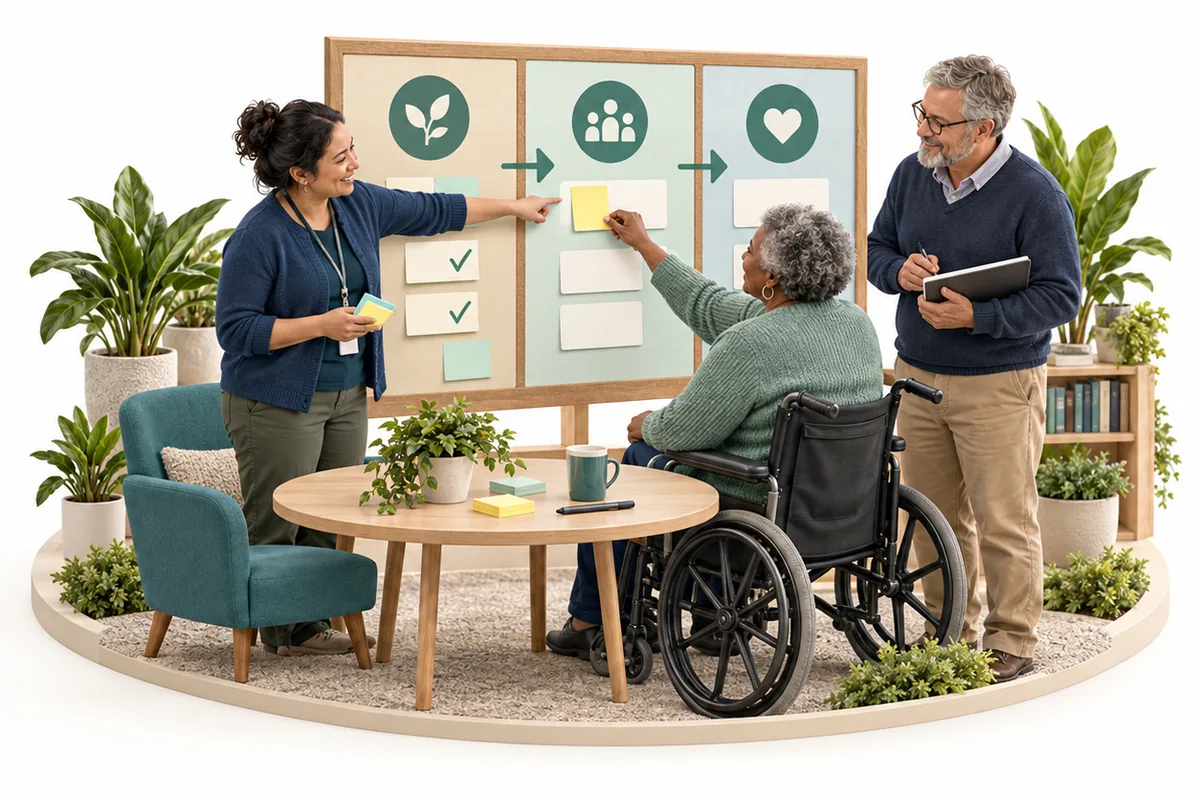
Write down what the partnership is there to do
A partnership needs shared expectations about the service it offers. Clarify the purpose, responsibilities, boundaries, and contact route before a participant depends on the arrangement.
Observations. Evidence. Ideas.
News, observations, and practical ideas for people who support care. Explore what is changing and what it means for your community.
Explore the research behind our workStart with a topic or a few words, or leave search blank to browse.
Search looks through titles, summaries, authors, and article text. With several words, each word must appear somewhere in the article.
Choose a theme to see its articles straight away. Your applied search and filters stay in place. Choose All themes to explore across themes.
For a closer match, open More filters and choose a setting, reader role, or article type, then select Apply filters. You can also enter words and choose Find articles. Results must match every option you choose. Leave an option set to All to keep that part open.
An article can belong to more than one theme. Explore what each covers and why we write about it.
Find articles relevant to a community, care setting, or organization. These options include people and partners as well as places:
Choose a perspective that interests you. You can read from any role:
No matches? Try fewer words or remove a filter. Clear filters clears your search and all selected options.
150 articles · Page 9 of 13
A partnership needs shared expectations about the service it offers. Clarify the purpose, responsibilities, boundaries, and contact route before a participant depends on the arrangement.
A federal caregiver-strategy progress report records work completed and underway. It also invites a useful distinction: activity accomplished is not yet the same as a change people can experience.
Retention belongs in ordinary management conversations. Look at the working day, the support people can actually access, and which recurring difficulty the organization is willing to address.
For a person living with dementia, a change of setting should not erase the everyday details that help staff understand them. NICE guidance prompts teams to carry relevant preferences and familiar routines into the next care conversation.
A chatbot may answer the timetable question while missing the exception that matters. An established report on financial-service chatbots prompts our reflection on reachable human help, useful context, and honest response expectations.
The first AHEAD model selections connect state health-system ambitions with local communities. The useful starting point is a shared understanding of what people need to reach and use.
An update can improve a tool and still leave familiar instructions behind. NIST guidance prompts a practical review of everyday tasks, support cards, and who responds when the new version changes the experience.
A continuity plan becomes useful when colleagues can act on it. Walk through a modest disruption, agree the essential work, and check how people will hear about changed arrangements.
When someone moves between services, a question about a changed medicine needs a responsible professional and a clear route to an answer. WHO’s transition-safety work prompts teams to separate recording a question from resolving it.
The 2024 launch of Medicare’s GUIDE model put caregiver support alongside dementia care. Our takeaway: a useful plan should make room for the person giving care, too.
The 2024 ADA Title II digital-access rule makes accessibility a purchasing and service responsibility. A supplier’s product should be examined through the tasks people need to complete.
An invitation can be accurate and still be hard to use. Review the words, format, and practical next step with the people it is meant to reach before sending it widely.