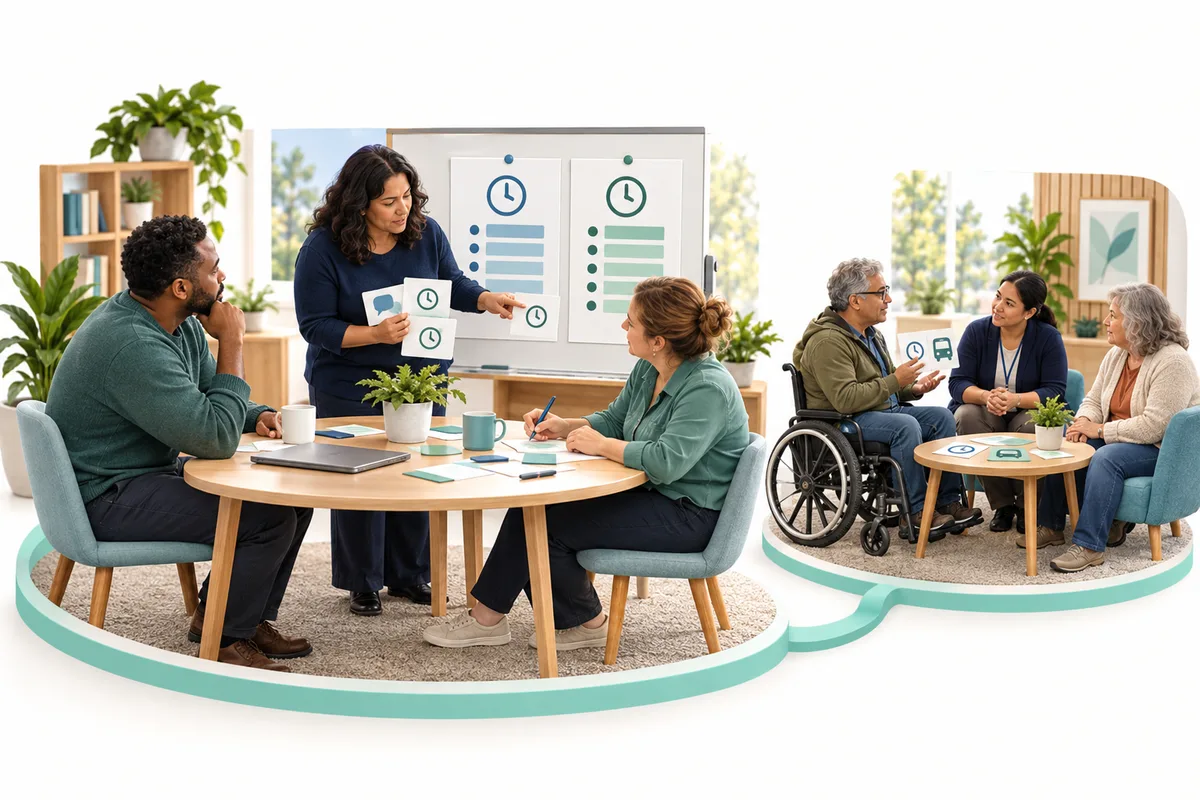
Make room for the work between appointments
The visible appointment is only part of a service’s workload. Leaders can examine preparation, follow-up, and variation before deciding how many places a timetable can carry.
Observations. Evidence. Ideas.
News, observations, and practical ideas for people who support care. Explore what is changing and what it means for your community.
Explore the research behind our workStart with a topic or a few words, or leave search blank to browse.
Search looks through titles, summaries, authors, and article text. With several words, each word must appear somewhere in the article.
Choose a theme to see its articles straight away. Your applied search and filters stay in place. Choose All themes to explore across themes.
For a closer match, open More filters and choose a setting, reader role, or article type, then select Apply filters. You can also enter words and choose Find articles. Results must match every option you choose. Leave an option set to All to keep that part open.
An article can belong to more than one theme. Explore what each covers and why we write about it.
Find articles relevant to a community, care setting, or organization. These options include people and partners as well as places:
Choose a perspective that interests you. You can read from any role:
No matches? Try fewer words or remove a filter. Clear filters clears your search and all selected options.
224 articles · Page 18 of 19
The visible appointment is only part of a service’s workload. Leaders can examine preparation, follow-up, and variation before deciding how many places a timetable can carry.
New Medicare payments recognize work that connects people with community resources. For potential partners, the useful first conversation is about responsibilities, capacity, and the person’s priorities.
A 2023 CMS evaluation raises a useful question for care teams: did a referral lead to support the person could actually use? Our perspective on practical follow-through, clear responsibility, and knowing when a service is out of reach.
Caregiver connection should lead to useful help. Our perspective on 2023 guidance: turn a seasonal offer into one agreed responsibility, with a clear handoff and room for plans to change.
An offered chair or quiet introduction can make room for someone to join. Drawing on a 2023 poll, we reflect on thoughtful offers, comfortable choices and everyday community life.
CMS’s 2024 caregiver-training payment policy gives organizations a reason to examine the learning around care: a clear purpose, appropriate professional teaching, time for questions, and support people can realistically agree to provide.
A useful feedback process continues after the comments are collected. Invite people into a decision, explain what changed or could not, and return to ask whether the result made everyday service easier to use.
A connected device can send information without settling what happens next. A 2023 study of remote patient monitoring invites a practical conversation about people’s expectations, agreed contact arrangements, and the human work behind a connection.
The 2023 GUIDE announcement connected dementia care with caregiver support and community services. For local partners, the practical work begins with an honest offer, clear responsibilities, and a route people can use.
Research across 16 countries links hobbies with better wellbeing in later life. It invites a practical question for community groups: what might people enjoy doing together, with room to be beginners?
An AI-assisted update can read smoothly while getting a person’s day wrong. WHO’s 2023 cautions about health AI prompt a closer look at source notes, human review, permission, and the space for people to correct how their experience is described.
Leaving hospital brings a plan into the practical conditions of home. A 2023 CMS reminder and AHRQ’s established discharge guidance prompt us to ask whether people know what happens next, who is involved and where to take a question.